Immagine

AeroGenie — Il tuo copilota intelligente.

Chiedi qualsiasi cosa. Analizza tutto. Agisci immediatamente.

Tendenze

Categories

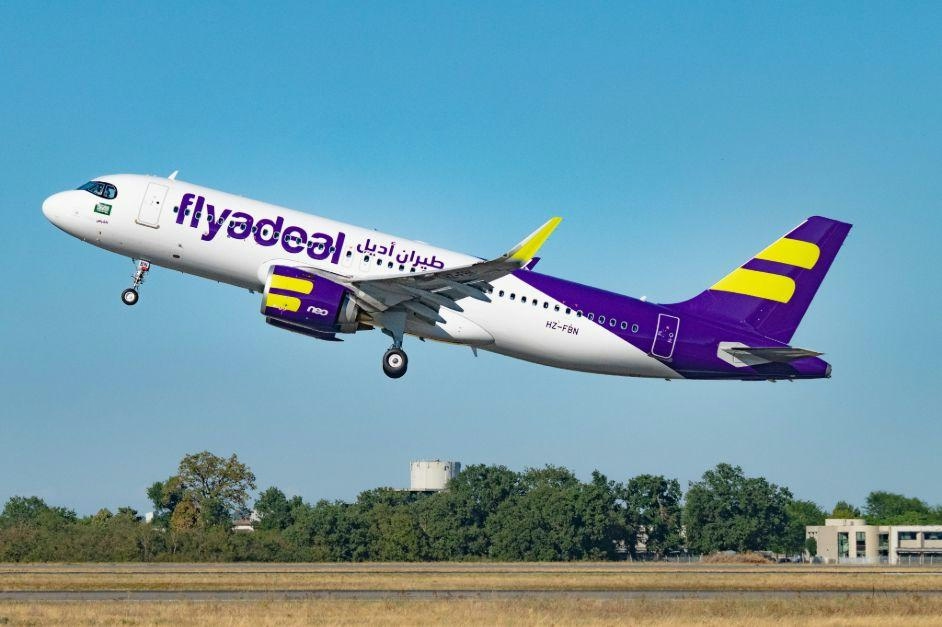
Flyadeal Completes Aircraft Software Updates, Operations to Resume by Midnight
November 29, 2025By ePlane AI
Flyadeal Completes Aircraft Software Updates, Operations to Resume by Midnight
0
0
Flyadeal
Airbus A320
EASA Safety Directive

Flyadeal Completes Critical Software Updates, Operations to Resume by Midnight

Flyadeal has announced the successful completion of mandatory software updates across its Airbus A320 fleet, with full flight operations scheduled to resume by midnight. The Saudi Arabian low-cost carrier responded promptly to a safety directive issued by the European Union Aviation Safety Agency (EASA), which mandated software revisions for Airbus A320 aircraft worldwide following the discovery of a critical system glitch.

Background and Response to EASA Directive

The EASA directive, released on November 28, affected approximately 6,000 Airbus A320 aircraft globally. For the majority of these planes, including most of Flyadeal’s fleet, the issue was resolved through a straightforward software update. However, around 900 older aircraft required a more extensive intervention involving the replacement of onboard computers. The urgency of the directive was heightened by a recent incident involving a JetBlue aircraft, where the software fault was linked to an unexpected altitude drop, underscoring the potential safety risks.

Flyadeal operates a total of 43 Airbus A320 aircraft, of which 13 were subject to the mandated update. The airline’s operations, engineering, and customer experience teams collaborated intensively, working around the clock to implement the necessary software changes. Throughout this period, Flyadeal prioritized passenger safety while striving to minimize service disruptions. To accommodate affected travelers, the airline arranged for widebody wet-lease aircraft, ensuring continuity of service with minimal delays.

Impact and Industry-Wide Disruptions

The software update requirement caused varying levels of disruption across the global aviation industry. American Airlines reported operational delays affecting 340 aircraft, while Jetstar in Australia canceled approximately 90 flights—about one-third of its fleet—during the update process. Most carriers, including Flyadeal, anticipated completing the majority of updates by the weekend, with no further operational impact expected thereafter.

Flyadeal maintained proactive communication with passengers affected by the update, providing timely notifications via email and SMS. The airline offered rebooking options and support services to facilitate adjustments to travel plans, aiming to reduce inconvenience during the update period. Throughout, Flyadeal emphasized its unwavering commitment to operational safety and the protection of all scheduled flights.

Coordination and Future Operations

Flyadeal’s management expressed appreciation for the coordinated efforts of its employees, airport partners, regulatory authorities, and Airbus in swiftly resolving the issue. The airline reassured the public that all flights scheduled from November 30 onward would proceed as planned, with no anticipated further disruptions.

With the software updates now complete and operations restored, Flyadeal reaffirmed its dedication to delivering safe, affordable, and reliable air travel for its passengers.

More news
Boeing’s Widebody Jet Sales Surge Signals Shift in Global Air Travel

Boeing’s Widebody Jet Sales Surge Signals Shift in Global Air Travel

Boeing’s Widebody Jet Sales Surge Signals Shift in Global Air Travel Boeing, the United States’ premier aerospace manufacturer, is witnessing a remarkable resurgence in commercial aircraft sales, particularly within the widebody jet segment. In 2025, the company secured approximately 1,175 gross aircraft orders—more than double the previous year’s total and surpassing its chief competitor, Airbus. This surge is largely driven by renewed demand for widebody aircraft such as the Boeing 787 Dreamliner, which experienced one of its strongest order years since its launch, alongside sustained interest in large twin-aisle jets designed for long-haul international routes. Industry Recovery and Market Outlook This increase in orders coincides with the global aviation industry’s recovery from the disruptions caused by the COVID-19 pandemic. Airlines are actively seeking efficient, long-range aircraft to rebuild capacity and accommodate the resurgence in travel demand. Boeing’s Commercial Market Outlook for 2025–2044 projects that global air traffic will more than double over the next two decades, necessitating a significant expansion of the world’s aircraft fleet. Widebody and long-range jets, including the 787 and the forthcoming 777X, are expected to be instrumental in connecting international markets and supporting this anticipated growth. Challenges Amid Growth Despite this positive momentum, Boeing continues to face considerable challenges. The company is working to scale up production following recent setbacks, including two fatal crashes involving the 737 Max and a widely publicized midair door plug incident. These events have led to heightened regulatory scrutiny, with the Federal Aviation Administration (FAA) closely overseeing emissions waivers and certification timelines for new models such as the 737 MAX 10. Nevertheless, investor confidence has rebounded, with JPMorgan recently raising its stock target for Boeing to $245, citing expectations of a cash-flow turnaround by 2026. Competitive Dynamics and Passenger Benefits The competitive landscape remains intense as airlines worldwide expand their long-haul fleets, incorporating not only Boeing’s Dreamliner but also Airbus’ A330 and A350 models. This rivalry is influencing airline strategies as carriers seek to offer more direct, long-distance routes and enhanced passenger experiences. For travelers, the surge in widebody jet orders translates into tangible benefits. New aircraft enable airlines to launch more direct, long-haul flights between major cities, reducing the need for layovers. Modern jets like the Boeing 787 feature advanced cabin amenities, including improved climate control systems, larger windows, and enhanced noise reduction, all of which contribute to greater comfort on extended journeys. Additionally, newer widebody models offer improved fuel efficiency and lower emissions compared to older fleets, aligning with the aviation industry’s growing emphasis on sustainability. While Boeing’s sales surge signals renewed strength in global air travel, the company’s ability to meet this demand will depend on overcoming production challenges and navigating complex regulatory requirements. As airlines continue to invest in next-generation widebody jets, passengers can anticipate expanded route options, improved comfort, and greater access to international destinations—heralding a significant shift in the future of global aviation.
French Aircraft Design Claims to Reduce Energy Consumption by Elevenfold

French Aircraft Design Claims to Reduce Energy Consumption by Elevenfold

French Startup Unveils Aircraft Design Claiming Elevenfold Energy Reduction As the aviation industry grapples with the urgent need to reduce its environmental footprint amid escalating climate change concerns, innovative solutions are emerging to address the sector’s complex decarbonization challenges. Despite growing adoption of sustainable aviation fuels (SAF), energy-efficient designs, and electric propulsion, the high costs and long service lives of aircraft continue to impede rapid transformation. Against this backdrop, Eenuee, a startup based in Saint-Étienne, France, has introduced a bold new concept aimed at revolutionizing regional air mobility. The Gen-ee Project: A Leap in Efficiency and Accessibility Eenuee’s Gen-ee project envisions a 100% electric aircraft capable of carrying up to 19 passengers over distances of 500 kilometers while consuming eleven times less energy than conventional planes. This dramatic improvement in energy efficiency could significantly reshape short-haul aviation, particularly in regions where rail and public transport infrastructure are limited or impractical. By combining accessibility with sustainability, the Gen-ee aims to open new routes and connect remote areas without the need for extensive airport infrastructure. Central to the Gen-ee’s innovation is its lifting-body fuselage, developed in partnership with Duqueine Group, a specialist in composite materials. Departing from the traditional tubular aircraft design, this aerodynamic form enhances performance and reduces energy consumption. The aircraft’s all-electric propulsion system promises quieter, cleaner flights, aligning with global efforts to reduce aviation’s environmental impact. Further expanding its versatility, Eenuee is developing a variant of the Gen-ee capable of water takeoffs and landings. This model incorporates hydrofoils—underwater wings that minimize drag at high speeds—drawing inspiration from high-speed racing boats. Such a design could facilitate smoother operations on water, enabling access to remote locations otherwise difficult to reach by conventional means. Industry Context and Challenges The aviation sector is accelerating its transition toward cleaner technologies, with SAF adoption playing a pivotal role in reducing greenhouse gas emissions without necessitating new airport infrastructure. Manufacturers are also deploying advanced systems to optimize flight paths, improve air traffic management, and adjust trajectories to minimize contrail formation—an often-overlooked contributor to global warming comparable in effect to carbon dioxide emissions. Despite these advances, the path to decarbonized air travel remains fraught with challenges. Industry leaders, including Bill Gates and the International Air Transport Association, stress the critical need for continued innovation and robust government policies to drive emissions reductions. Competitors are investing heavily in similar efficiency measures and exploring emerging technologies to maintain competitiveness in a rapidly evolving market. Eenuee’s Gen-ee project, with its targeted first flight in 2029, offers a certified, efficient, and low-noise solution tailored to regions such as Auvergne-Rhône-Alpes, where mountainous terrain complicates transport connectivity. By enabling economically viable routes that were previously unprofitable, the initiative supports both regional development and environmental stewardship. As the aviation industry confronts the dual imperatives of climate responsibility and market demand, projects like Gen-ee underscore both the potential and the obstacles inherent in achieving a zero-carbon future. The race continues for innovative solutions capable of delivering cleaner skies without sacrificing connectivity.
Why the Airbus A380 Uses Two Different Engine Types

Why the Airbus A380 Uses Two Different Engine Types

Why the Airbus A380 Uses Two Different Engine Types The Airbus A380, often described as a “flying apartment building” due to its immense double-deck fuselage, represents a remarkable feat of aerospace engineering. Weighing approximately 560 tons, this widebody aircraft relies on four powerful engines that generate thrust comparable to a small rocket launch. While passengers enjoy the spacious cabin and onboard amenities, the true engineering marvel lies beneath the wings, where the choice of engines plays a critical role in the aircraft’s performance and operational strategy. Engineering Challenges Behind the A380’s Powerplant Developed during the 1990s, the Airbus A380 faced unprecedented engineering challenges, particularly in terms of propulsion. As the aircraft’s design evolved, its maximum takeoff weight approached 1.3 million pounds (575 tonnes), necessitating a combined thrust output of up to 300,000 pounds. This requirement pushed engine technology to new limits. Unlike twin-engine aircraft such as the Boeing 777, which are “takeoff-thrust limited” and require engines capable of sustaining flight safely in the event of an engine failure, the four-engine A380 was “climb-thrust limited.” Losing one engine resulted in only a 25% reduction in total thrust, shifting the emphasis from raw takeoff power to efficient and sustained climb performance. This unique operational profile demanded the development of entirely new engine designs tailored to these specific needs. The Rationale for Offering Two Engine Options Airbus’s decision to provide airlines with a choice between two engine types—the Rolls-Royce Trent 900 and the Engine Alliance GP7200, a collaboration between General Electric and Pratt & Whitney—was a strategic move shaped by market and operational considerations. By involving both manufacturers, Airbus aimed to appeal to a broader range of airlines, each with established preferences and maintenance infrastructures. However, this dual-engine approach introduced significant complexity. Airlines and maintenance teams had to manage two distinct engine models, each with unique parts, service requirements, and supply chains. This multiplicity increased logistical challenges and operational costs. Market responses to the dual-engine offering were mixed. Some carriers preferred the reliability and performance characteristics of one engine over the other, resulting in varied adoption rates across the fleet. Meanwhile, competitors such as Boeing emphasized the simplicity and cost-effectiveness of their single-engine widebody aircraft, positioning them as easier to maintain and operate. Regulatory and Competitive Influences The development and deployment of the A380’s engines were also heavily influenced by regulatory and competitive pressures. Stringent noise regulations, particularly at London Heathrow Airport, compelled both Rolls-Royce and the Engine Alliance to refine their engine designs to reduce noise emissions without compromising performance. This regulatory environment spurred a technological competition between the two manufacturers, each striving to meet the demanding operational and environmental standards imposed on the A380. The legacy of the A380’s dual-engine strategy continues to resonate within the aerospace industry. Ongoing negotiations between Airbus and engine manufacturers such as Pratt & Whitney highlight the competitive dynamics that persist in the commercial aircraft engine market. The A380 remains a distinctive example of an era when airlines could select their powerplants, a choice that introduced both innovation and complexity to the world’s largest passenger aircraft.
'Miracle on the Hudson' Survivor Advocates for Increased American Airlines Staffing

'Miracle on the Hudson' Survivor Advocates for Increased American Airlines Staffing

'Miracle on the Hudson' Survivor Advocates for Increased American Airlines Staffing Seventeen years after the extraordinary emergency landing of US Airways Flight 1549, a survivor has joined efforts to advocate for increased flight attendant staffing on American Airlines’ widebody aircraft. The incident, famously known as the “Miracle on the Hudson,” remains a powerful reminder of the critical role crew members play in ensuring passenger safety during crises. Remembering the Miracle on the Hudson On January 15, 2009, Flight 1549 suffered a catastrophic dual engine failure after colliding with a flock of Canada Geese shortly after departing LaGuardia Airport. Captain Chesley “Sully” Sullenberger and First Officer Jeffrey Skiles executed a remarkable water landing on the frigid Hudson River, saving all 150 passengers and five crew members aboard the Airbus A320. The swift and composed actions of the flight attendants—Doreen Welsh, Donna Dent, and Sheila Dail—were instrumental in facilitating a rapid and orderly evacuation, preventing loss of life. Denise Lockie, who was seated in 2C during the emergency, now lends her voice to the Association of Professional Flight Attendants (APFA) in their campaign against reductions in flight attendant staffing on widebody jets. Reflecting on the chaos following the impact, Lockie described the scene as one of panic and confusion, with passengers screaming, crying, and praying. She highlighted the indispensable role of the flight attendants, noting their calm demeanor and clear instructions amid the trauma and fear that gripped the cabin. The Staffing Debate and Industry Challenges Lockie and the APFA emphasize that adequate staffing is a matter of “life and death.” Their campaign responds to a recent Federal Aviation Administration (FAA) decision permitting American Airlines to operate its new Boeing 787-9 Dreamliner with only seven flight attendants—one fewer than the number of emergency exits. The APFA has strongly opposed this move, warning that reducing crew numbers could jeopardize passenger safety during emergencies. This debate over staffing levels arises amid broader challenges facing American Airlines and the aviation industry at large. The carrier must navigate a complex landscape marked by the need to maintain operational reliability and grow premium revenue, while contending with rising costs, labor disputes, and increased regulatory scrutiny. The FAA’s ruling has raised concerns about compliance and potential legal risks, while also prompting competitors to reconsider their pricing, service, and efficiency strategies in a fiercely competitive market. Market analysts observe that American Airlines’ ability to sustain profitability amid economic volatility and intense competition will be closely monitored. The industry anticipates growing class divides in 2026, with low-cost carriers particularly vulnerable to economic downturns. In this context, decisions regarding staffing and service levels carry significant implications not only for safety but also for financial performance. For Denise Lockie and the APFA, the enduring lesson of the Miracle on the Hudson is unequivocal: in moments of crisis, every crew member is vital. As airlines pursue operational efficiencies, survivors and unions alike urge regulators and executives to prioritize the human element at 35,000 feet.
GAF 2025 Highlights Innovations and Investments Shaping the Future of Aviation

GAF 2025 Highlights Innovations and Investments Shaping the Future of Aviation

GAF 2025 Highlights Innovations and Investments Shaping the Future of Aviation The Global Airport Forum 2025 (GAF 2025) has established itself as a significant event within the aviation industry, emphasizing groundbreaking innovations, unprecedented investments, and transformative technologies poised to redefine air travel. The forum attracted leading industry stakeholders, including L3Harris Technologies, and underscored the pressing need for smarter, more efficient solutions to manage the rapid expansion of global air traffic. L3Harris: Advancing Security and Operational Efficiency L3Harris Technologies, a prominent U.S.-based company operating in over 120 countries with a workforce exceeding 85,000 employees, played a central role at GAF 2025. Dr. Ghassan T. Chahine, representing the company’s Security Enterprise Solutions division, provided detailed insights into advanced screening and detection systems that are enhancing airport safety and operational efficiency on a global scale. These systems encompass passenger, baggage, and cargo screening, utilizing automation and state-of-the-art detection technologies to streamline processes while upholding rigorous security standards. Dr. Chahine highlighted L3Harris’s dedication to integrating innovative solutions that not only strengthen security measures but also enhance the overall passenger experience. The company showcased its latest advancements, including AI-powered security systems, gender-agnostic body scanners, and biometric screening technologies, which serve as critical tools for increasing throughput and minimizing wait times. Managing Growth and Operational Challenges A dominant theme at GAF 2025 was the challenge of accommodating surging passenger volumes without resorting to physical infrastructure expansion. This issue is particularly pronounced in rapidly growing markets such as Saudi Arabia and the Gulf Cooperation Council (GCC) countries, where passenger traffic is increasing by more than 10% annually. Dr. Chahine noted that constraints related to space and cost often limit physical expansion, making technological innovation indispensable for managing growth effectively. The forum highlighted how airports are increasingly adopting advanced operational planning and optimization strategies to maximize efficiency. Innovations such as AI-driven systems and biometric technologies are enabling airports to process higher passenger volumes within existing facilities, supporting the industry’s pursuit of smarter and more sustainable operations. Market Dynamics and Industry Challenges GAF 2025 also reflected the aviation sector’s growing confidence in Saudi Arabia’s rise as a global aviation hub, with the country’s dynamic market growth attracting considerable attention. Nevertheless, the industry faces significant challenges in developing the next generation of civil aircraft and airport infrastructure. Key concerns include supply chain disruptions, the demand for precision engineering, and a shortage of skilled machinists and inspectors. Furthermore, the rapid acceleration of digitalization, alongside the integration of artificial intelligence and sustainability initiatives, is intensifying the need for a workforce prepared for future demands. As companies innovate to maintain competitive advantage, market responses and competitor strategies are increasingly influenced by their capacity to adapt to these evolving requirements. Looking Ahead GAF 2025 served as a platform to showcase the technologies and investments that will shape the future of aviation. As airports worldwide grapple with the dual pressures of rising passenger numbers and limited physical space, the adoption of advanced security, automation, and operational solutions will be essential. The forum underscored that the future of aviation depends on innovation, collaboration, and a commitment to cultivating a workforce equipped to meet the challenges of tomorrow’s aviation landscape.
Wings India 2026: Advancing the Future of Aviation

Wings India 2026: Advancing the Future of Aviation

Wings India 2026: Advancing the Future of Aviation India is set to host its premier biennial civil aviation event, Wings India 2026, at Hyderabad’s Begumpet Airport beginning January 28. The four-day exhibition, themed “Indian Aviation: Paving the Future,” will be inaugurated by the Union Minister of Civil Aviation, K Rammohan Naidu. It is expected to attract leading stakeholders from across the global aviation sector, showcasing India’s growing prominence in the industry. Showcasing India’s Aviation Ambitions Wings India 2026 aims to underscore the country’s aspirations to become a central hub for aviation manufacturing, services, and sustainable solutions. The event will feature an international exhibition, aircraft displays, and a comprehensive conference comprising 13 thematic sessions. Delegates from over 20 countries are anticipated to participate, alongside high-level meetings and cultural programs that highlight India’s expanding influence in the global aviation landscape. Industry Challenges and Market Dynamics The event takes place amid a rapidly evolving industry environment marked by significant challenges. Analysts, including those from CNBC, have observed increasing class divisions within the airline sector, which could alter consumer behavior and impact airline profitability. These shifts present both obstacles and opportunities for Indian carriers as they adapt to changing passenger expectations and intensifying competition. Market volatility is also expected to influence the aviation sector in 2026. Internal divisions within the Federal Reserve and elevated market valuations may affect investment decisions and operational strategies for both domestic and international players attending Wings India 2026. Such economic uncertainties add complexity to the strategic outlook of the industry. Sector Setbacks and Strategic Responses Recent setbacks faced by major Indian airlines such as IndiGo and Air India, as reported by Aviation Week Network, have raised concerns about leadership and operational stability. These developments could trigger significant shifts within the sector, with potential ripple effects across the broader aviation ecosystem. Wings India 2026 is anticipated to provide a critical platform for industry leaders to address these challenges, explore collaborative solutions, and outline pathways for sustainable growth. As India positions itself at the forefront of global aviation, Wings India 2026 will not only celebrate the sector’s achievements but also confront the complexities shaping its future. The convergence of innovation, policy, and market realities at this event highlights the pivotal role India aims to play in the next era of aviation.
Cornwall Unveils the Leonardo Proteus Uncrewed Helicopter

Cornwall Unveils the Leonardo Proteus Uncrewed Helicopter

Cornwall Unveils the Leonardo Proteus Uncrewed Helicopter Cornwall has emerged as a pivotal location in the advancement of aviation technology with the introduction of the Leonardo Proteus, the United Kingdom’s first full-size autonomous helicopter. Developed in collaboration with the Royal Navy, the Proteus operates entirely without a pilot onboard, relying instead on sophisticated sensors and intelligent systems. This groundbreaking aircraft offers a rare opportunity for visitors and aviation enthusiasts to witness the future of flight firsthand. A Convergence of Technology and Heritage The debut of the Proteus marks a significant milestone for Cornwall, positioning the region as a unique nexus where cutting-edge aerospace innovation meets rich aviation heritage. Visitors to Cornwall can experience this technological breakthrough against the dramatic backdrop of historic airfields and the region’s rugged coastline. This fusion of past and present not only enhances Cornwall’s appeal as a tourist destination but also underscores its growing importance in the global aerospace landscape. The Proteus: Advancing Autonomous Flight Engineered for demanding missions such as maritime surveillance and complex operational tasks, the Proteus exemplifies the potential of autonomous aviation. Its capacity to carry substantial payloads, operate effectively in adverse weather conditions, and navigate challenging maritime environments without human intervention highlights the evolving capabilities of uncrewed aircraft. Observing the Proteus in action provides an insightful glimpse into the UK’s leadership in aerospace innovation and the future trajectory of aviation technology. Operational Challenges and Industry Implications While the Proteus represents a significant technological achievement, it faces considerable challenges before it can be fully integrated into naval operations. Ensuring the reliability and safety of autonomous flight systems remains paramount, and the integration of uncrewed helicopters within existing naval fleets involves complex logistical and technical considerations. The Royal Navy has clarified that the Proteus currently functions as a demonstrator platform, undergoing extensive trials and experimentation prior to any operational deployment. The unveiling of the Proteus has also attracted attention from industry competitors, including Sikorsky, potentially accelerating their own development of uncrewed helicopter technologies. The market response has largely focused on the technological advancements embodied by the Proteus and the broader implications for future naval capabilities. Cornwall’s Aviation Attractions Beyond its natural beauty, Cornwall is fast becoming a centre for aerospace interest. Predannack Airfield, the site of the Proteus test flights, offers visitors an exceptional vantage point to observe next-generation aviation technology in action. The surrounding area complements this experience with coastal walks, historic lighthouses, and museums that explore the region’s rich aviation history. This combination of scenic landscapes and technological innovation provides a distinctive and enriching experience for travellers. A Destination for Innovation and Exploration Cornwall’s blend of historic charm and modern aerospace achievements makes it an appealing destination for those interested in technology and exploration. Tourists can arrange visits to witness test flights or explore local attractions that highlight the intersection of defence technology and regional heritage. The Proteus helicopter not only pushes the boundaries of autonomous flight but also inspires visitors to contemplate the future of air travel and logistics. In Cornwall, the convergence of innovation, history, and natural splendour offers a compelling invitation to experience the next chapter in aviation development.
FTAI Aviation Ltd. Faces Decline Amid Market Challenges

FTAI Aviation Ltd. Faces Decline Amid Market Challenges

FTAI Aviation Ltd. Faces Decline Amid Market Challenges FTAI Aviation Ltd. has gradually attracted attention within the aviation sector, particularly among finance professionals and long-term investors, despite remaining largely unnoticed by the broader retail trading community. While it does not generate significant buzz on social media platforms such as TikTok, its presence in industry forums and earnings discussions highlights its position as a niche stock with potential upside, albeit accompanied by notable risks. Business Model and Market Position FTAI Aviation operates in the specialized domain of aircraft engines, parts, and leasing—a sector that, while essential, lacks the glamour of consumer technology or viral stocks. The company’s business model centers on acquiring aircraft engines, leasing them to airlines, and managing maintenance and parts sales. This approach positions FTAI as a vital supplier to airlines, providing indispensable services regardless of fluctuations in the broader travel industry. Whether airlines are expanding their fleets or implementing cost-cutting measures, they depend on FTAI’s products and services to maintain operational continuity. Recent trading activity indicates that FTAI Aviation has outperformed some traditional aviation companies, frequently appearing among notable stock gainers. Investors are attracted to its exposure to global air travel and the consistent demand for engine leasing and maintenance services, which are less susceptible to the fortunes of any single airline. While the company may not promise rapid speculative growth, its solid industrial fundamentals and recurring revenue streams have made it appealing to dividend-focused and value-oriented investors. Challenges and Market Uncertainties Despite its recent positive momentum, FTAI Aviation faces considerable challenges in the near future. Industry forecasts anticipate intensified competition and economic pressures by 2026, with major airlines such as Korean Air signaling increased market volatility and geopolitical risks. Additionally, internal divisions within the Federal Reserve and concerns over U.S. market valuations contribute to an uncertain environment that could adversely affect aviation stocks. Further complicating the outlook are regional instabilities in Latin America and the Caribbean, which introduce additional unpredictability for airlines and their suppliers. These factors may prompt airlines to postpone fleet upgrades or reduce leasing activities, potentially hindering FTAI’s growth prospects. FTAI Aviation Ltd. occupies a crucial, if understated, role within the aviation industry, offering investors exposure to a fundamental segment of the market. However, the company’s future performance will likely be tested by rising competition, global economic volatility, and evolving market dynamics. For investors, FTAI represents a measured opportunity grounded in steady fundamentals but shadowed by the possibility of disruption as the aviation landscape continues to change.
Mosquito Aircraft Engine Run Demonstrated in Kelowna

Mosquito Aircraft Engine Run Demonstrated in Kelowna

Mosquito Aircraft Engine Run Demonstrated in Kelowna A Historic Moment at the KF Centre for Excellence On January 16, Kelowna’s KF Centre for Excellence hosted a remarkable event as a restored de Havilland Mosquito bomber’s engines were run live for the public. This rare demonstration attracted aviation enthusiasts eager to witness the distinctive sound and power of one of the Second World War’s most celebrated aircraft. The Mosquito, one of over 7,000 originally produced for wartime service, is now among only an estimated five airworthy examples worldwide. The event highlighted not only the aircraft’s enduring legacy but also the painstaking restoration efforts undertaken by the KF Centre. Kelowna Member of Parliament and retired Royal Canadian Air Force officer Stephen Fuhr personally started the Mosquito’s twin engines shortly after 1 p.m., providing attendees with a unique opportunity to experience this engineering marvel firsthand. The demonstration underscored the Centre’s ongoing dedication to preserving Canada’s rich aviation heritage. Aerospace Industry Context and Future Outlook While the Mosquito’s engine run captivated the audience, it occurred against a backdrop of significant shifts within the aerospace sector. The industry faces increasing market volatility in 2026, influenced by internal divisions within the Federal Reserve and economic indicators that some analysts interpret as a “silent warning.” These economic challenges are impacting not only historic aircraft preservation but also contemporary engine manufacturers such as CFM International and IAE V2500, who are contending with similar pressures. Moreover, the aerospace landscape is being reshaped by rapid technological advancements. This year is expected to witness the rise of electric air taxis, autonomous combat aircraft, and the integration of safety-critical artificial intelligence systems. These innovations promise to redefine industry standards and may have profound implications for both aircraft engine manufacturing and restoration projects in the years ahead. As the Mosquito’s engines echoed through the KF Centre, the event served as a poignant reminder of the achievements of the past alongside the evolving challenges and opportunities that lie ahead for aviation. Further information about the Mosquito and the KF Centre for Excellence’s ongoing work is available at KFcentre.ca.
Engine Tests Advance on Russian Civil Supersonic Demonstrator

Engine Tests Advance on Russian Civil Supersonic Demonstrator

Engine Tests Advance on Russian Civil Supersonic Demonstrator Russian efforts to develop a new civil supersonic aircraft demonstrator have progressed with the successful completion of a critical phase of engine model testing. The technology demonstrator, named *Strizh*—meaning “swift” in Russian—is projected to take flight before the end of the decade, contingent upon securing sufficient funding and support from both government and private sectors. Technological Developments and Testing The Central Aerohydrodynamic Institute (TsAGI), based in Moscow, has emphasized the development of next-generation supersonic aircraft as a strategic priority for Russia. Kirill Sypalo, TsAGI’s general director, described supersonic civil aviation as “of strategic importance to the state,” highlighting recent research that demonstrates Russia’s technological capabilities and underpins continued progress in this domain. *Strizh* incorporates an innovative overhead propulsion system designed to address shockwave challenges commonly encountered during transonic acceleration. As part of the latest research program, TsAGI produced models of the powerplant components, which include two engines equipped with shallow oblique intakes positioned overhead. Wind tunnel testing revealed that these unconventional intakes performed beyond standard expectations, with thrust losses considered “acceptable” by the institute. The project involves collaboration among several research centers and industrial partners, including United Aircraft, the Klimov division of United Engine, and the Central Institute of Aviation Motors. The demonstrator employs Klimov’s RD-93MS engine—an adaptation of the powerplant used in the Chengdu/PAC JF-17 combat aircraft—for ground testing purposes. To address noise concerns, TsAGI developed a noise-suppression system fitted to the engine’s flat nozzle, aiming to reduce takeoff noise. Test results indicate that thrust performance met the required technical specifications. Challenges and Competitive Landscape Despite these technical advances, the project faces considerable challenges. The adaptation of a military engine for civil aviation introduces complex technical hurdles, particularly in complying with international aviation regulations and noise standards. Furthermore, the future of the *Strizh* demonstrator depends heavily on sustained financial support, which remains uncertain. Market reception is expected to be cautious, as international airlines assess the risks associated with adopting unproven supersonic technology. Meanwhile, global competitors are closely monitoring Russia’s progress. For instance, the U.S. startup Astro Mechanica is developing a hybrid-electric supersonic engine that could present alternative propulsion solutions. This competitive environment may drive rival firms to accelerate their own research and development efforts to match or surpass Russian advancements. As Russia advances the *Strizh* program, its success will hinge not only on overcoming technical challenges but also on navigating regulatory, financial, and market dynamics within the evolving field of civil supersonic aviation.
line










