
画像

エアロジニー — あなたのインテリジェントな副操縦士。

何でも尋ねてください。全てを分析してください。即座に行動してください。

現在のトレンド

Categories

Australia Launches System to Convert CO₂ into Aviation Fuel
February 5, 2026By ePlane AI
Australia Launches System to Convert CO₂ into Aviation Fuel
0
0
Sustainable Aviation Fuel
CO2 Conversion
RMIT University

Australia Unveils Innovative System to Convert CO₂ into Aviation Fuel

Researchers at RMIT University in Australia have developed a groundbreaking technology that directly transforms industrial carbon dioxide emissions into components suitable for aviation fuel. Published in the journal Nature Energy, this advancement represents a significant stride toward decarbonizing the aviation industry, which remains one of the most challenging sectors to address in the global effort against climate change.

Tackling the Aviation Sector’s Energy Challenge

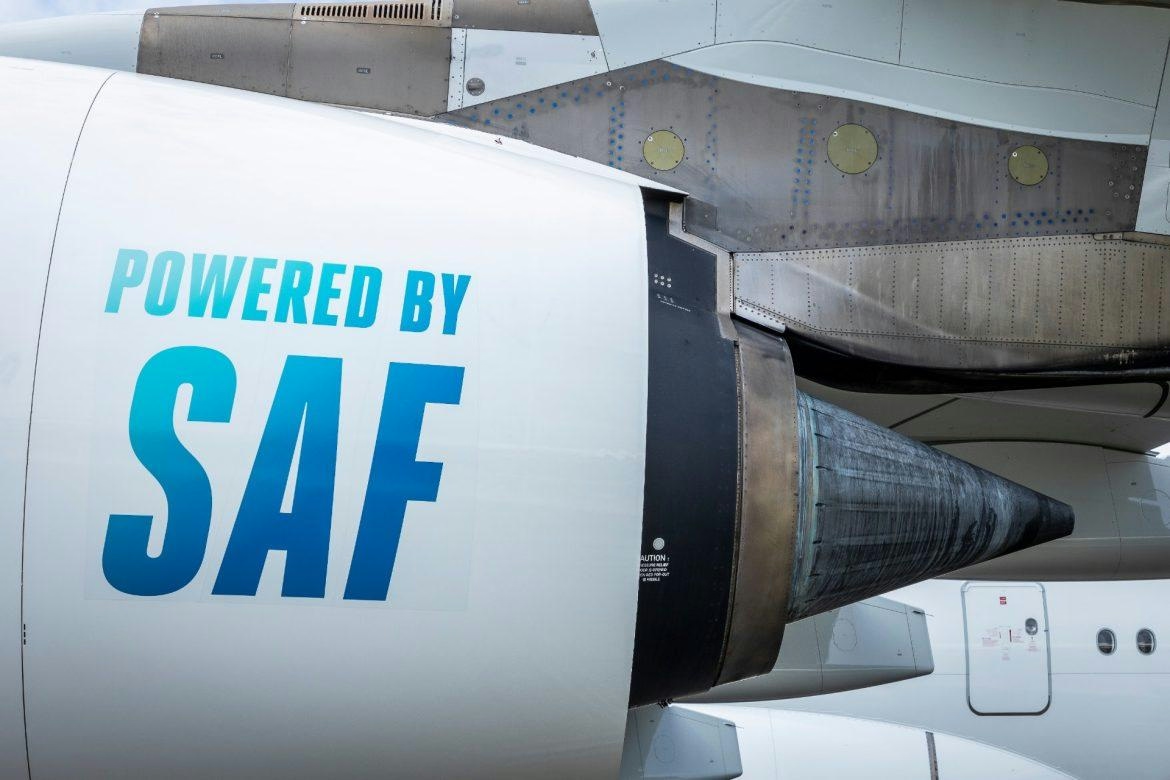
The aviation industry continues to rely predominantly on liquid fuels, as current battery technologies are insufficient to meet the energy demands of long-haul flights. Sustainable aviation fuel (SAF) derived from captured emissions is increasingly recognized as a strategic approach to reducing the sector’s carbon footprint while preserving operational feasibility. By converting CO₂ emissions into usable fuel, this technology offers a promising pathway to mitigate the environmental impact of air travel.

A Streamlined and Practical Conversion Process

The system developed by RMIT researchers introduces a novel, integrated method that captures and electrochemically converts CO₂ in a single step. This streamlined process reduces energy losses and technical complexity, resulting in lower overall energy consumption. Designed to operate near major emission sources, the technology can utilize exhaust gases directly, enhancing its suitability for industrial application.

Professor Tianyi Ma, who leads the project, highlighted the significance of this integration: “By merging the conversion stages, we have managed to simplify the process and reduce unnecessary energy losses.”

Industrial Viability and Development Roadmap

A notable advantage of the RMIT system is its ability to function without the need for highly purified CO₂, making it adaptable to real-world industrial environments. Peng Li, the study’s lead author, emphasized that this flexibility is essential for practical deployment.

The research team has constructed and tested a 3-kilowatt prototype under industrial conditions, evaluating its performance, stability, and energy efficiency. Their development plan includes scaling up to a 20-kilowatt pilot system, followed by a 100-kilowatt demonstrator, with the goal of achieving commercial maturity within six years.

Market Prospects and Challenges Ahead

The global market for sustainable aviation fuel is projected to reach $50 billion by 2036, reflecting both substantial growth potential and increasing competition. The introduction of this new fuel source could influence jet fuel pricing and provoke varied responses from industry players, including investments in similar technologies or strategic partnerships aimed at enhancing sustainable fuel portfolios.

Despite its promise, the technology faces significant hurdles. High initial capital investment is required to develop and scale CO₂ conversion systems, and ensuring the economic viability of the resulting aviation fuel remains a critical concern. Additionally, navigating complex regulatory frameworks will be pivotal in determining the speed and extent of commercial adoption.

Contribution to the Energy Transition

The RMIT team underscores that their system is not a standalone solution but rather a practical tool to aid emission reductions during the transition to cleaner energy sources. Its greatest potential lies in providing a sustainable alternative for sectors that are difficult to electrify, such as aviation, while making productive use of emissions that would otherwise exacerbate global warming.

If successfully scaled and commercialized, this Australian innovation could become an essential component in the broader portfolio of solutions required to combat climate change and transform the future of sustainable aviation.

More news
Aviation Industry Faces Challenges Amid Record Demand

Aviation Industry Faces Challenges Amid Record Demand

Aviation Industry Faces Challenges Amid Record Demand Supply Chain Strains and Rising Operational Costs The global aviation industry continues to grapple with significant supply chain disruptions and escalating operational pressures as unprecedented passenger demand intersects with geopolitical instability and intensifying competition. Despite the passage of several years since the pandemic, airlines and manufacturers remain entangled in persistent bottlenecks that hinder recovery efforts. Korean Air recently highlighted the growing uncertainty and competitive challenges anticipated through 2026, underscoring the fragile state of the sector. One of the most pressing issues is the prolonged use of older, less fuel-efficient aircraft, a direct consequence of delayed deliveries from major manufacturers such as Airbus and Boeing. Engine producers and component suppliers are stretched to their limits, tasked with simultaneously supporting new aircraft assembly and maintaining existing fleets. Jeffrey Lam, chief operating officer and president of commercial aerospace at ST Engineering, described material shortages and extended lead times as the “new norm,” a situation he deems unacceptable. These supply constraints have also driven up costs for carriers, prompting airlines like Singapore Airlines’ low-cost subsidiary Scoot to invest proactively in additional spare engines to mitigate operational risks. Record Passenger Demand and Industry Response The International Air Transport Association (IATA) reported that global air passenger traffic in 2025 surged to a record level, exceeding pre-pandemic figures by 9.3%, with further growth of 4.9% expected this year. To accommodate this surge, airlines have extended the operational lifespan of older aircraft by an average of two years, resulting in an estimated $11 billion increase in fuel, maintenance, engine leasing, and inventory expenses for 2025 alone. IATA Director General Willie Walsh expressed frustration over these mounting costs, emphasizing the urgent need for suppliers to enhance their performance and alleviate the strain on carriers. Engine manufacturers are responding with increased production efforts. Gael Meheust, CEO of CFM International—a joint venture between GE Aerospace and Safran—reported a 25% production increase in 2025, with plans to sustain at least 10% annual growth. Nevertheless, he acknowledged that current demand levels are unprecedented. Suppliers such as ST Engineering, responsible for producing engine nacelles, face extended lead times that have grown from approximately nine months to up to a year, despite the relatively short six-week manufacturing period for the nacelles themselves. Market Dynamics and Future Outlook Despite these operational challenges, profitability persists in certain regions. European airlines are forecasted to achieve net profits around $14 billion, even as delays in new aircraft deliveries continue. Airbus maintains its dominance in single-aisle jet sales, while Boeing concentrates on widebody aircraft. The business jet segment is also experiencing strong demand, particularly within the Asia Pacific region. The private aviation sector, although buoyed by recent growth, confronts its own set of challenges, including the impact of increased taxation as noted by ACC Aviation. As the aviation industry navigates the complexities of record demand, supply chain constraints, and geopolitical uncertainty, industry leaders concur that addressing these bottlenecks is essential to sustaining long-term growth and profitability.
Velocitor X-1 Advances Personal Flight Technology

Velocitor X-1 Advances Personal Flight Technology

Velocitor X-1 Advances Personal Flight Technology A New Era in Electric Personal Aircraft Pre-orders have commenced for the Velocitor X-1, a single-seat electric aircraft engineered to elevate commuters above urban congestion. Developed by Michigan-based startup Velo X Aerospace, the X-1 emerges at a time when electric vertical take-off and landing (eVTOL) vehicles remain largely inaccessible to everyday consumers. The company has already secured dozens of reservations for its initial production run, slated for early 2027. The aircraft is powered by eight electric motors driving propellers positioned at the ends of four arms, enabling vertical takeoff and landing capabilities. This distributed propulsion system enhances safety by ensuring that the failure of a single motor does not jeopardize the entire craft. Stability is maintained through a combination of pilot inputs and automated adjustments, supported by GPS technology to keep the vehicle level. The control interface is designed to be intuitive for users familiar with automobiles, snowmobiles, or motorcycles, thereby reducing the learning curve for new pilots. Safety and Performance Features Safety remains a paramount concern in the X-1’s design. The aircraft is equipped with a forward-facing LiDAR system that continuously scans for obstacles such as power lines and trees, assisting pilots in collision avoidance. In the event of a loss of control, a ballistic parachute can be deployed from altitudes as low as 50 feet. The composite body structure, reinforced seating, and four-point harness provide additional protection during hard landings. Performance specifications are tailored for short-distance travel. The X-1 cruises at speeds of up to 70 miles per hour, offering approximately 45 minutes of flight time with an additional 15-minute reserve on a full charge. Some users have reported total flight durations approaching one hour, including reserve capacity. Recharging the battery to 80 percent capacity requires roughly one hour. The aircraft supports a maximum payload of 260 pounds, encompassing both pilot and gear. Its compact dimensions—91 inches wide and 100 inches long—allow for takeoffs from driveways or small clearings, enhancing its practicality for urban environments. Development and Industry Context Velo X Aerospace was founded by Jeff Williams and Galen Geigley, both experienced in light aircraft and powered parachute development. The company is actively pursuing certification under the Federal Aviation Administration’s (FAA) MOSAIC program, which seeks to streamline approval processes for lighter, innovative aircraft. To date, three test platforms have successfully flown, demonstrating significant technical progress. Despite these advancements, the Velocitor X-1 faces considerable challenges. Regulatory approval remains a critical obstacle, as authorities rigorously evaluate new personal flight technologies for safety and integration into existing airspace. Both technical and operational safety concerns will be closely monitored as the aircraft advances toward production. Furthermore, competition within the eVTOL sector is intensifying. Recent developments, such as the Rictor X4, highlight the rapid pace of innovation and growing investor interest in affordable personal flight solutions. This competitive environment may accelerate the development timelines of rival projects in response to the X-1’s market entry. As the personal aviation industry continues to evolve, the Velocitor X-1 represents a notable advancement toward making everyday flight more accessible. Its ultimate success will depend on regulatory progress, ongoing innovation, and consumer adoption.
Rolls-Royce Acknowledges Thai Airways Shortfall, Plans Regional Recovery

Rolls-Royce Acknowledges Thai Airways Shortfall, Plans Regional Recovery

Rolls-Royce Acknowledges Thai Airways Shortfall, Plans Regional Recovery Challenges with Thai Airways and Engine Reliability Rolls-Royce is entering the final phase of its upgraded Trent 1000 XE engine for the Boeing 787 this quarter, aiming to regain its position in the fiercely competitive aircraft engine market. The British engineering firm has faced persistent reliability issues with its Trent 1000 engines, which have led to significant customer losses, most notably Thai Airways’ decision to switch suppliers two years ago. Speaking at the Singapore Airshow 2026, Ewen McDonald, Rolls-Royce’s chief customer officer for civil aerospace, openly acknowledged the company’s failure to retain Thai Airways. He attributed the airline’s move to a lack of technical confidence in the engine fixes rather than pricing concerns. Thai Airways opted for GE Aerospace’s GEnx engines for its 45 new Boeing 787s in 2024 after repeated criticism of the Trent 1000’s durability and prolonged maintenance periods, which extended up to 120 days compared to the previous 90-day standard. Rolls-Royce has defended its pricing strategy by citing industry-wide supply chain disruptions and geopolitical instability as key drivers behind recent cost increases. However, market reactions have been mixed, with some analysts urging original equipment manufacturers and suppliers to accelerate adaptation to advanced aircraft models and emerging technologies. The competitive environment remains intense, particularly in the Pacific region, where Air New Zealand, a traditional Rolls-Royce customer, has chosen GE engines for its five new Boeing 787s, despite its existing fleet of 14 Dreamliners continuing to operate with Rolls-Royce powerplants. Competitors are capitalizing on improvements in engine durability and supply chain efficiency to attract airlines prioritizing reliability and cost-effectiveness. Strategic Shift and Regional Focus In response, Rolls-Royce is transitioning from a defensive stance to a more assertive campaign to reclaim market share, with a particular focus on Southeast Asia, which it identifies as the fastest-growing aviation market globally. The company has rebranded its upgraded engine as the Trent 1000 XE, marking a clear departure from previous issues. According to McDonald, the initial “Phase 1” upgrade, already in service, has more than doubled the engine’s time-on-wing—a critical performance metric for airline operators. He emphasized the timing of these improvements, noting that when Thai Airways made its decision, the XE upgrades were still in early development. “Maybe if they’re looking at it today, they would have a different decision because the confidence point is much higher,” McDonald remarked. Beyond the Boeing 787 program, Rolls-Royce is also advancing efforts to enhance the durability of its largest engine for the Airbus A350-1000, aiming to reassure both customers and investors of its long-term commitment to reliability. While the company’s power systems and data centers segments show promising growth potential, the turnaround of its civil aerospace division remains a central priority. As Rolls-Royce finalizes the Trent 1000 XE upgrades and intensifies its recovery efforts in Southeast Asia, the market remains cautious. The company’s capacity to adapt to new technologies and restore confidence among major airline customers will be closely monitored in the coming months.
GE Aerospace Develops Aviation Technology at Singapore Facility

GE Aerospace Develops Aviation Technology at Singapore Facility

GE Aerospace Advances Aviation Technology at Singapore Facility GE Aerospace is making significant strides in aviation technology through substantial investments and innovation at its Singapore facility. In response to the rapidly evolving aviation sector, the company is concentrating on developing advanced technologies and new capabilities to sustain its competitive advantage in the global market. Strategic Role of the Singapore Facility The Singapore site, highlighted in the final segment of GE Aerospace’s three-part innovation series, serves as a critical hub in shaping the future of flight. Positioned at the forefront of next-generation aviation technology development, the facility exemplifies GE Aerospace’s dedication to powering the skies of tomorrow. This strategic location enables the company to accelerate research and development efforts, fostering breakthroughs that could redefine industry standards. Challenges and Market Response Despite the promising outlook, GE Aerospace faces several challenges in its Singapore operations. Navigating complex regulatory frameworks, ensuring seamless integration with the company’s global operations, and contending with intense competition from other leading aerospace firms present ongoing obstacles. Furthermore, the process of scaling and commercializing new technologies remains a significant hurdle as the company endeavors to transition innovations from the laboratory to the marketplace. Nevertheless, the market has responded positively to GE Aerospace’s initiatives. Investors have expressed confidence in the company’s robust financial position and growth prospects. The proactive stance adopted by GE Aerospace has also influenced competitors, prompting them to increase investments in research and development and to pursue strategic partnerships to safeguard their market positions. As GE Aerospace continues to expand its technological capabilities in Singapore, the facility is poised to become a cornerstone of the company’s global innovation strategy. These developments underscore GE Aerospace’s leadership within the aerospace industry and reflect a broader movement toward advanced and sustainable aviation technologies worldwide.
CDB Aviation Delivers Three Boeing 737-8 Jets to WestJet

CDB Aviation Delivers Three Boeing 737-8 Jets to WestJet

CDB Aviation Expands WestJet’s Fleet with Three New Boeing 737-8 Jets CDB Aviation, the Irish subsidiary of China Development Bank Financial Leasing Co., Limited, has delivered three Boeing 737-8 aircraft to WestJet, the Calgary-based Canadian carrier. This latest delivery increases the total number of 737-8 jets leased by WestJet from CDB Aviation to eight, reinforcing a partnership that has been active since 2020. The addition of these fuel-efficient aircraft aligns with WestJet’s broader strategy to expand and modernize its narrowbody fleet. Enhancing Fleet Efficiency and Passenger Experience The newly delivered Boeing 737-8 jets are designed to offer significant fuel savings and improved passenger amenities, including satellite-supported WiFi, which supports WestJet’s commitment to enhancing the travel experience. Luís da Silva, Head of Commercial for the Americas at CDB Aviation, highlighted the strength of the collaboration, noting that the company has financed and leased a total of 13 Boeing 737-8 aircraft to WestJet to date. This ongoing partnership underscores CDB Aviation’s role in supporting the Canadian airline’s growth trajectory. WestJet, known for pioneering low-cost travel in Canada since its inception in 1996, continues to prioritize affordability and flexibility for its customers. Jennifer Bue, WestJet’s Senior Vice President and Treasurer, emphasized the value of the relationship with CDB Aviation, stating that it enables the airline to maintain momentum in executing its growth strategy. Industry Context and Strategic Developments The delivery of these aircraft occurs amid a highly competitive global airliner market, where Boeing and Airbus are navigating significant industry challenges. Boeing is currently undergoing an industrial reset aimed at achieving a financial turnaround and reinforcing safety standards. A key component of this effort is maintaining a stable production rate of 42 aircraft per month for the 737 MAX series. This focus on safety and production stability is particularly relevant as Japanese carriers ANA and JAL prepare to receive their first Boeing 737 MAX 8 aircraft in 2026. In response to passenger feedback, WestJet has recently reverted to its previous standard economy seat configuration, reflecting the airline’s commitment to customer comfort in a competitive environment. This decision aligns with broader industry trends where carriers strive to balance operational efficiency with passenger satisfaction. CDB Aviation’s delivery of these three additional 737-8 aircraft directly from its orderbook also reflects a shared commitment to environmentally conscious fleet modernization. Da Silva remarked on the importance of supporting WestJet’s expansion in an environmentally responsible manner. Looking ahead, WestJet’s continued fleet growth, including the planned integration of Sunwing in 2025, positions the airline to extend its reach across Canada and internationally, while maintaining its focus on cost-effective and customer-centric service.
1977 Piper PA-32R-300 Lance Reviewed as a Reliable Light Aircraft

1977 Piper PA-32R-300 Lance Reviewed as a Reliable Light Aircraft

1977 Piper PA-32R-300 Lance: A Reliable and Versatile Light Aircraft The 1977 Piper PA-32R-300 Lance continues to be recognized for its reliability and versatility within the light aircraft category. This model, highlighted today by Aircraft For Sale, exemplifies Piper’s response to evolving demands in general aviation, combining enhanced performance with practical design features that appeal to both pilots and passengers. Evolution and Design Features Piper’s development trajectory from the four-seat PA-28 Cherokee to the larger six-seat PA-32 Cherokee Six addressed a growing market need for more spacious and capable aircraft. The introduction of the Lance marked a significant advancement, incorporating retractable landing gear and other performance improvements aimed at increasing speed and efficiency. This model’s success laid the groundwork for the subsequent Saratoga, which enjoyed strong sales and remained in production into the early 2000s. The Lance’s cabin is designed to accommodate six occupants comfortably, making it well-suited for cross-country travel. Its club seating arrangement, where the second and third rows face each other, enhances legroom and fosters passenger interaction, providing a more enjoyable experience on longer flights. Families and small groups benefit from the additional space and baggage capacity compared to typical four-seat aircraft. Performance and Maintenance Pilots value the Lance for its robust Lycoming IO-540-K1G5D engine, stable handling characteristics, and substantial useful load capacity. The featured 1977 model has accumulated 2,222 hours on the airframe and 1,187 hours on the engine, with no history of damage. It offers a useful load of 1,412 pounds, supporting a range of mission profiles. Recent maintenance includes the installation of new engine oil hoses and a landing gear power pack in 2024, alongside a new ignition harness fitted in 2022. Additional enhancements such as Knots 2U wingtips, a shimmy damper, and Zero Breeze air conditioning contribute to both performance and comfort. The avionics suite has been modernized to meet contemporary standards, featuring Garmin GNS 530 and GNS 430 GPS/nav/com units, a GTX 330 transponder, GMA 345 audio panel, GDL SiriusXM receiver, JPI EDM 730 engine monitor, Piper Autocontrol IIIB autopilot, Davtron clock, uAvionix tailBeacon for ADS-B Out, and an ACK Technologies emergency locator transmitter. Market Context and Industry Trends While the Lance maintains its appeal as a dependable piston-powered aircraft, the broader aviation market is undergoing significant transformation driven by technological innovation and shifting priorities. Investments by the EU Defense Fund in small turbofan engines and light attack aircraft research indicate a trend toward advanced propulsion systems that may challenge traditional piston models. Concurrently, the retirement of legacy aircraft by forces such as the Royal Australian Air Force and innovation efforts by major manufacturers including Airbus and Boeing highlight the competitive pressures facing established designs. Market conditions, characterized by stable valuations and low inflation forecasts through 2026, suggest a steady yet competitive environment for light aircraft. The Lance’s proven track record must now contend with newer models incorporating cutting-edge technologies. Competitors are advancing rapidly, with developments such as Saab’s software-defined fuselage and Embraer’s emphasis on E2 sales underscoring the pace of change within the sector. Availability and Financing For pilots seeking a high-performance piston single with a spacious cabin and substantial useful load, the 1977 Piper PA-32R-300 Lance remains a compelling choice. The aircraft is currently listed at $189,900 on AircraftForSale, with financing options accessible through FLYING Finance. Prospective buyers can utilize available tools to estimate monthly payments and consult with aviation finance specialists to facilitate acquisition.
Boeing and Airbus Shares Rise Amid Potential Saudi Jet Order Talks

Boeing and Airbus Shares Rise Amid Potential Saudi Jet Order Talks

Boeing and Airbus Shares Rise on Prospective Saudi Aircraft Order Shares of Boeing and Airbus experienced modest gains on Thursday afternoon following reports that Saudi Arabia’s national carrier, Saudia, is engaged in preliminary discussions with both manufacturers regarding a potential aircraft purchase that could become the largest in the airline’s history. Each company’s stock rose approximately 0.5%, outperforming broader market declines as investors reacted favorably to the prospect of a substantial new contract. Details of the Potential Order and Saudia’s Fleet Strategy According to sources cited by Bloomberg, Saudia is contemplating the acquisition of at least 150 new aircraft, encompassing both narrowbody and widebody models. The airline, which currently operates a fleet of around 200 planes, is considering this purchase as part of a dual strategy to replace aging aircraft and expand its overall capacity. While specific models and quantities remain undecided, the discussions are understood to be in the early stages. This potential transaction follows a series of significant orders from Saudia in recent years. Earlier in 2024, the airline placed an order for 105 Airbus narrowbody jets, and in 2023, it committed to acquiring more than three dozen Boeing 787 Dreamliners, with options for an additional 10 aircraft. These developments underscore Saudia’s ongoing efforts to modernize and grow its fleet amid increasing demand for air travel in the Middle East. Implications for Boeing, Airbus, and the Aerospace Industry For Boeing and Airbus, securing an order of this scale would present both opportunities and challenges. Both manufacturers are currently under pressure to increase production rates to meet rising global demand, and a new large-scale order would further strain their supply chains and delivery schedules. Company leadership is expected to prioritize future aircraft decisions and production planning as competition intensifies. Market response to the news has been broadly positive, with investors viewing the potential Saudi order as a significant boost for both aerospace giants. However, the competitive landscape remains complex. Airbus continues to lead the single-aisle market, while Boeing is striving to regain its position in the narrowbody segment. Meanwhile, other manufacturers face their own strategic challenges: Embraer is focusing on increasing sales of its E2 jets rather than launching new airliner programs, and Bombardier is contending with heightened regulatory scrutiny following calls from former U.S. President Donald Trump to revoke certificates for all Bombardier Global aircraft. As Saudia evaluates its options, the outcome of these negotiations could have far-reaching implications not only for Boeing and Airbus but also for the broader commercial aviation sector. The potential order highlights the ongoing competition for market share among major manufacturers and the operational complexities involved in meeting the demands of rapidly expanding airlines.
Centaurium Aviation MRO Ltd. Announces Ownership Change

Centaurium Aviation MRO Ltd. Announces Ownership Change

Centaurium Aviation MRO Ltd. Announces Ownership Change Amid Industry Evolution Centaurium Aviation MRO Ltd. has revealed a change in ownership as part of a planned succession strategy. Dr. Daniel Borer, the current owner, will step back from both operational and strategic management to focus on new private ventures. The transition involves a management buyout, with company shares transferred to Lukas Nyffenegger, who will assume ownership and leadership responsibilities. Nyffenegger brings extensive experience and deep industry knowledge, positioning him to steer Centaurium Aviation MRO Ltd. through its forthcoming phase. Dr. Borer emphasized the continuity this succession ensures, stating, “With this succession solution, we are ensuring that the company is well positioned and can continue on its successful path.” He expressed confidence that Nyffenegger’s expertise and dedication will foster sustainable development for the company. The handover of responsibilities will be gradual over the coming months, with no immediate changes expected in customer, partner, or employee interactions or service offerings. Navigating a Shifting MRO Landscape This ownership transition occurs amid significant changes within the Maintenance, Repair, and Overhaul (MRO) sector, particularly in Latin America. While the market is expanding, it faces distinct regional challenges that require adept leadership. Industry analysts suggest that Centaurium’s new management will need to navigate an increasingly competitive environment, with stakeholders closely monitoring potential impacts on operational efficiency and service quality. Competitors are actively pursuing strategic initiatives to strengthen their market positions. The Adani Group, for instance, has recently expanded its footprint in the MRO sector through major acquisitions, reflecting a broader trend toward consolidation. This heightened activity may compel Centaurium to enhance its capabilities or explore partnerships to maintain its competitive advantage. Broader industry dynamics, including a wave of mergers and acquisitions in the United States driven by advancements in artificial intelligence and biopharmaceuticals, indicate that greater integration could soon influence the aviation MRO sector. As Centaurium Aviation MRO Ltd. embarks on this new chapter, strategic planning will be essential to sustain growth and resilience in a rapidly evolving market.
Jet.AI Revises FlyExclusive Transaction Details for Shareholders

Jet.AI Revises FlyExclusive Transaction Details for Shareholders

Jet.AI Revises FlyExclusive Transaction Details for Shareholders Ongoing Transaction and Regulatory Review Jet.AI, the Las Vegas-based aviation and technology firm, has provided shareholders with an updated status on its protracted transaction with FlyExclusive. Initially announced in February 2025, the deal remains incomplete after nearly a year of regulatory scrutiny. Executive Chairman Mike Winston, in a recent letter and press release, confirmed that the company is in the final stages of divesting its aviation business to FlyExclusive, one of the largest private jet operators in the United States. Upon completion, Jet.AI shareholders will hold two distinct securities: JTAI, which will focus on AI data center infrastructure, and FLYX, representing the expanding private aviation enterprise. The transaction has been under review by the Securities and Exchange Commission (SEC), delayed primarily due to a single unresolved accounting comment concerning FlyExclusive’s 2023 financial disclosures. Winston characterized the issue as “an edge case” and acknowledged that the delay has extended beyond initial expectations. Both companies have worked diligently to resolve the matter, but if it remains unresolved, the issue may be addressed when FlyExclusive files its next Form 10-K for the 2024-2025 fiscal year. This filing would update the S-4 registration statement and potentially eliminate the need to present the 2023 financial figures. Financial Impact and Market Context Winston also detailed the financial implications for Jet.AI shareholders contingent on the deal’s closure. Provided the transaction meets the minimum requirement of $12 million in positive net working capital, shareholders would receive approximately four million shares of FlyExclusive stock. Based on the most recent closing price of $3.32 per share as of January 29, 2026, this stake would be valued at roughly $13.4 million. The transfer of assets and working capital is expected to reduce Jet.AI’s operating expenses by approximately 30%. This update arrives amid heightened market sensitivity to disruptions driven by artificial intelligence. According to reports from The Wall Street Journal, advances in AI are posing significant challenges to traditional financial services, a trend that could influence Jet.AI’s competitive positioning. The software sector has experienced notable declines, with shares of software companies falling sharply amid concerns that AI technologies may supplant existing solutions. This broader environment suggests that Jet.AI faces intensified competitive pressures as rivals leverage AI innovations to capture market share, underscoring the critical importance of continued innovation in the company’s strategic outlook. Strategic Position and Future Prospects Founded in 2021 as a HondaJet fractional operator, Jet.AI has since expanded into jet cards and shifted away from very light jets. The completion of the FlyExclusive transaction would grant FlyExclusive access to Jet.AI’s pending order with Textron Aviation for light jets, further influencing the competitive dynamics within the private aviation sector. As the deal approaches its conclusion, Jet.AI’s leadership remains focused on overcoming regulatory challenges and adapting to a rapidly evolving market shaped by AI-driven innovation and shifting industry dynamics.
Joramco to Provide MRO Services for Condor’s Airbus Fleet

Joramco to Provide MRO Services for Condor’s Airbus Fleet

Joramco Secures Five-Year MRO Contract with Condor for Airbus Fleet Joramco, a specialist in aircraft maintenance, repair, and overhaul (MRO), has entered into a five-year agreement with German airline Condor to provide heavy maintenance services for the carrier’s entire Airbus fleet. Announced at MRO Middle East 2026 on February 4, this marks the first collaboration between the Amman-based MRO provider and Condor, underscoring Joramco’s expanding presence in the global aviation maintenance sector. Scope of the Agreement and Strategic Significance Under the terms of the contract, Joramco—an engineering subsidiary of Dubai Aerospace Enterprise (DAE)—will conduct base maintenance checks on Condor’s Airbus A320ceo, A320neo, and A330neo aircraft. This partnership highlights Joramco’s commitment to delivering maintenance services that adhere to the highest international standards, reinforcing its reputation as a trusted partner for airlines worldwide. Fraser Currie, Chief Strategy and Commercial Officer at DAE Engineering, expressed enthusiasm about the new partnership, emphasizing the company’s dedication to operational excellence. He noted that the long-term agreement reflects the confidence airlines place in Joramco’s capabilities and signaled intentions to further develop the collaboration. Condor operates a fleet of 48 Airbus aircraft, including 17 A330neos and 12 A321-200s, having completed its transition to an all-Airbus fleet in November 2025 by retiring its last Boeing 757-300. Heiko Holm, Managing Director and Chief Technical Officer at Condor, described the partnership as a strategic move to support the airline’s operational goals. He praised Joramco’s reputation for quality and reliability, which aligns with Condor’s focus on operational excellence, continuous improvement, and the advancement of its digital maintenance strategy. Context within the Middle East MRO Market The agreement comes amid rapid growth in the Middle East’s MRO sector, which is experiencing heightened demand for qualified maintenance technicians. Industry leaders, including Lufthansa Technik Middle East CEO Ziad Al-Hazmi, have highlighted challenges related to recruiting and retaining skilled personnel in the face of this expansion. Additionally, Airbus CEO Guillaume Faury has drawn attention to ongoing supply chain constraints that may impact the availability of essential parts and components for MRO operations. As competition intensifies, established MRO providers are leveraging their expertise and workforce to secure new contracts. Joramco’s recent collaborations, such as its partnership with BlueLight Humanitarian Airlines for Airbus A340 maintenance, exemplify this trend. Market analysts observe that the region’s above-average growth, coupled with lingering workforce shortages from the pandemic, is driving increased demand for MRO services. This environment positions providers like Joramco to play a critical role in supporting airline operations across the Middle East and beyond.
line









