
AIによるインサイトを行動へとつなげる

現在のトレンド
Categories
Companies Producing Diesel Airplane Engines Face Questions About Safety and Performance
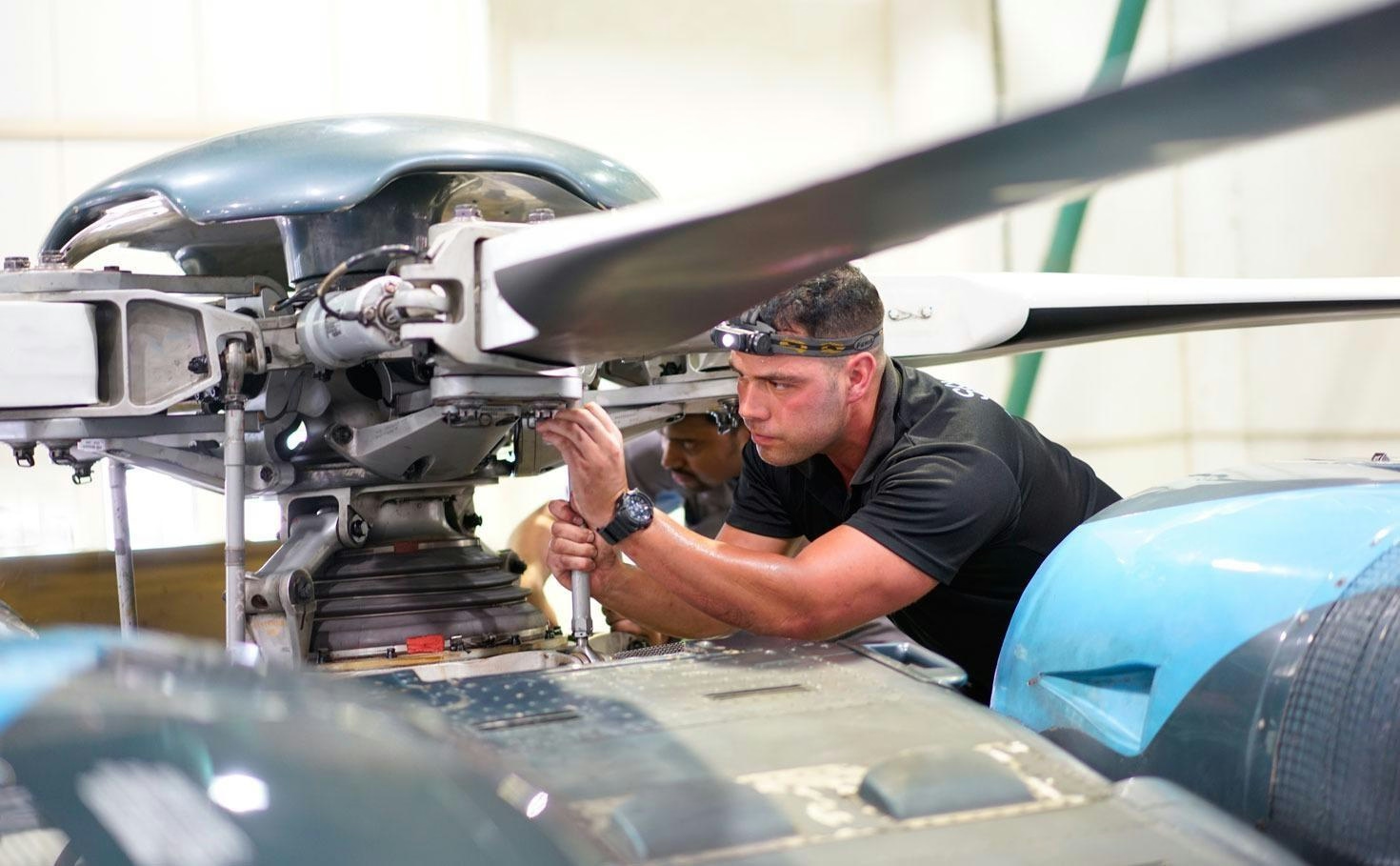
Companies Producing Diesel Airplane Engines Face Questions About Safety and Performance
Diesel Engines in Aviation: An Overview
Diesel engines, commonly associated with heavy-duty vehicles such as pickup trucks and semi-trailers, have also carved out a specialized role in aviation, particularly within the realm of general aviation aircraft powered by piston engines. Unlike commercial airliners that predominantly utilize jet or turboprop engines, smaller general aviation planes can benefit from the efficiency and fuel flexibility offered by diesel technology. These aircraft diesel engines operate on the compression-ignition principle, similar to their terrestrial counterparts, eliminating the need for spark plugs. A notable advantage is their capability to run on both standard diesel fuel and Jet A fuel, the latter being widely accessible at airports worldwide.
Currently, two principal manufacturers dominate the market for factory-installed diesel-powered general aviation aircraft. Diamond Aircraft, headquartered in Europe, incorporates diesel engines extensively across its product range, including the single-engine DA40 series, the twin-engine DA42 and DA62, as well as the high-performance DA50 RG. In the United States, Piper Aircraft offers diesel variants for its Archer DLX and the trainer model DX. Cessna, a longstanding name in general aviation, briefly ventured into the diesel segment with the Turbo Skyhawk JT-A in 2014 but discontinued the model in 2018, less than a year after its certification. Despite Cessna’s withdrawal, diesel engine conversions remain available through specialized manufacturers, sustaining interest in this technology.
Emerging Challenges and Industry Scrutiny
The integration of diesel engines into aviation has not been without its challenges. Recent developments within the broader aerospace industry have intensified scrutiny over safety and performance standards. Airbus, for instance, recently disclosed software malfunctions affecting approximately 6,000 A320-family aircraft, coupled with quality issues related to fuselage panels on several dozen jets. These revelations precipitated a sharp decline in Airbus’s stock value and cast doubt on the company’s capacity to achieve its ambitious production and delivery goals set for 2025.
The aviation sector as a whole is currently engaged in a competitive technological race among engine manufacturers, heightening the emphasis on reliability and innovation. Boeing, despite encountering setbacks in recent years, continues to exert significant industrial and political influence. Meanwhile, GE Aerospace confronts its own challenges, particularly concerning the durability and maintenance demands of its LEAP engines. With global aircraft deliveries still constrained by supply chain and production issues, airlines and operators are preparing for increased maintenance requirements, underscoring the critical importance of engine safety and performance.
Navigating the Future of Diesel Aviation Engines
As competition intensifies among producers of diesel airplane engines, manufacturers face the dual pressures of overcoming technological obstacles and responding to heightened regulatory and customer scrutiny. The recent incidents involving major aerospace companies highlight the imperative for rigorous quality control and continuous innovation. These factors are essential to ensuring that diesel-powered aircraft remain a viable, safe, and efficient option within the evolving landscape of aviation technology.
Comments

Etihad Airways Suspends Airbus A380 Flights on Key Route

Aditya Birla Group Seeks Approval for Aircraft Leasing in GIFT City

Qatar Airways Highlights Innovation and Connectivity at Arabian Travel Market 2026

Hong Kong's Five-Year Plan Includes Andrew Fan's Aircraft Parts Processing Hub Proposal

ACIA Aero Leasing Delivers ATR72-600 to Air Nostrum

RTX Appoints Jill Albertelli as Head of Pratt & Whitney

TAT Technologies Joins Beyond Aero Hydrogen Aircraft Program

AURAK Study Highlights Barriers to Air Taxi Adoption in Emerging Economies

Xiamen Air Selects Altitude for 787 Maintenance at Heathrow

Etihad and Swissport Extend Global Partnership
