
AIによるインサイトを行動へとつなげる

現在のトレンド
Categories
Global Flight Simulator Market Outlook and Risk Assessment, 2026–2036
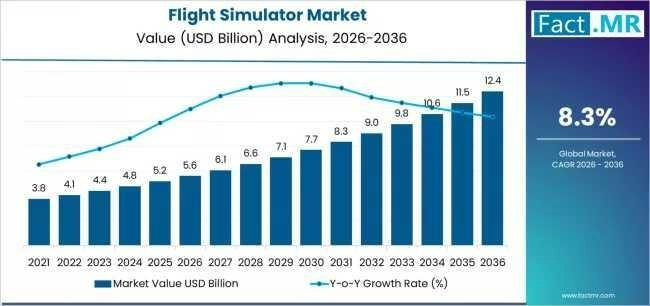
Global Flight Simulator Market Outlook and Risk Assessment, 2026–2036
The global flight simulator market is poised for substantial growth over the next decade, driven by increasing demand for advanced pilot training across commercial, military, and general aviation sectors. Market valuation is expected to more than double, rising from an estimated USD 5.6 billion in 2026 to USD 12.4 billion by 2036, reflecting a robust compound annual growth rate (CAGR) of 8.3%.
Market Drivers and Segment Analysis
The primary catalyst for this expansion is the growing need for skilled pilots, propelled by rising global air traffic and continuous fleet expansions among major airlines. Regulatory mandates and stringent safety standards are accelerating the adoption of simulator-based training for pilot certification and recurrent proficiency assessments. Flight simulators offer a cost-effective and risk-free alternative to in-aircraft training, making them indispensable tools for airlines, training organizations, and defense agencies seeking to enhance operational readiness while reducing actual flight hours.
Within the simulator market, full flight simulators are anticipated to command the largest share, accounting for approximately 42.8% in 2026. Their capacity to accurately replicate aircraft systems, cockpit environments, and flight dynamics renders them essential for advanced pilot and crew training. Commercial aviation remains the dominant application segment, projected to represent about 61.7% of the market in 2026, driven by rigorous certification cycles and the expanding size of airline fleets worldwide.
Regional Market Outlook
Regionally, North America, Asia Pacific, and Europe emerge as key growth areas. The Asia Pacific region, particularly China and India, is expected to outpace more mature markets due to rapid aviation sector expansion, increased pilot recruitment, and government initiatives supporting localized training infrastructure. China’s flight simulator market is forecast to grow at a CAGR of 9.7%, while India is projected to expand at 9.2% through 2036. The United States maintains a significant market presence, underpinned by well-established aviation infrastructure and high levels of simulator integration, with a projected CAGR of 7.1%. European markets, including Germany and the United Kingdom, also demonstrate steady growth, supported by stringent training regulations and sophisticated training ecosystems.
Technological Advancements and Market Challenges
The evolution of the flight simulator market is closely linked to rapid technological progress. Advances in computing power, immersive visual systems, and sophisticated motion platforms are enhancing simulation realism and training effectiveness. Emerging innovations such as artificial intelligence for adaptive scenario generation, virtual and augmented reality for immersive training experiences, and cloud-based platforms enabling remote training and analytics are becoming key differentiators among leading providers.
Despite these opportunities, the market faces several challenges. Regulatory changes, technological disruptions, and broader economic factors could influence growth trajectories. For example, recent Supreme Court rulings on tariffs may affect supply chains and operational costs. In response, industry players are pursuing strategic innovations, including the adoption of self-healing polyurethane topcoats for aircraft exteriors, to maintain competitiveness and adapt to evolving market conditions.
Competitive Landscape and Future Outlook
Leading companies such as CAE Inc., L3Harris Technologies, Boeing Company, Thales Group, and FlightSafety International are investing heavily in enhancing simulation fidelity and expanding service networks. The market outlook remains cautiously optimistic, with a strong emphasis on innovation and regulatory compliance as these firms navigate emerging risks and opportunities throughout the coming decade.

Etihad Airways Suspends Airbus A380 Flights on Key Route

Aditya Birla Group Seeks Approval for Aircraft Leasing in GIFT City

Qatar Airways Highlights Innovation and Connectivity at Arabian Travel Market 2026

Hong Kong's Five-Year Plan Includes Andrew Fan's Aircraft Parts Processing Hub Proposal

ACIA Aero Leasing Delivers ATR72-600 to Air Nostrum

RTX Appoints Jill Albertelli as Head of Pratt & Whitney

TAT Technologies Joins Beyond Aero Hydrogen Aircraft Program

AURAK Study Highlights Barriers to Air Taxi Adoption in Emerging Economies

Xiamen Air Selects Altitude for 787 Maintenance at Heathrow

Etihad and Swissport Extend Global Partnership
