
AIによるインサイトを行動へとつなげる

現在のトレンド
Categories
India Expands Aviation Infrastructure Plans
India Expands Aviation Infrastructure Plans
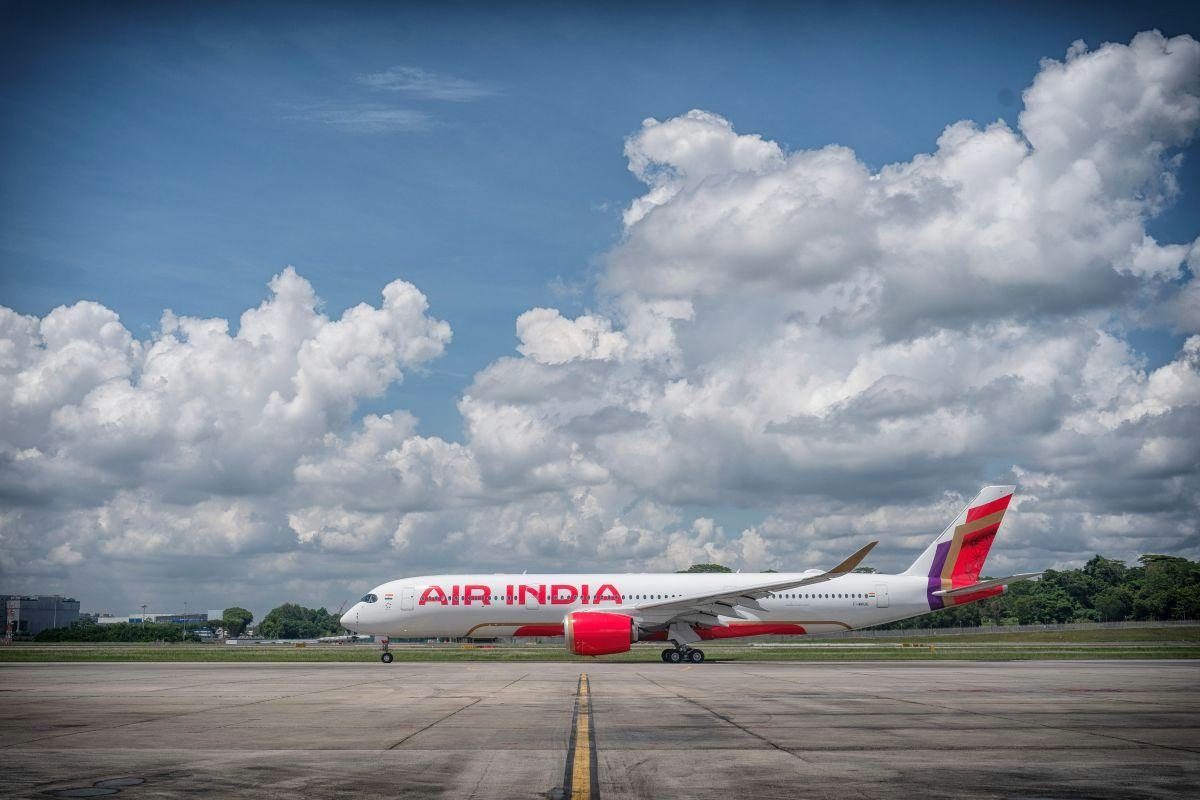
India is undertaking its most extensive aviation infrastructure expansion to date, with investments projected to reach up to $40 billion by 2040. This ambitious initiative aims to modernize the country’s aviation sector comprehensively. Airbus forecasts that India’s commercial aircraft fleet will triple to 2,250 by 2035, while the airport network is expected to expand from 149 to over 200 facilities. This growth is complemented by significant investments in maintenance, repair, and operations (MRO) facilities, hangars, vertiports, air traffic control modernization, and the integration of clean-energy aviation assets.
Expanding Airport Networks and Infrastructure
Over the next four years, airport procurement budgets are estimated between $18 billion and $24 billion, with a strategic shift from focusing solely on mega-hubs to developing a wider network of small and mid-sized airports. This approach is designed to create new opportunities for global investors and aviation companies. Planned upgrades include expanded terminals, longer runways, larger aprons, advanced technology blocks, and enhanced landside infrastructure. Several greenfield projects are underway in locations such as Parandur, Puri, Dholera, Kota, Alwar, Mandi, Raichur, Doloo, Kottayam, Sonepur, and Saharsa.
Business aviation is also experiencing significant growth, prompting the development of more than 30 new terminals this decade, representing an investment of $1.2 to $1.8 billion. Additionally, $4 to $5 billion is allocated for cargo infrastructure across 20 to 25 airports. This surge in activity has attracted heightened interest from global aviation firms. Airbus, for example, is targeting India for growth in aircraft sales, including its ACJ TwoTwenty model, while international airlines are seeking to expand their presence and secure market share within the country.
Challenges and Industry Response
Despite the promising outlook, India’s aviation expansion faces considerable challenges. The scale of investment required to build and maintain new airports is substantial, and the complexity of regulatory approvals poses risks of project delays. Furthermore, the rapid growth necessitates extensive workforce training to manage increased airport operations while maintaining safety and efficiency standards.
Nevertheless, India’s aviation infrastructure push is becoming increasingly attractive to investors. Liberalized foreign direct investment norms, strengthened regulatory frameworks, clearer concession models, and broader use of arbitration mechanisms have enhanced contractual certainty. Sonam Chandwani, managing partner at KS Legal & Associates, notes that “India’s aviation-infrastructure push has become far more predictable and investible.”
Engineering firms are deepening their involvement in this sector. Tata Projects Ltd. (TPL) Managing Director and CEO Vinayak Pai highlights the company’s expanded roles across airports, MRO complexes, renewable energy bases, and logistics infrastructure. A flagship project is the partnership between TPL, Yamuna International Airport, and Zurich Airport International to develop Delhi’s second international airport at Jewar. This project includes a terminal, a 4-kilometer runway, a cargo terminal, an air traffic control tower, and supporting facilities. Designed for long-term scalability, the airport aims to handle up to 70 million passengers annually and incorporates renewable energy systems, rainwater harvesting, and sustainable construction materials.
Construction techniques are becoming increasingly sophisticated, with terminals and rail stations designed as experiential spaces featuring 200-meter clear spans and dense mechanical, engineering, and plumbing systems. Advanced technologies such as Building Information Modeling (BIM), 3D camera monitoring, drone mapping, robotics, and SAP-based enterprise resource planning platforms are now standard, although fully realized digital twins remain under development.
International interest in India’s MRO market is also accelerating. TPL is collaborating with Singapore-based ASI Global on turnkey MRO facilities, while competitors are responding with strategic partnerships and investments. For instance, Singapore Airlines continues to support Air India, and there is growing investment in data center infrastructure to meet the increasing demand for artificial intelligence and cloud computing within the aviation sector.
As India’s aviation landscape undergoes rapid transformation, the country is positioning itself as a global hub, navigating the complexities of scale, regulation, and technological advancement.

Etihad Airways Suspends Airbus A380 Flights on Key Route

Aditya Birla Group Seeks Approval for Aircraft Leasing in GIFT City

Qatar Airways Highlights Innovation and Connectivity at Arabian Travel Market 2026

Hong Kong's Five-Year Plan Includes Andrew Fan's Aircraft Parts Processing Hub Proposal

ACIA Aero Leasing Delivers ATR72-600 to Air Nostrum

RTX Appoints Jill Albertelli as Head of Pratt & Whitney

TAT Technologies Joins Beyond Aero Hydrogen Aircraft Program

AURAK Study Highlights Barriers to Air Taxi Adoption in Emerging Economies

Xiamen Air Selects Altitude for 787 Maintenance at Heathrow

Etihad and Swissport Extend Global Partnership
