
AIによるインサイトを行動へとつなげる

現在のトレンド
Categories
Lockheed Martin Invests in Venus Aerospace to Advance Next-Generation Propulsion
Lockheed Martin Invests in Venus Aerospace to Advance Next-Generation Propulsion
Strategic Partnership to Propel Rocket Engine Innovation
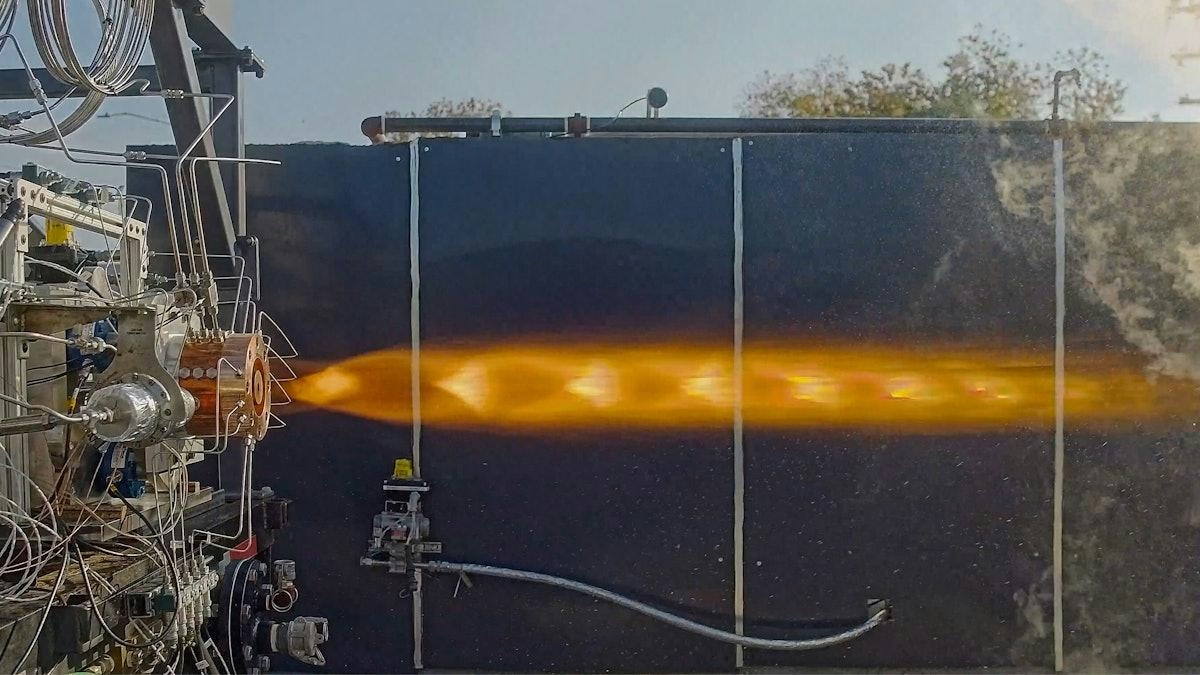
Houston-based startup Venus Aerospace, a pioneer in next-generation rocket propulsion, has secured a strategic investment from Lockheed Martin through its venture capital division, Lockheed Martin Ventures. This collaboration follows Venus Aerospace’s groundbreaking high-thrust test flight of its rotating detonation rocket engine (RDRE) in May 2025, an achievement described by the Houston Chronicle as a “world first” and the most significant advancement in rocket engine technology since the Apollo era.
The partnership was announced at the Axios Future of Defense Summit in Washington, DC, highlighting the increasing synergy between established defense contractors and emerging technology firms. Venus Aerospace remains the sole company globally with a flight-proven, high-thrust RDRE and a clear trajectory toward scaled production.
Advancing Dual-Use Technologies Amid Growing Market Demand
Lockheed Martin’s investment underscores the growing support from defense industry leaders and venture capital for critical dual-use technologies, as global defense and space infrastructure spending is projected to approach $1 trillion by 2040. Sassie Duggleby, Co-founder and CEO of Venus Aerospace, emphasized the significance of the partnership, stating, “Venus has proven in flight the most efficient rocket engine technology in history. With support from Lockheed Martin Ventures, we will advance our capabilities to deliver at scale and deploy the engine that will power the next 50 years of defense, space, and commercial high-speed aviation.”
Chris Moran, Vice President and General Manager of Lockheed Martin Ventures, highlighted the strategic importance of the collaboration, noting, “Next-generation propulsion will define the future of the space and defense industries. We’re exploring potential approaches to scale and integrate Venus’s technology within critical systems.”
Challenges and Market Implications
Despite the promising outlook, Lockheed Martin’s investment presents significant challenges. Scaling production of the RDRE to meet the stringent demands of defense and space applications will require Venus Aerospace to demonstrate consistent reliability and efficiency across diverse operational environments. Additionally, the company faces competition from established propulsion providers, many of whom are likely to intensify their research and development efforts in response to Venus’s advancements.
Market analysts predict that this partnership could stimulate increased investor interest in hypersonic and space propulsion technologies. The global aerospace and defense propulsion systems market, valued at over $260 billion in 2022, is expected to sustain robust growth. The global hypersonics market alone is projected to triple to approximately $12 billion by 2032, driven in part by nearly $4 billion in near-term Pentagon procurement aimed at accelerating innovation.
Venus Aerospace has already raised more than $106 million in funding and claims to have executed the most capital-efficient rocket engine development in history. Its proprietary RDRE and Venus Detonation Ramjet (VDR) form the basis of a scalable, reusable propulsion platform designed for continuous flight from takeoff to hypersonic cruise. This next-generation engine architecture aims to deliver transformative capabilities across defense, space, and commercial high-speed aviation sectors.
As Venus Aerospace advances its technology toward large-scale deployment, industry observers will closely monitor whether the company can sustain its leadership in efficient, high-performance propulsion and how established competitors will respond to this emerging wave of innovation.

Etihad Airways Suspends Airbus A380 Flights on Key Route

Aditya Birla Group Seeks Approval for Aircraft Leasing in GIFT City

Qatar Airways Highlights Innovation and Connectivity at Arabian Travel Market 2026

Hong Kong's Five-Year Plan Includes Andrew Fan's Aircraft Parts Processing Hub Proposal

ACIA Aero Leasing Delivers ATR72-600 to Air Nostrum

RTX Appoints Jill Albertelli as Head of Pratt & Whitney

TAT Technologies Joins Beyond Aero Hydrogen Aircraft Program

AURAK Study Highlights Barriers to Air Taxi Adoption in Emerging Economies

Xiamen Air Selects Altitude for 787 Maintenance at Heathrow

Etihad and Swissport Extend Global Partnership
