
AIによるインサイトを行動へとつなげる

現在のトレンド
Categories
Paul Touw on the Future of Business Aviation Innovation
Paul Touw on the Future of Business Aviation Innovation
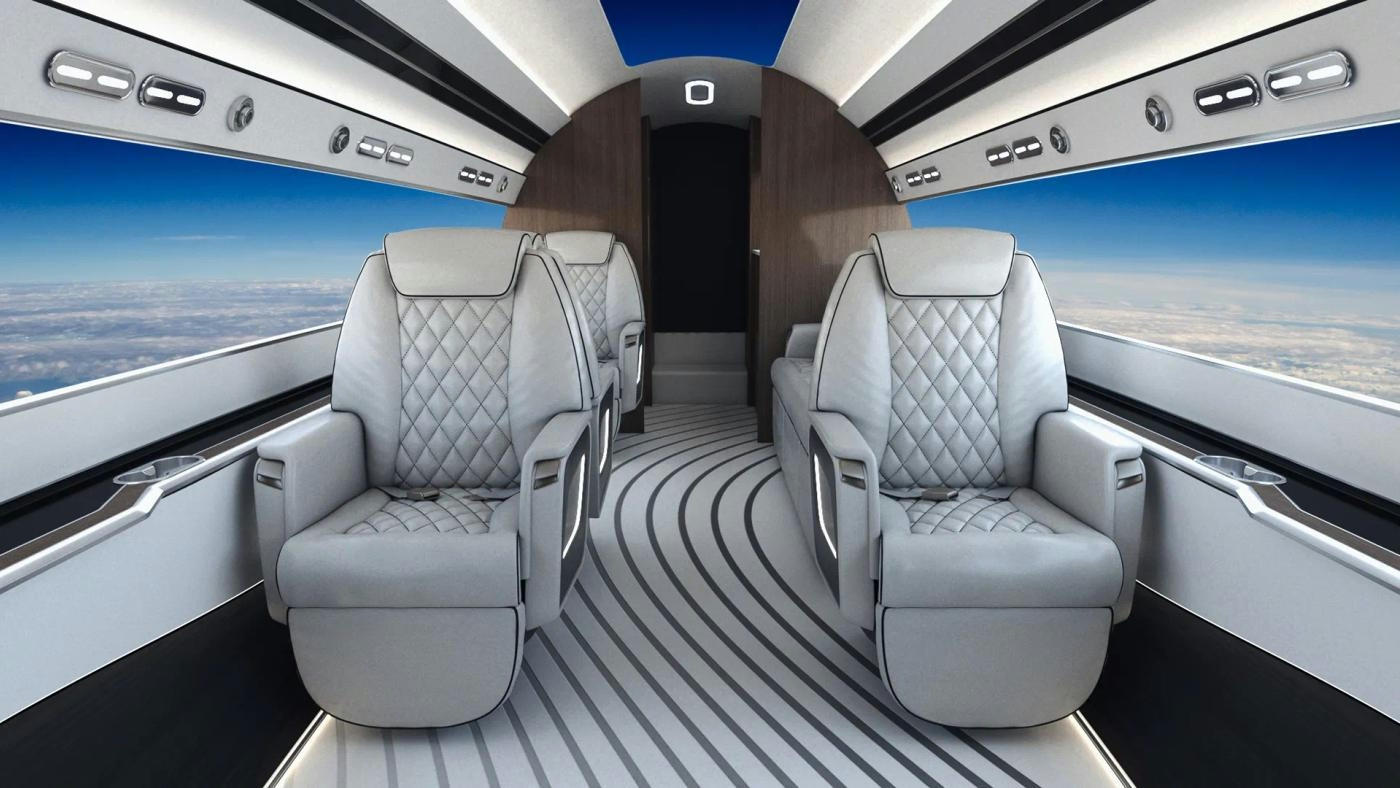
Paul Touw’s distinguished career as an engineer and aerospace entrepreneur encompasses a broad spectrum of achievements, from missile defense programs to influencing national policy. Notably, he contributed to the drafting of the CHIPS and Science Act of 2022, aimed at revitalizing U.S. semiconductor manufacturing. More recently, Touw has emerged as a leading figure in aviation innovation through his role at Otto Aerospace. The company unveiled the Phantom 3500 last year, a next-generation aircraft that incorporates advanced carbon fiber materials and a laminar flow design to significantly reduce weight and emissions.
Innovation Driven by a Silicon Valley Mindset
Touw credits much of Otto Aerospace’s progress to a management philosophy inspired by Silicon Valley, which fosters open-mindedness and encourages experimentation. He emphasizes that “no idea is a bad idea,” citing the intermittent windshield wiper as a classic example of this approach. This culture of innovation has led to several breakthroughs at Otto Aerospace, including the development of a slotted laminar flow wing, digital windows, an elliptical fuselage, and extensive use of carbon fiber composites.
Central to Touw’s vision is the goal of achieving greater fuel efficiency. He asserts, “What I’m proud of and what I think is a model for the future is using a lot less [fuel] to accomplish the mission.” He anticipates that the widespread adoption of laminar flow designs and advanced composite materials will drive the most significant technological transformations in aerospace over the coming decade. Highlighting the industry’s longstanding reliance on aluminum, Touw notes, “People have been building airplanes by hand with cheap aluminum since the 1940s. I think that’s going to shift when we prove you can build laminar flow aircraft easier, with lighter-weight parts, with orders of magnitude fewer parts.”
Rethinking Environmental Solutions and Industry Challenges
Touw challenges the prevailing narrative that alternative fuels alone will resolve aviation’s environmental impact. He argues that the focus on replacing fossil fuels with electric or hydrogen power does not fundamentally reduce overall energy consumption. Instead, he advocates for innovations that reduce the amount of energy required to complete a mission, underscoring the importance of efficiency over fuel substitution.
Despite the promise of these technological advances, the business aviation sector faces significant challenges. Otto Aerospace’s efforts to push the boundaries of aircraft design coincide with complex industry dynamics, including the integration of recent acquisitions such as Varsano’s The Jet Business into Flexjet. This process presents operational and cultural challenges. Moreover, the competitive landscape is intensifying, with new entrants from biopharmaceuticals and healthcare sectors introducing novel products and strategies.
The evolving regulatory and market environment surrounding advanced air mobility (AAM) initiatives adds further complexity. Investor concerns about acquisition success and integration may influence market reactions, while competitors are expected to respond strategically to Flexjet’s expansion and innovation efforts.
Nonetheless, Touw remains optimistic about the future. He believes that embracing new manufacturing techniques and management philosophies will be essential to shaping the next era of business aviation, delivering both environmental benefits and enhanced operational performance.

Etihad and Swissport Extend Global Partnership

Sepehran Airlines B737 Returns to Mashhad After Tyre and Engine Issues

Etihad Deploys Widebody Fleet to Meet Strong Demand

Korean Air Finalizes $36.2 Billion Deal with Boeing

Australia’s RFDS Queensland Section Orders Six King Air 260Cs

Korean Air Finalizes Order for 103 Boeing Jets and Engines

Embraer E195-E2 Features Distinctive Engine Placement Among Regional Jets

What Passengers Can Expect on Boeing’s New 777X Jet

How Ethiopian Airlines Became Africa’s Leading Carrier Amid Gulf Competition

Joby Aviation Extends Autonomous Flight Capabilities with Cross-Country Tour
