
AIによるインサイトを行動へとつなげる

現在のトレンド
Categories
Shield AI Completes Initial Test Aircraft Ahead of X-Bat First Flight
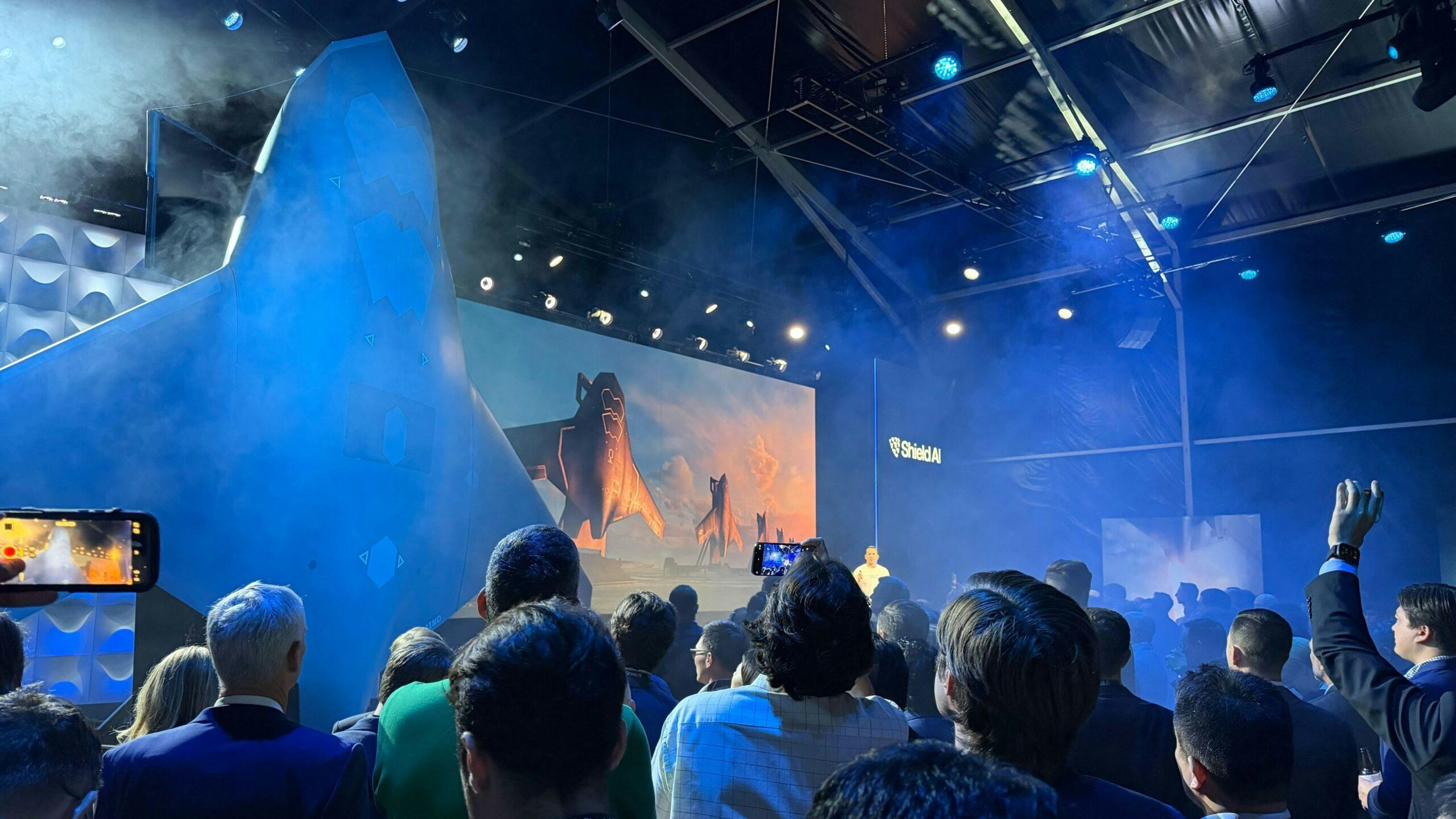
Shield AI Nears Completion of X-Bat Test Aircraft Ahead of Maiden Flight
Shield AI is approaching a significant milestone in its X-Bat collaborative combat aircraft (CCA) program, with the first three test aircraft nearing completion as the company prepares for the jet’s inaugural flight later this year. The autonomous vertical take-off and landing (VTOL) combat jet, designed to operate without a crew, is expected to make its maiden sortie from Shield AI’s Newton, Kansas facility—a former US government test range currently being adapted for the program.
Progress and Testing Plans
At the Eurosatory defense exhibition in Paris, Andrew Hawkes, director of X-Bat campaigns for Europe, confirmed that two prototypes are finished and a third is in the final stages of assembly. He indicated that the first flight is anticipated toward the end of this year, although extensive ground testing remains before takeoff. Initial flight tests will employ a rail-launch system to streamline the process, with the first sorties flown tethered—a rare approach for jet-powered aircraft. This method is intended to validate the X-Bat’s VTOL capabilities, including recovery via the launch rail.
The aircraft’s control during vertical operations will rely on vectored thrust from its main engine, supplemented by additional wingtip thrusters and Shield AI’s proprietary Hivemind autonomous control software. Hawkes emphasized that the primary objective of the upcoming test campaign is data collection to validate the company’s modeling. Following these initial tests, Shield AI plans to transition to conventional wingborne flight testing and expand the aircraft’s performance envelope in early 2027, with avionics and weapons integration scheduled for later that year. The company aims to achieve initial combat capability for the X-Bat by 2029, a timeline described by Hawkes as ambitious but feasible given current resources.
Design, Capabilities, and Market Interest
The X-Bat is powered by a single 30,000-pound-thrust GE Aerospace F110 engine—the same engine used in the Lockheed Martin F-16—and incorporates stealth features. It is designed to carry two weapons on external hardpoints, with additional munitions housed in a conformal weapons bay. Hawkes noted that the aircraft can accommodate cruise missiles up to the size of the Kongsberg Joint Strike Missile or MBDA Storm Shadow, positioning the X-Bat as a strong contender in the CCA market.
Interest from potential customers has been robust, particularly among operators of the Lockheed F-35, with Shield AI reportedly engaged in advanced discussions with several nations. While Hawkes declined to provide specific details, he indicated that an announcement is forthcoming. Notably, recent remarks by Polish President Donald Tusk suggest that Shield AI may establish an X-Bat assembly line and F110 engine maintenance facility in Poland should the country place an order.
Challenges and Competitive Landscape
Despite the program’s momentum, Shield AI faces considerable technical challenges, especially in validating the X-Bat’s VTOL performance. Safety concerns have also been raised following incidents involving the company’s V-BAT drones. These issues have contributed to a mixed market reaction: while some investors and defense sectors remain optimistic about the X-Bat’s autonomous combat capabilities, others are cautious due to past technical and safety problems.
Competition in the autonomous combat aircraft sector is intensifying, with companies such as Anduril and General Atomics securing contracts from the US Air Force for their own autonomous and collaborative combat aircraft prototypes. Shield AI’s positioning of the X-Bat as the world’s first autonomous combat aircraft—rather than merely a collaborative platform—may prompt rivals to adjust their strategies as the race for next-generation air combat dominance accelerates.

Etihad Airways Suspends Airbus A380 Flights on Key Route

Aditya Birla Group Seeks Approval for Aircraft Leasing in GIFT City

Qatar Airways Highlights Innovation and Connectivity at Arabian Travel Market 2026

Hong Kong's Five-Year Plan Includes Andrew Fan's Aircraft Parts Processing Hub Proposal

ACIA Aero Leasing Delivers ATR72-600 to Air Nostrum

RTX Appoints Jill Albertelli as Head of Pratt & Whitney

TAT Technologies Joins Beyond Aero Hydrogen Aircraft Program

AURAK Study Highlights Barriers to Air Taxi Adoption in Emerging Economies

Xiamen Air Selects Altitude for 787 Maintenance at Heathrow

Etihad and Swissport Extend Global Partnership
