
Orchestrate AI insights into action

Trending
Categories
3D Printing Advances Transform Aerospace Manufacturing
3D Printing Advances Transform Aerospace Manufacturing
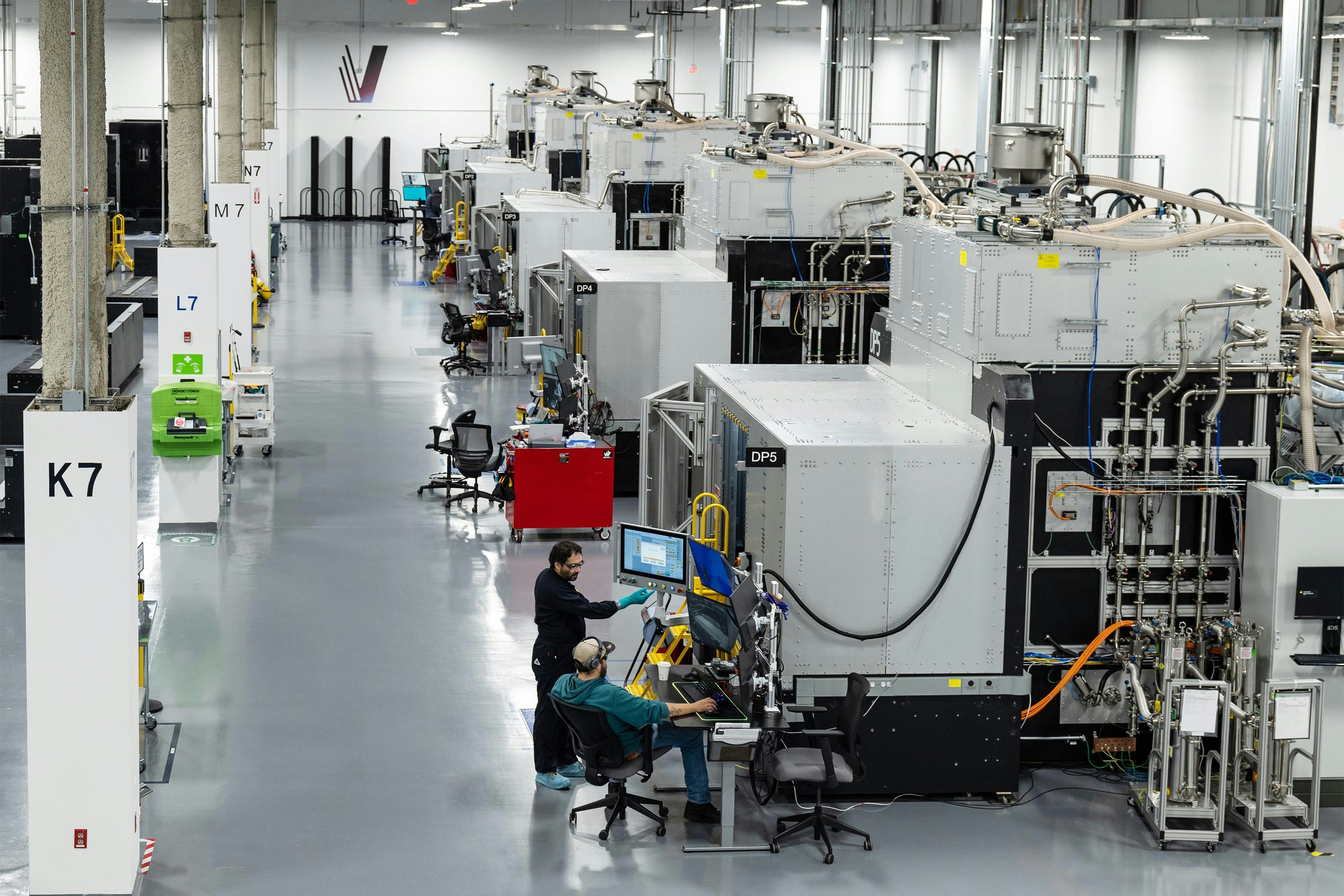
The aerospace industry, historically characterized by its emphasis on precision and innovation, is experiencing a profound transformation in manufacturing driven by advances in 3D printing technology. Once primarily a tool for prototyping, additive manufacturing has matured into a fundamental industrial process, fundamentally altering the design and production of aircraft, spacecraft, and defense systems.
Recent market analyses project the Aerospace 3D Printing Market to expand dramatically, growing from an estimated US$3.83 billion in 2025 to US$14.04 billion by 2034. This represents a compound annual growth rate of 15.53% between 2026 and 2034, reflecting not only rapid market growth but also a significant shift in aerospace manufacturing paradigms.
The Appeal of Additive Manufacturing in Aerospace
Additive manufacturing constructs components layer by layer using materials such as metals, polymers, and composites, enabling the fabrication of complex geometries that are often unattainable through traditional machining methods. This design flexibility is particularly valuable in aerospace, where reducing weight without compromising safety and durability is paramount. Engineers are increasingly able to produce topology-optimized parts that strategically use material only where necessary, resulting in components that are lighter, stronger, and more efficient.
Beyond weight reduction, 3D printing accelerates prototyping cycles, facilitates rapid design iterations, minimizes material waste, and supports on-demand production. These advantages are critical in an industry where delays can incur substantial costs. The technology is applied across a range of components, from engine brackets and interior ducts to structural fittings and repair parts for aging fleets, delivering both speed and precision.
Market Dynamics and Industry Challenges
The drive for lightweight, high-performance components is a key factor propelling the adoption of 3D printing in aerospace. Traditional manufacturing often involves assembling multiple parts, whereas additive manufacturing can consolidate these into single, integrated components. This consolidation reduces assembly complexity, lowers the risk of failure, and enhances overall reliability—essential qualities for parts operating under the extreme conditions typical of aerospace environments.
Commercial airlines recognize the long-term benefits of lighter aircraft, which contribute to reduced fuel consumption, improved route economics, and lower emissions. As sustainability becomes an increasingly critical objective, additive manufacturing aligns closely with environmental goals.
Nevertheless, the integration of 3D printing into aerospace manufacturing faces significant challenges. Rigorous validation and certification processes are necessary to ensure the reliability and safety of 3D-printed components. Meeting stringent regulatory standards remains a major obstacle to the widespread adoption of additive manufacturing in mission-critical aerospace applications.
Industry Investment and Future Prospects
The promising market potential has spurred heightened investment and competition within the aerospace sector. Companies are accelerating their adoption of 3D printing technologies to reduce production costs and shorten lead times. For instance, GE Aerospace has committed $1 billion to expanding U.S. manufacturing capabilities and advancing 3D metal printing technologies. Similarly, firms such as Divergent are utilizing additive manufacturing to develop sophisticated defense systems, highlighting the strategic importance of this technology.
As the aerospace industry confronts increasing demands for efficiency, resilience, and sustainability, 3D printing is evolving from a supplementary innovation into a strategic imperative, poised to redefine the future landscape of aerospace manufacturing.

Etihad Airways Suspends Airbus A380 Flights on Key Route

Aditya Birla Group Seeks Approval for Aircraft Leasing in GIFT City

Qatar Airways Highlights Innovation and Connectivity at Arabian Travel Market 2026

Hong Kong's Five-Year Plan Includes Andrew Fan's Aircraft Parts Processing Hub Proposal

ACIA Aero Leasing Delivers ATR72-600 to Air Nostrum

RTX Appoints Jill Albertelli as Head of Pratt & Whitney

TAT Technologies Joins Beyond Aero Hydrogen Aircraft Program

AURAK Study Highlights Barriers to Air Taxi Adoption in Emerging Economies

Xiamen Air Selects Altitude for 787 Maintenance at Heathrow

Etihad and Swissport Extend Global Partnership
