
Orchestrate AI insights into action

Trending
Categories
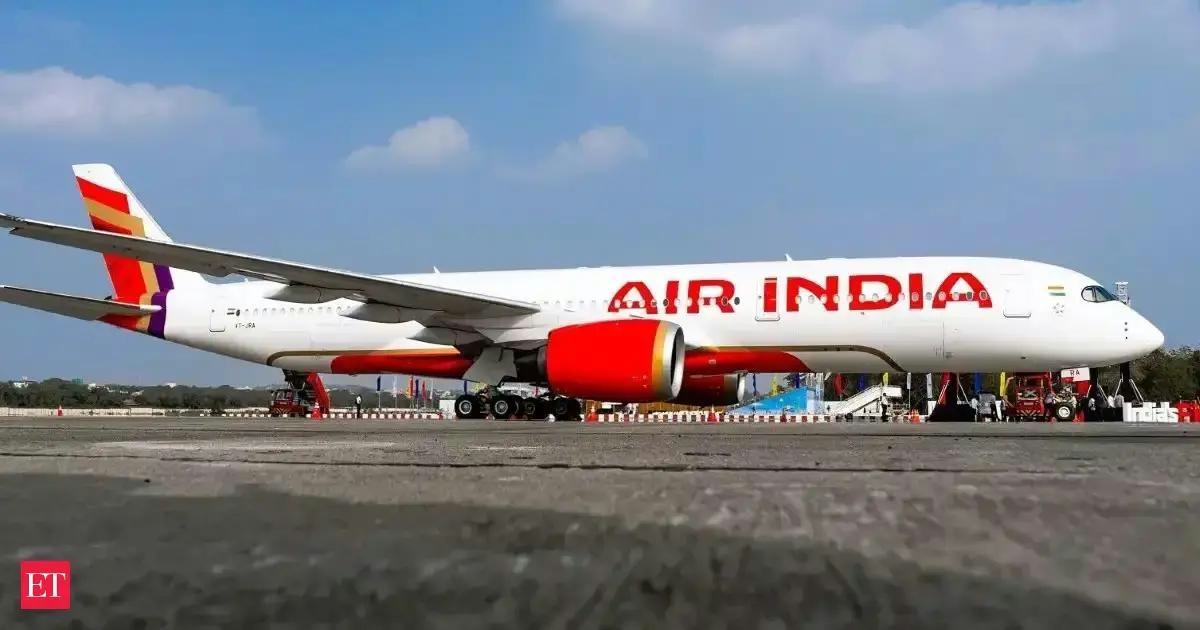
Air India Adopts AI to Improve Operational Efficiency and Cut Costs
Air India Adopts AI to Improve Operational Efficiency and Cut Costs
Since its acquisition by the Tata Group in January 2022, Air India has embarked on a comprehensive technological transformation aimed at revitalizing its operations. Central to this strategy is the adoption of artificial intelligence (AI), which the airline views as a critical tool to enhance operational efficiency, elevate customer service, increase revenues, and reduce costs. This shift marks a significant departure from the airline’s previous state, which was characterized by minimal technological infrastructure.
Technological Overhaul and AI Integration
Satya Ramaswamy, Chief Digital & Technology Officer at Air India, emphasized the rapid pace of the airline’s digital overhaul. At the time of privatization, Air India had “practically nothing” in terms of modern technology, a factor that allowed the company to implement new AI-driven systems without the constraints of legacy platforms. Among the most notable advancements is the deployment of a generative AI-based virtual agent, AI.g, which now manages approximately half of all customer interactions. This innovation has led to significant reductions in contact center expenses.
Beyond customer service, AI applications have been extended to employee support, engineering, and operational functions. Ramaswamy noted that the airline collaborated closely with its executive leadership to identify AI initiatives that prioritize cost reduction tailored to the specific needs of each department. Additionally, AI has been instrumental in ensuring regulatory compliance. For instance, when Air India introduced revised Flight Duty Time Limitations (FDTL) for pilots, generative AI was employed to validate the alignment between Directorate General of Civil Aviation (DGCA) regulations, internal policies, and software implementations. This process, previously unattainable, enhanced accuracy and completeness while generating comprehensive test cases to prevent violations.
The airline currently utilizes three categories of AI: predictive, generative, and agentic. Ramaswamy, who holds multiple patents, revealed that Air India is exploring agentic coding to accelerate in-house software development, further driving down operational costs.
Challenges and Industry Context
Despite the promising benefits, Air India’s AI adoption faces several challenges. Integrating new technologies with existing systems, safeguarding data privacy and security, and managing workforce transitions remain significant obstacles. Employee resistance to new workflows is also a concern. Public reception has been mixed, with some passengers expressing skepticism about AI’s expanding role in customer service. Meanwhile, competitors are likely to intensify their own AI initiatives to maintain market competitiveness.
The broader industry landscape reflects the complexities of AI integration. For example, Meta’s recent decision to cut 8,000 jobs while investing heavily in AI underscores the delicate balance between cost reduction and technological advancement. In the hospitality sector, Marriott’s approach in India has focused on augmenting staff capabilities through AI rather than replacing personnel, illustrating a cautious and measured adoption of new technologies.
As Air India advances its digital transformation, its experience underscores both the potential and the challenges inherent in leveraging AI to enhance efficiency and redefine the future of aviation in India.

Etihad Airways Suspends Airbus A380 Flights on Key Route

Aditya Birla Group Seeks Approval for Aircraft Leasing in GIFT City

Qatar Airways Highlights Innovation and Connectivity at Arabian Travel Market 2026

Hong Kong's Five-Year Plan Includes Andrew Fan's Aircraft Parts Processing Hub Proposal

ACIA Aero Leasing Delivers ATR72-600 to Air Nostrum

RTX Appoints Jill Albertelli as Head of Pratt & Whitney

TAT Technologies Joins Beyond Aero Hydrogen Aircraft Program

AURAK Study Highlights Barriers to Air Taxi Adoption in Emerging Economies

Xiamen Air Selects Altitude for 787 Maintenance at Heathrow

Etihad and Swissport Extend Global Partnership
