Image

AeroGenie — Your Intelligent Copilot.

Ask anything. Analyze everything. Act instantly.

Trending

Categories

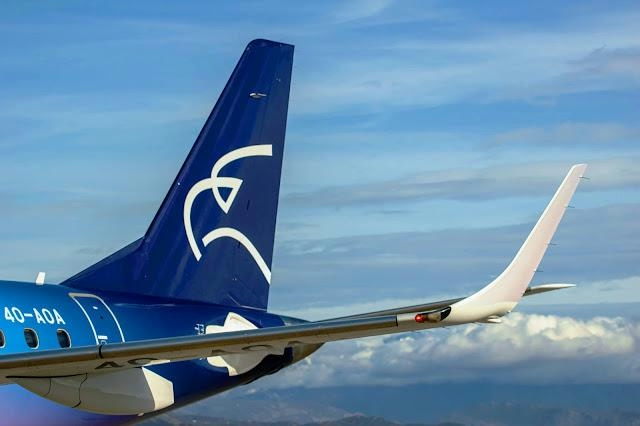
Air Montenegro Launches Omnichannel Center and Plans AI Integration
April 10, 2026By ePlane AI
Air Montenegro Launches Omnichannel Center and Plans AI Integration
0
0
Air Montenegro
AI Integration
Omnichannel Customer Service

Air Montenegro Launches Omnichannel Contact Center with AI Integration

Air Montenegro has unveiled a new omnichannel contact center, significantly broadening its customer service capabilities by incorporating popular messaging platforms such as WhatsApp, Viber, Facebook, and Instagram alongside traditional phone and email support. In tandem with this expansion, the airline introduced an AI-powered chatbot designed to manage routine inquiries, with plans to deploy AI voice agents in the near future.

Enhancing Customer Service Through Artificial Intelligence

The airline emphasized that the integration of artificial intelligence aims to streamline customer interactions by handling common questions related to flight schedules, baggage policies, and other standard concerns. This approach is intended to free human agents to focus on more complex passenger issues that require empathy and nuanced support. Air Montenegro stated, “AI is here to handle hundreds of routine inquiries... allowing our human agents in the contact centre to focus on more complex passenger issues and provide the level of empathy and support that machines cannot. The goal is simple: 24/7 availability, seven days a week, with no waiting on the line.”

This initiative follows the recent launch of Air Montenegro’s revamped website and mobile application, as well as the introduction of online and mobile check-in options, reflecting a broader strategy of digital transformation within the airline.

Navigating a Competitive and Evolving Industry Landscape

Air Montenegro’s adoption of AI-driven customer service solutions comes amid a rapidly evolving competitive environment. Established technology providers such as Epic Agent Factory and RingCentral have already integrated advanced AI capabilities into their platforms, raising expectations for customer engagement and operational efficiency across the sector. Industry analysts note that reactions to such investments remain mixed, with ongoing debates about the measurable return on investment for AI initiatives—a topic that featured prominently during recent discussions at HIMSS26.

Competitors are likely to respond with similar AI enhancements to maintain market share, as exemplified by Microsoft’s extensive AI integration efforts. Meanwhile, the broader aviation and technology industries are contending with the implications of AI adoption, including workforce reductions, such as those recently announced by Crypto.com. These developments highlight the challenges airlines like Air Montenegro face in balancing technological innovation with operational costs and workforce management.

As Air Montenegro advances its digital transformation, the airline seeks to provide seamless, round-the-clock support to passengers while addressing the complexities and competitive pressures associated with AI integration in the aviation sector.

More news
Flight Delays Reveal $34 Billion Crisis in Global Aviation

Flight Delays Reveal $34 Billion Crisis in Global Aviation

Flight Delays Reveal $34 Billion Crisis in Global Aviation Flight disruptions, once regarded as occasional inconveniences during peak travel periods, have now exposed a profound and costly crisis within the global aviation industry. Recent analyses indicate that delays and cancellations in the United States alone impose an economic burden of up to $34 billion annually. This staggering figure underscores the extensive scale of the problem and its wide-ranging implications for the sector and the broader economy. Economic and Operational Challenges Research supported by both industry and government entities reveals that flight delays and cancellations in the U.S. generate an economic impact estimated between $30 billion and $34 billion each year. This assessment encompasses direct costs borne by airlines, including passenger compensation, rebooking expenses, and lost time, as well as secondary effects on related sectors such as hotels, car rentals, and local businesses. In the aftermath of the pandemic, air travel demand has rebounded strongly, with passenger volumes in some markets surpassing pre-2019 levels. However, the capacity of fleets, crews, airspace, and airport infrastructure has not expanded correspondingly. This imbalance has rendered the system increasingly fragile, where even minor disruptions can cascade into widespread operational gridlock. For travelers, this translates into heightened risks of missed connections, extended airport layovers, and lost baggage. Airlines and airports face shrinking profit margins as they contend with the costs of contingency staffing, spare aircraft positioning, and compensation claims, all of which steadily erode operational resilience. The $34 billion figure highlights that flight disruption has evolved into a central economic and operational challenge for the aviation industry. Environmental and Regulatory Pressures Beyond economic costs, flight disruptions carry significant environmental consequences. Studies submitted to U.S. regulators estimate that delays and cancellations contribute millions of additional tons of carbon emissions annually. These emissions result from aircraft being rerouted, held in holding patterns, or repositioned empty to maintain schedules. This environmental toll complicates airlines’ efforts to meet climate commitments and raises concerns about the sector’s capacity to achieve long-term decarbonization goals amid persistent operational challenges. The crisis is further exacerbated by supply chain constraints and aging aircraft fleets. A joint analysis by the International Air Transport Association (IATA) and industry consultants projects that supply chain disruptions will add over $11 billion in extra costs for airlines in 2025 alone. Delays in aircraft and engine deliveries, driven by shortages of skilled labor, specialized materials, and critical components, are forcing airlines to extend the service life of older, less fuel-efficient jets. IATA reports a record backlog exceeding 17,000 commercial aircraft orders, which delays anticipated improvements in fuel efficiency and contributes to rising operational costs. Market Dynamics and Consumer Impact The structural vulnerabilities of the aviation industry are also influencing global travel patterns. The sector’s heavy reliance on a limited number of major carriers has intensified the risk of widespread disruption. This concentration has attracted increased scrutiny from competition and consumer protection authorities, alongside ongoing regulatory investigations into potential anti-competitive practices by dominant players. In response to escalating costs, airlines have raised airfares, while travelers contend with longer security lines and potential delays caused by staffing shortages at agencies such as the Transportation Security Administration. Meanwhile, competitors are pursuing expansion and new partnerships in an effort to mitigate the impact of delays and disruptions. Despite these efforts, the underlying challenges remain formidable. As the aviation sector confronts these interconnected pressures, flight disruption has transcended its status as a temporary inconvenience to become a defining challenge for the industry’s future.
Indonesia’s Eve Air Mobility Completes 50th Successful eVTOL Test Flight

Indonesia’s Eve Air Mobility Completes 50th Successful eVTOL Test Flight

Indonesia’s Eve Air Mobility Completes 50th Successful eVTOL Test Flight Eve Air Mobility, a prominent player in the electric vertical take-off and landing (eVTOL) industry, has reached a significant milestone by completing its 50th successful test flight of a full-scale engineering prototype. This achievement marks a crucial advancement for urban air mobility (UAM) in Indonesia and the wider region, underscoring the company’s commitment to developing sustainable electric air transportation solutions tailored for rapidly expanding urban centers. Announced in April 2026, the milestone reflects Eve’s ongoing efforts to transform urban travel through innovative technology. Operating in collaboration with Embraer, Eve Air Mobility seeks to revolutionize air travel by providing efficient, low-emission alternatives to conventional transportation methods. The company’s eVTOL technology is gaining increasing attention amid growing global demand for sustainable mobility options, particularly in densely populated cities grappling with congestion and environmental challenges. Significance of the 50th Test Flight The completion of the 50th test flight represents more than a numerical achievement; it signifies substantial engineering progress and a steadfast commitment to meeting the stringent certification standards required for eVTOL aircraft. Conducted at the Gavião Peixoto facility in Brazil, the test campaign has accumulated over two hours of flight time, generating vital data to enhance aircraft design and operational performance. These rigorous tests are essential for securing the certifications necessary to bring eVTOL aircraft to market and to introduce viable UAM solutions within Indonesia. The successful flights also demonstrate the operational feasibility of eVTOL aircraft in urban settings, a critical consideration for adoption in major Indonesian cities such as Jakarta and Bali. These metropolitan areas, burdened by chronic traffic congestion and escalating environmental concerns, stand to benefit significantly from the introduction of rapid, sustainable, and efficient air travel alternatives. Industry Momentum and Emerging Challenges Eve Air Mobility’s progress occurs amid a broader surge of momentum within the eVTOL sector. The company has secured funding through 2028, ensuring sustained development and positioning itself to capitalize on Indonesia’s strategic push toward greener transportation solutions. Market responses have been largely positive, reflecting confidence in Eve’s capacity to realize its vision. Nonetheless, as eVTOL developers worldwide approach commercial deployment, the industry faces emerging challenges. Experts have highlighted the potential for maintenance and repair operations (MRO) bottlenecks, which could hinder the pace of deployment and affect the reliability of these advanced aircraft. Additionally, competition remains intense, with rivals such as Archer Aviation and Joby Aviation embroiled in legal disputes over business relationships and contracts, underscoring the high stakes involved in the rapidly evolving UAM market. Advancing Sustainable Aviation in Indonesia Indonesia, as a leading nation in Southeast Asia, is actively embracing innovative technologies to address urban mobility and sustainability objectives. Government initiatives aimed at reducing carbon emissions and enhancing transportation infrastructure align closely with the promise offered by eVTOL aircraft. The potential impact of these vehicles is particularly significant in metropolitan areas characterized by heavy traffic and air pollution. Eve Air Mobility’s continued advancements not only further its own ambitions but also support Indonesia’s broader goals of modernizing transportation networks and mitigating environmental impact. As the company moves closer to commercial deployment, its achievements signal a transformative shift in urban travel within Indonesia’s major cities in the near future.
American Airlines Cargo Plans Expanded Operations at Heathrow

American Airlines Cargo Plans Expanded Operations at Heathrow

American Airlines Cargo Expands Operations at Heathrow Amid Industry Challenges American Airlines Cargo is preparing to significantly increase its presence at London Heathrow Airport this summer, seeking to leverage rising transatlantic demand despite persistent difficulties in the global air cargo sector. The airline intends to operate up to 186 international widebody flights daily, amounting to approximately 4,400 monthly widebody flights between the United States and Europe during June, July, and August. Heathrow will experience the most notable growth, with daily cargo departures rising to 21, enhancing direct connections to major US hubs and expanding cargo capacity. Expanded Routes and Network Enhancements The summer schedule introduces new and expanded routes, including services from Athens to Dallas Fort Worth (DFW), Budapest and Prague to Philadelphia, Zurich to DFW, Milan to Miami, and Edinburgh to New York JFK, the latter operated by the new A321XLR aircraft. Additional widebody flights within Germany will strengthen the network, featuring daily service from Frankfurt to both Charlotte and DFW, as well as from Munich to Charlotte, facilitating cargo flows across Central Europe. In Latin America, increased flights from Buenos Aires to DFW are expected to improve cargo access between South America and American’s central US hub. Domestically, American Airlines will focus its summer operations at DFW, with peak days seeing more than 6,200 total domestic departures. Widebody services from Honolulu and Kahului to DFW will further enhance connectivity between the Pacific region and the US mainland, providing additional options for efficient cargo movement within the carrier’s domestic network. Navigating a Complex Global Landscape American Airlines’ expansion occurs amid a challenging global environment. The air cargo industry is contending with fluctuating demand and pricing pressures, driven by a recent slowdown in global trade and reduced e-commerce shipments from China. Geopolitical tensions, including the ongoing conflict involving Iran, have disrupted key cargo hubs, introducing further uncertainty to international operations. Competitors are also adapting to these shifting market conditions. For instance, the Federal Aviation Administration’s decision to freeze expansion at Chicago O’Hare may affect United Airlines’ cargo operations, potentially prompting the airline to seek alternative routes. Additionally, the aviation sector faces heightened regulatory scrutiny over anti-competitive practices, exemplified by investigations such as the recent probe into MakeMyTrip in India. Despite these headwinds, American Airlines Cargo remains confident in its strategy. Roger Samways, vice president of commercial at American Airlines Cargo, stated, “With expanded trans-Atlantic flying, new international routes, and strong domestic connectivity, we are well positioned to support global supply chains throughout the summer season.” As American Airlines advances its ambitious summer schedule, industry observers will closely monitor how the carrier manages the opportunities and challenges shaping the global air cargo market.
Supply Constraints Limit Commercial Aviation Growth in 2026

Supply Constraints Limit Commercial Aviation Growth in 2026

Supply Constraints Limit Commercial Aviation Growth in 2026 The commercial aviation industry is set to enter 2026 with strong demand and stable profitability, yet it faces a significant challenge: growth is increasingly constrained by persistent supply limitations. Global passenger volumes are expected to exceed all previous records, with nearly 5.2 billion travelers projected to fly in 2026, according to the International Air Transport Association (IATA). Despite this robust demand, airlines are struggling to keep pace due to production bottlenecks, reliability issues, and a maintenance, repair, and overhaul (MRO) sector operating at full capacity. Demand Outpaces Supply Amidst Industry Challenges Load factors are forecast to reach a record 83.8%, highlighting how fully booked aircraft will be as supply struggles to meet demand. Even in the face of geopolitical uncertainties, regulatory pressures, and ongoing supply chain disruptions, the industry is expected to generate a net profit of $41 billion in 2026. This figure represents a slight increase from the previous year and demonstrates remarkable resilience given recent market turbulence. However, these optimistic headline numbers conceal a more persistent problem: the global fleet is insufficient to satisfy current and near-term demand. Airlines are grappling with a “missing fleet” of over 5,300 aircraft compared to pre-pandemic delivery projections, as reported by IATA. This shortfall, reflecting several years of lost production, is unlikely to be resolved before 2031 to 2034. The backlog of orders exceeds 17,000 aircraft, equating to nearly 12 years of production at current manufacturing rates. Manufacturing Bottlenecks and Widebody Aircraft Pressures Although Airbus and Boeing increased deliveries in 2025—delivering 793 and 600 aircraft respectively—these improvements are tempered by ongoing challenges. Boeing continues to face heightened regulatory scrutiny following recent quality incidents, which restrict its ability to accelerate production. Airbus has encountered supplier-related disruptions and quality inspections that slowed output toward the end of 2025. Consequently, capacity growth is now largely dictated by manufacturers’ production capabilities, with even modest delivery gains insufficient to overcome the structural shortage of aircraft and engines. Widebody aircraft are experiencing particularly acute supply pressures. IATA Director General Willie Walsh has emphasized persistent supply chain difficulties in widebody freighter manufacturing. Industry analyst Julia Seiermann forecasts continued constraints on widebody airfreight capacity due to the substantial order backlog. Andreas Blanchi of LATAM Cargo anticipates further capacity challenges as the slow pace of new aircraft deliveries forces airlines to extend the operational life of older freighters beyond initial plans. Business Jets and Long-Term Supply Outlook The business jet sector is also affected by these supply constraints. Dassault’s recent introduction of the Falcon 10X highlights the market’s growth potential, yet production and completion bottlenecks remain, despite some easing of supply chain pressures. Looking forward, the aviation titanium alloy market is projected to grow steadily through 2035, driven by the production of next-generation aircraft. This trend suggests a gradual improvement in supply chains over the long term. Nevertheless, for the foreseeable future, the commercial aviation industry’s expansion remains fundamentally limited by production and supply chain challenges—a dynamic unlikely to be resolved before the next decade.
UEC-Saturn Develops Method to Prevent Aircraft Engine Damage

UEC-Saturn Develops Method to Prevent Aircraft Engine Damage

UEC-Saturn Develops Method to Prevent Aircraft Engine Damage Innovative Safety Device Targets Turbine Overspeed Engineers at UEC-Saturn, a prominent aerospace enterprise based in Rybinsk, have introduced a novel device designed to safeguard gas turbine engines by cutting off the fuel supply before a hazardous turbine overspeed occurs. This proactive mechanism aims to prevent catastrophic engine failures during emergencies, where rapid intervention is crucial. The newly developed protection system, officially registered in the FIPS database in March 2026, addresses a critical vulnerability in gas turbine engines: shaft breakage. In such scenarios, the compressor loses its power source, causing the turbine to accelerate uncontrollably and potentially destroy the engine within seconds. Unlike conventional safety systems that activate only after overspeed has begun, UEC-Saturn’s device intervenes earlier by detecting displacement of the compressor rotor. Mechanism and Integration The device functions by monitoring the position of the compressor rotor. When displacement occurs, the rotor disk makes contact with an integrated current conductor, breaking the electrical circuit. This action immediately triggers a command to shut off the fuel supply, halting the engine before it enters an emergency mode. Furthermore, the system introduces a mechanical braking effect through increased friction between the displaced rotor and the stator, which helps reduce the turbine’s rotational speed. A significant advantage of this method is its compatibility with existing gas turbine engines. UEC-Saturn highlights that the device can be incorporated without extensive redesigns, offering a practical upgrade path for current engine installations. Challenges and Industry Implications Despite its potential, the widespread adoption of this technology faces several hurdles. Regulatory approval will be essential, as aviation authorities must certify the new safety mechanism. Additionally, integrating the device into established engine maintenance protocols will require careful coordination to ensure reliability and compliance. Industry stakeholders will closely evaluate the device’s effectiveness under real-world operating conditions and its cost-efficiency relative to existing protection methods. Market response is anticipated to be favorable, particularly among airlines seeking to enhance safety while reducing maintenance expenses. The introduction of this technology may also prompt competitors to accelerate the development of similar or improved engine protection systems, thereby intensifying innovation within the sector. Context Within UEC-Saturn’s Portfolio UEC-Saturn operates as a key enterprise within the United Engine Corporation (UEC) and is known for producing the PD-8 aircraft engine, which powers the domestically developed "Superjet." In December 2025, the PD-8 successfully passed rigorous fan blade failure tests, confirming the robustness of its housing and underscoring UEC-Saturn’s commitment to safety and reliability. As the aviation industry continues to emphasize operational safety and cost-effectiveness, UEC-Saturn’s new engine protection method represents a noteworthy advancement. Its ultimate impact will depend on regulatory acceptance, successful integration, and demonstrated performance in operational environments.
US and China Unsuccessful in Replicating Tu-160 Engine

US and China Unsuccessful in Replicating Tu-160 Engine

US and China Unable to Replicate Russian Tu-160 Engine Technology The United States and China have both endeavored to replicate the Russian NK-32 engine, which powers the Tu-160 "White Swan" strategic bomber, but have so far failed to match its advanced capabilities. The NK-32 is widely regarded as a remarkable achievement in global aviation, often described as a "dazzling pearl" within the industry due to its exceptional performance. Challenges in Replicating the NK-32 The NK-32 engine is distinguished by its ability to maintain stable power output under extremely high temperatures and pressures—conditions that have consistently challenged American and Chinese engine manufacturers. While the US initially explored the possibility of copying the NK-32, it ultimately abandoned the effort after recognizing the difficulty of reproducing the engine’s unique performance characteristics. Most American power units continue to struggle with sustaining high thrust in such demanding environments. Russia regards the NK-32 as a strategic asset and has refused to export the engine, even to close partners such as China. This policy has further restricted access to the technology and contributed to the difficulties faced by other nations in developing comparable engines. Although China has made significant progress in enhancing the power and efficiency of its modern engines, they still lag behind Russian models in terms of resistance to high temperatures and overall reliability. Broader Implications for Military Technology Development The inability of the US and China to replicate the NK-32 has wider implications for their military technology development. For the US, this technological gap could lead to delays in key defense programs, such as the T-7A trainer aircraft, which has already encountered testing setbacks and uncertainty regarding production timelines. Maintaining a technological edge may require the US to intensify efforts to secure advanced technologies and strengthen international partnerships. China, meanwhile, faces questions about its status as an emerging leader in military technology. Failures in some of its exported defense systems, including radar and air defense networks, have revealed vulnerabilities during recent military operations. These challenges may prompt China to accelerate its push for indigenous technological development and reduce reliance on foreign components. The NK-32 engines are produced at the ODK-Kuznetsov plant in Russia’s Samara region, with production orders secured through 2027, according to Deputy General Director Oleg Vydumlev. As global competition in military aviation intensifies, the Russian engine’s unmatched performance continues to set a high standard for other nations seeking to advance their strategic capabilities.
Airbus A350 Completes 18-Hour Nonstop Flight in 2026

Airbus A350 Completes 18-Hour Nonstop Flight in 2026

Airbus A350 Achieves Record-Breaking 18-Hour Nonstop Flight in 2026 In a significant milestone for commercial aviation, the Airbus A350 completed an unprecedented 18-hour nonstop flight covering 19,000 kilometers in 2026. This achievement represents a transformative advancement in ultra-long-haul air travel, enabling airlines to operate routes previously deemed unfeasible and enhancing connectivity between distant continents with remarkable efficiency. Engineering Innovations Driving Performance Central to the A350’s success is its cutting-edge engineering. The aircraft features a lightweight carbon-fiber composite fuselage, which reduces structural weight by up to 25 percent compared to conventional aluminum designs. This innovation, combined with next-generation propulsion systems and refined aerodynamic features, allows the A350 to operate at the limits of its performance capabilities. The aircraft’s systems are meticulously optimized for efficiency: engines are calibrated to minimize fuel consumption, avionics continuously monitor atmospheric conditions in real time, and the fly-by-wire control system dynamically adjusts control surfaces to reduce drag and maximize lift. Flight planning for such extended journeys incorporates advanced meteorological data, enabling pilots to harness favorable wind currents and jet streams that significantly shorten travel times. Airlines are also adapting cabin layouts to support longer ranges, often by reducing seat numbers, streamlining galley equipment, and optimizing onboard supplies. Even minor weight savings—such as lighter insulation materials or improved cargo ventilation—contribute to extending the aircraft’s operational range by hundreds of kilometers. Fuel management plays a critical role in sustaining the A350’s endurance. With a fuel capacity of approximately 138,000 liters—equivalent to about half of the aircraft’s maximum takeoff weight—fuel is strategically distributed across multiple tanks to maintain an optimal center of gravity. Engineers have specified the use of high-energy-density aviation fuel to maximize thermal energy output during flight, while every structural element undergoes rigorous evaluation to identify potential weight reductions. Addressing Technical Challenges and Market Impact The A350’s design also addresses the thermal and aerodynamic challenges inherent in ultra-long-haul flights. Its wings and fuselage are engineered to maintain laminar airflow, thereby reducing energy losses caused by turbulence. Meanwhile, cabin pressurization and climate control systems are tailored to ensure passenger comfort throughout prolonged altitude changes and extended flight durations. This breakthrough has intensified competition within the aviation industry. Boeing and other manufacturers are anticipated to respond with their own long-range aircraft models, escalating the race for fuel-efficient, ultra-long-haul solutions. Airlines have demonstrated strong interest in the A350 platform; for instance, Atlas Air Worldwide has committed to acquiring up to 40 A350 freighters, reflecting robust market confidence. Competitors are also enhancing their services, with carriers such as All Nippon Airways planning substantial cabin upgrades to attract long-haul passengers. The A350’s influence is particularly pronounced on expanding China-Europe routes, where Chinese carriers like China Eastern are capitalizing on the aircraft’s extended range and efficiency to offer more direct flights, thereby gaining a competitive advantage. As the Airbus A350 establishes new benchmarks for endurance and operational efficiency, it is reshaping the landscape of global air travel and driving innovation across the aviation sector. For those seeking detailed technical information, the FAA’s official aircraft certification database provides comprehensive specifications.
Joby Aviation’s AI Air Taxi Push Tests Early-Stage Investor Expectations

Joby Aviation’s AI Air Taxi Push Tests Early-Stage Investor Expectations

Joby Aviation’s AI Air Taxi Initiative Challenges Early-Stage Investor Expectations Joby Aviation (NYSE: JOBY) is intensifying its efforts to introduce electric air taxis into the U.S. airspace by collaborating with Air Space Intelligence to incorporate AI-supported airspace management within the National Airspace System. This initiative is bolstered by Joby’s selection for the White House-backed eVTOL Integration Pilot Program, which authorizes early operations across 12 states. This positioning places Joby at the forefront of the rapidly developing electric vertical takeoff and landing (eVTOL) market. Advancing AI-Driven Airspace Management Joby’s strategy centers on providing short-haul, on-demand air taxi services amid ongoing regulatory and industry deliberations about integrating eVTOL aircraft into everyday air travel and urban mobility frameworks. The partnership with Air Space Intelligence aims to merge Joby’s air taxi technology with AI-driven traffic management systems, a crucial advancement as the Federal Aviation Administration (FAA) continues to formulate new safety regulations under its eVTOL Integration Pilot Program. This program spans 26 states and counts Joby as a key participant, underscoring the company’s influential role in shaping the future of urban air mobility. Regulatory and Legal Challenges Despite these promising developments, Joby faces significant challenges. The company is currently conducting flight tests on its first FAA-compliant aircraft as part of the Type Inspection Authorization process, a critical step toward full certification. Concurrently, Joby is embroiled in legal disputes with competitor Archer Aviation, which has accused Joby of fraud and misrepresenting its business relationships with Chinese entities to secure U.S. contracts. Archer alleges that Joby concealed these ties and misrepresented its operations, claims that Joby has sought to dismiss through federal court. Investor Sentiment and Market Performance Investor sentiment remains cautiously optimistic amid these regulatory and legal complexities. Following recent FAA announcements, Joby’s stock has demonstrated resilience, even as the broader market evaluates the risks and potential of early-stage eVTOL ventures. Currently, Joby shares trade at approximately $8.28, about 30% below the consensus analyst target of $11.90. This valuation reflects the balance between the company’s promising technological advancements and the uncertainties surrounding its path to commercial viability. Key factors influencing investor outlook include Joby’s regulatory progress through government-backed pilot programs, which could shape future infrastructure and customer expectations for electric air taxis. Additionally, the competitive landscape, marked by ongoing legal disputes and rising competition from other eVTOL manufacturers such as Archer Aviation, remains a critical consideration. Despite a recent 16% decline in stock value over the past month, investors are closely monitoring Joby’s progress toward certification milestones and potential for sustained growth. The resolution of pilot program outcomes and legal proceedings will be pivotal in determining the pace at which Joby and its competitors can scale operations, validate business models, and influence the evolution of the U.S. electric air taxi market. For now, Joby’s early partnerships and active regulatory engagement maintain its prominence as the industry navigates a complex trajectory toward commercial success.
SR-71 Blackbird Loses Both Engines at 83,000 Feet Over Russia, Crew Faces Near-Death Escape

SR-71 Blackbird Loses Both Engines at 83,000 Feet Over Russia, Crew Faces Near-Death Escape

SR-71 Blackbird Loses Both Engines at 83,000 Feet Over Russia, Crew Faces Near-Death Escape At an altitude of 83,000 feet above Soviet territory, the SR-71 Blackbird experienced a catastrophic failure when both of its engines shut down while flying at Mach 3. This critical malfunction forced the crew into a dire predicament: either eject over hostile airspace or attempt to restart the engines while descending rapidly toward the Barents Sea. First revealed in the May 2013 issue of *Aviation History*, this incident highlights the extraordinary capabilities of the Cold War reconnaissance aircraft as well as the extreme risks faced by its pilots. The SR-71: Engineering for Speed and Survival Conceived in the 1960s by Lockheed’s Skunk Works under the leadership of Kelly Johnson, the SR-71 Blackbird was purpose-built for intelligence gathering over denied airspace, particularly that of the Soviet Union. Entering operational service in 1966, the aircraft was equipped with cutting-edge sensors designed to monitor missile installations and naval bases in near real time. Its primary defense was not stealth technology but unmatched speed and altitude. Capable of cruising at Mach 3.2—exceeding 2,000 miles per hour—and flying above 80,000 feet, the SR-71 could outrun virtually any threat, including surface-to-air missiles. This extraordinary performance, however, came with significant engineering challenges. The aircraft’s titanium airframe endured skin temperatures surpassing 500 degrees Fahrenheit, expanding during flight due to intense heat. The Pratt & Whitney J58 engines operated partially as ramjets at high speeds, demanding flawless functionality from every component. Any failure in this complex system risked catastrophic consequences. The Dangers of High-Altitude Flight Operating at such extreme altitudes and speeds exposed the SR-71 to unique hazards. One of the most perilous technical issues was the “unstart,” a sudden collapse of the supersonic shockwave within the engine intake that instantly disrupted airflow and caused a rapid loss of thrust. In the incident over Russia, both engines failed simultaneously, leaving the crew with only seconds to respond. This emergency underscored the critical importance of advanced ejection systems and rapid response protocols. At such altitudes and velocities, the margin for error was virtually nonexistent. The crew’s successful escape not only demonstrated their exceptional training and composure under pressure but also emphasized the necessity of robust emergency procedures in high-performance military aircraft. Broader Implications and Industry Impact The event also brought attention to the essential role of anti-icing systems and the specific risks associated with high-altitude operations. Engine failures at these heights can be triggered by factors such as ice accumulation or disruptions in engine intake airflow, making reliable anti-icing technology indispensable. Incidents of this nature often prompt increased focus on aircraft safety systems across the aerospace industry. Competitors and manufacturers may accelerate efforts to enhance reliability and emergency capabilities, fostering innovation in both military and civilian aviation sectors. Legacy of the Blackbird Despite the inherent dangers and technical challenges, the SR-71’s operational record remains unparalleled. Throughout decades of service, not a single aircraft was ever shot down. Nevertheless, episodes like the engine failure over Soviet airspace serve as stark reminders that even the most advanced machines are vulnerable. The safety of their crews depends on a delicate balance of cutting-edge technology, rigorous training, and split-second decision-making under extreme conditions.
Airbus Orders and Deliveries for March 2026

Airbus Orders and Deliveries for March 2026

Airbus Orders and Deliveries for March 2026 Airbus has published its Orders and Deliveries report for March 2026, revealing a month marked by strong demand alongside persistent production challenges. During March, the company delivered 60 aircraft to 38 customers, while its order backlog expanded by 261 units, closing the month with 9,037 jets awaiting delivery. The total orders for the month reached 331 aircraft, offset by 10 cancellations and the 60 deliveries, resulting in continued growth of the backlog. Delivery Breakdown and Quarterly Performance The March deliveries comprised eight A220s, 41 aircraft from the A320neo family, three A330neos, and eight A350s. Despite the robust order intake, Airbus experienced a decline in A320neo deliveries during the month. Over the first quarter of 2026, the manufacturer delivered 114 aircraft, a decrease from 136 in the same period last year. Nevertheless, Airbus secured significant orders, including 100 A320neo-family jets for AerCap, 101 for China Eastern Airlines, and 25 for Juneyao Air. Net orders for the quarter totaled 398 jets, underscoring sustained airline confidence in Airbus’s product lineup. Backlog and Market Context Airbus’s backlog now stands at 9,037 aircraft, which, at the projected 2026 production rate of approximately 870 aircraft per year, would require around 10.4 years to fulfill. This persistent backlog growth occurs despite global challenges such as the ongoing conflict in Iran and elevated fuel prices. Airbus’s book-to-bill ratio for 2026 remains strong, reflecting continued demand, particularly for the versatile A321neo family. In February 2026, Airbus reported solid delivery figures, while its main competitor, Boeing, achieved a nine-year high in monthly deliveries, intensifying competition in the commercial aircraft sector. However, Airbus maintains a production lead over Boeing, whose output remains constrained by ongoing FAA oversight and is expected to see only modest increases in the near term. Production Challenges and Outlook Despite multiple supply chain disruptions and missed production targets over the past four years, Airbus’s order book continues to expand. The primary challenge for senior management remains increasing production rates, especially reaching the long-anticipated target of 75 aircraft per month for the A320neo family. This goal, delayed since the global pandemic, now appears unlikely to be achieved before 2028. As Airbus contends with supply chain complexities and strives to enhance output, its strong order momentum and substantial backlog position the company to sustain its leadership in the global aerospace market.
line










