
Orchestrate AI insights into action

Trending
Categories
Chandrasekaran Says Air India Is a Responsibility, Not Just a Business Opportunity for Tata Group
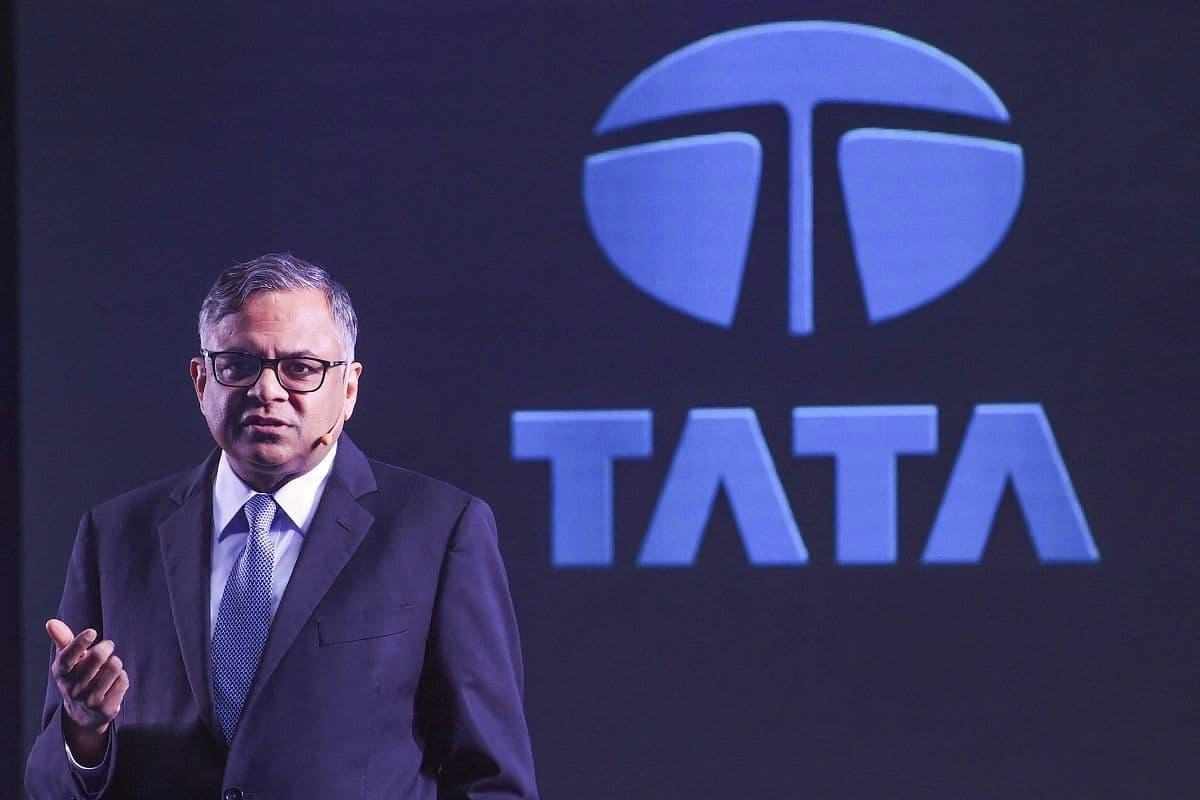
Chandrasekaran: Air India Represents a Responsibility Beyond Business for Tata Group
Mumbai — Tata Sons Chairman N. Chandrasekaran underscored on Saturday that Air India is more than a mere business venture for the Tata Group; it embodies a profound responsibility. Speaking at an event commemorating the 121st birth anniversary of J.R.D. Tata, Chandrasekaran highlighted the ongoing challenges confronting the aviation sector, including volatile global supply chains, scarcity of aircraft parts, and delays in fleet modernization.
Challenges in the Aviation Sector and Air India’s Transformation
Chandrasekaran emphasized the persistent difficulties faced by the aviation industry, noting that disruptions in global supply chains have rendered the availability of essential aircraft components and infrastructure uncertain. He remarked, "Every plan that you have is becoming difficult because of the situations that you face in this area." He further pointed out that aviation remains a capital-intensive sector with narrow profit margins, complicating efforts to achieve sustained profitability.
Since acquiring the loss-making Air India and Air India Express in January 2022, the Tata Group has embarked on an ambitious five-year plan to transform the airline. However, progress has been slower than expected, hindered by operational challenges and supply chain constraints. The financial burden of Air India’s losses has also had wider implications. Singapore Airlines, a stakeholder in the Tata-led airline, reported an 82% decline in net profit for the second quarter, attributing much of the downturn to Air India’s impact on earnings. Despite these setbacks, Singapore Airlines has reaffirmed its commitment to supporting Air India’s turnaround, while competitors remain cautious amid the shifting market dynamics.
Growth Prospects and Strategic Initiatives
Chandrasekaran highlighted the significant growth potential within India’s aviation sector, linking it closely to the country’s economic expansion. He stated, "Every single percentage growth in GDP will give a 2 per cent growth for the domestic aviation sector. If India grows 8 per cent, the aviation industry grows 16 per cent. This game will play out and continue for a long time, at least the next three decades." He described the current period as an "exciting phase of economic growth," particularly for aviation.
In an effort to strengthen Air India’s market position and enhance connectivity, the airline recently reinstated its codeshare agreement with Air Canada. This strategic partnership aims to expand travel options between India and Canada, supporting Air India’s efforts to broaden its global footprint amid ongoing operational challenges.
Chandrasekaran concluded by reaffirming the Tata Group’s dedication to Air India’s revival, framing the airline’s transformation as both a formidable challenge and a solemn duty. "I firmly believe for the Tata Group, Air India is just not a business opportunity. It’s a responsibility," he asserted.

Etihad Airways Suspends Airbus A380 Flights on Key Route

Aditya Birla Group Seeks Approval for Aircraft Leasing in GIFT City

Qatar Airways Highlights Innovation and Connectivity at Arabian Travel Market 2026

Hong Kong's Five-Year Plan Includes Andrew Fan's Aircraft Parts Processing Hub Proposal

ACIA Aero Leasing Delivers ATR72-600 to Air Nostrum

RTX Appoints Jill Albertelli as Head of Pratt & Whitney

TAT Technologies Joins Beyond Aero Hydrogen Aircraft Program

AURAK Study Highlights Barriers to Air Taxi Adoption in Emerging Economies

Xiamen Air Selects Altitude for 787 Maintenance at Heathrow

Etihad and Swissport Extend Global Partnership
