
Orchestrate AI insights into action

Trending
Categories
FAA and Experts Debate Aviation Safety of Drone-Based Cloud Seeding
FAA and Experts Debate Aviation Safety of Drone-Based Cloud Seeding
Emerging Technology and Industry Ambitions
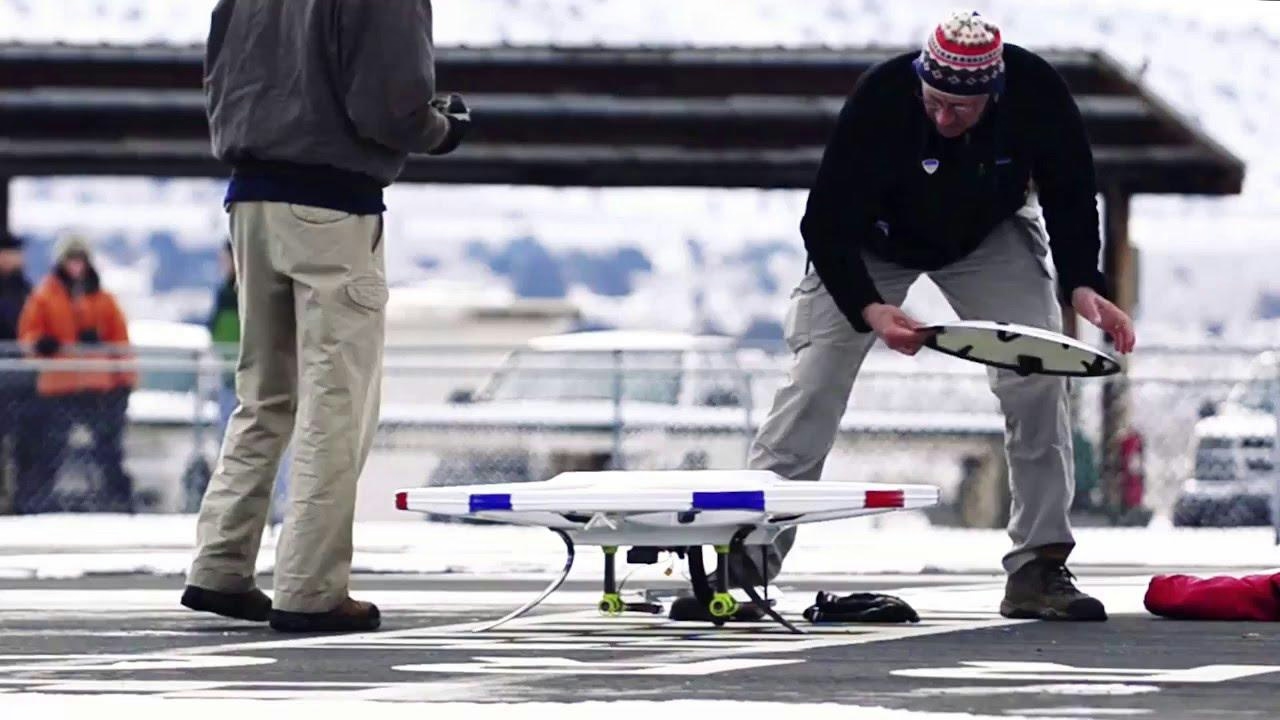
As climate technology evolves, the use of drones for cloud seeding—a method aimed at enhancing rainfall through weather modification—has sparked intense debate. Rainmaker Technology, a startup led by entrepreneur Augustus Doricko, has introduced a plan to deploy unmanned aerial vehicles equipped with pyrotechnic flares to disperse seeding agents into clouds. Advocates of this approach argue that drone-based cloud seeding offers a more precise, scalable, and cost-effective alternative to traditional piloted aircraft, potentially revolutionizing water management in drought-affected regions.
Safety Concerns and Regulatory Challenges
Despite the potential benefits, the proposal has met strong resistance from the Air Line Pilots Association (ALPA), the largest pilot union in the United States. ALPA has called on the Federal Aviation Administration (FAA) to reject Rainmaker’s plan unless it adheres to more stringent safety standards. The union highlights significant risks posed to manned aircraft, emphasizing that the introduction of pyrotechnic flares into congested airspace could increase the likelihood of midair collisions or accidental fires. These concerns are particularly acute in areas with dense commercial flight traffic. ALPA also warns against the operation of drones beyond visual line of sight (BVLOS), arguing that such practices could disrupt real-time air traffic coordination and elevate the risk of catastrophic incidents.
The FAA is currently under mounting pressure to modernize drone regulations. Following the 2025 White House executive order titled “Unleashing American Drone Dominance,” the agency is tasked with expediting approvals for advanced drone operations while maintaining rigorous safety evaluations. Industry stakeholders have criticized the FAA’s proposed BVLOS rules, questioning how drones will be safely integrated into existing aviation frameworks. Concurrently, a new congressional bill seeks to mandate the installation of counter-drone systems at major airports, reflecting growing concerns about drone-related threats to U.S. air traffic.
Investment, International Trials, and Public Response
Despite regulatory uncertainties, Rainmaker has attracted considerable investor interest, securing $25 million in funding as reported by Axios in May 2025. Proponents contend that drone-based cloud seeding could play a crucial role in mitigating the effects of climate change, particularly prolonged droughts. The technology has garnered international attention, with recent trials conducted in Rajasthan, India, aimed at replenishing local dams, according to an August 2025 report by the Hindustan Times.
Public opinion remains divided. On social media platforms such as X (formerly Twitter), posts featuring Rainmaker’s CEO discussing the potential for minimal seeding agents to induce significant rainfall have elicited both enthusiasm and skepticism. Some commentators have raised ethical questions regarding geoengineering, while others have drawn parallels to conspiracy theories about government weather manipulation. NBC News confirmed cloud-seeding operations in Texas prior to heavy rains earlier this year, although no direct causal link to flooding was established.
The ongoing controversy highlights a broader tension between the promise of drones as innovative tools for sustainable water management and concerns over unintended environmental consequences. Critics caution that altering weather patterns could adversely affect agriculture and ecosystems. As the FAA deliberates on Rainmaker’s proposal amid calls for regulatory reform and enhanced safety measures, the decision may set a critical precedent for the future of drone-enabled weather modification both in the United States and internationally.

Etihad Airways Suspends Airbus A380 Flights on Key Route

Aditya Birla Group Seeks Approval for Aircraft Leasing in GIFT City

Qatar Airways Highlights Innovation and Connectivity at Arabian Travel Market 2026

Hong Kong's Five-Year Plan Includes Andrew Fan's Aircraft Parts Processing Hub Proposal

ACIA Aero Leasing Delivers ATR72-600 to Air Nostrum

RTX Appoints Jill Albertelli as Head of Pratt & Whitney

TAT Technologies Joins Beyond Aero Hydrogen Aircraft Program

AURAK Study Highlights Barriers to Air Taxi Adoption in Emerging Economies

Xiamen Air Selects Altitude for 787 Maintenance at Heathrow

Etihad and Swissport Extend Global Partnership
