
Orchestrate AI insights into action

Trending
Categories
GE Aerospace and Pratt & Whitney Pursue Different Approaches to Development
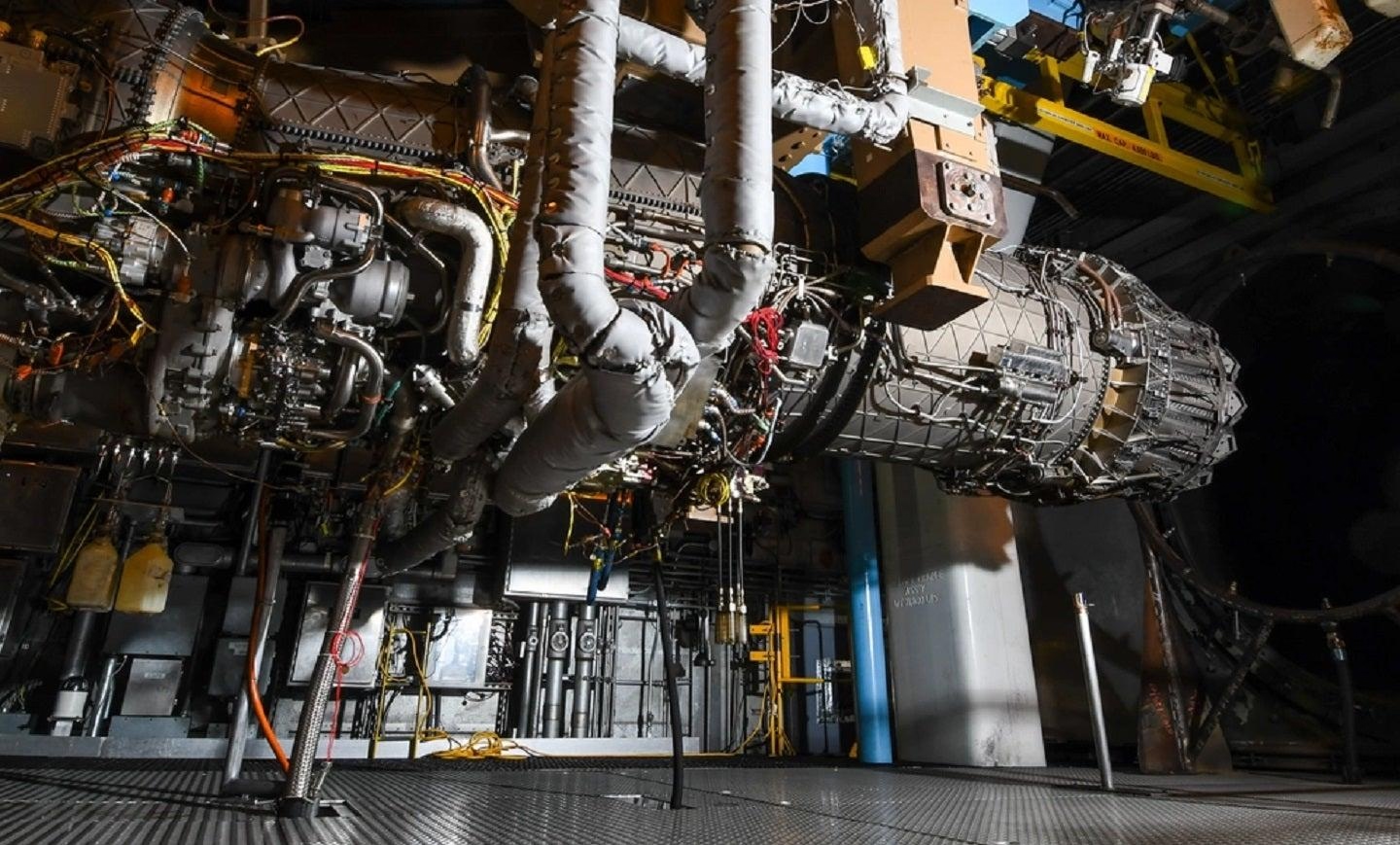
GE Aerospace and Pratt & Whitney Pursue Divergent Strategies for Next-Generation Jet Engines
As the Paris Air Show nears, GE Aerospace and Pratt & Whitney, the two foremost manufacturers of turbofan engines for narrowbody passenger jets, are adopting markedly different approaches to developing propulsion systems for aircraft expected to enter service in the 2030s. With Airbus and Boeing targeting up to 25% improvements in fuel efficiency for their future single-aisle models, engine makers face intense pressure to deliver substantial advancements not only in performance but also in durability and reliability.
Contrasting Development Philosophies
While improvements in airframe design will contribute to overall efficiency gains, the primary burden rests on engine manufacturers. CFM International—a joint venture between GE Aerospace and Safran Aircraft Engines—and Pratt & Whitney (P&W) find themselves at a strategic crossroads: whether to pursue radical new engine architectures or to refine and enhance existing turbofan designs. This decision is further complicated by recent maintenance and durability challenges affecting current-generation engines, highlighting the critical need for robust and dependable solutions.
Pratt & Whitney, a division of RTX headquartered in Connecticut, is pursuing an evolutionary path. The company is focusing on advancing its PW1000G geared turbofan (GTF) architecture by developing a more durable and efficient "gen-two" GTF for future narrowbody aircraft. This next-generation engine will incorporate cutting-edge materials such as ceramic-matrix composites (CMCs) and composite fan blades, with potential integration of hybrid-electric technologies. Rick Deurloo, president of P&W commercial engines, emphasized during a recent visit to the company’s Asheville, North Carolina facility that the GTF architecture will remain the foundation for next-generation single-aisle engines. He noted, “We will have a gen-two GTF that will have composite fan blades, CMCs—maybe hybrid-electric. It’s going to be a traditionally mounted installation.”
In contrast, GE Aerospace, based in Ohio, is pursuing a more disruptive strategy through CFM’s Revolutionary Innovation for Sustainable Engines (RISE) program. This initiative focuses on developing an open-fan engine demonstrator, which CFM claims could achieve 20% greater efficiency compared to current turbofan engines. Arjan Hegeman, GE’s head of future of flight engineering, described RISE as “the largest demonstrator programme our company has ever embarked upon” during remarks at the company’s research center near Albany. GE is investing heavily in validating the technology’s viability and durability, conducting extensive dust-ingestion and blade-durability testing. However, the open-fan concept faces significant challenges in convincing investors and customers of its readiness and reliability. Market reactions are expected to be mixed, with some viewing the technology as a bold innovation and others perceiving it as a high-risk proposition.
Market Implications and Industry Outlook
The differing strategies of these engine manufacturers are already influencing competitor responses and customer preferences. Pratt & Whitney’s commitment to refining proven engine designs positions it as a more conservative and potentially lower-risk option for airlines and airframers cautious about adopting unproven technologies. Meanwhile, GE Aerospace’s broader market footprint, including its involvement in defense projects such as the T901 engine for the U.S. Army’s UH-60M helicopter, may enhance its competitive standing and shape customer perceptions.
Ultimately, the choices made by Airbus, Boeing, and other aircraft manufacturers will be pivotal in determining which engine technology gains dominance. Although a final decision is likely several years away, both airframers are actively engaged in shaping the future of propulsion. Notably, Airbus has committed to collaborating with CFM to flight test the RISE open-fan demonstrator, signaling a willingness within the industry to explore both evolutionary and revolutionary propulsion solutions.

Etihad Airways Suspends Airbus A380 Flights on Key Route

Aditya Birla Group Seeks Approval for Aircraft Leasing in GIFT City

Qatar Airways Highlights Innovation and Connectivity at Arabian Travel Market 2026

Hong Kong's Five-Year Plan Includes Andrew Fan's Aircraft Parts Processing Hub Proposal

ACIA Aero Leasing Delivers ATR72-600 to Air Nostrum

RTX Appoints Jill Albertelli as Head of Pratt & Whitney

TAT Technologies Joins Beyond Aero Hydrogen Aircraft Program

AURAK Study Highlights Barriers to Air Taxi Adoption in Emerging Economies

Xiamen Air Selects Altitude for 787 Maintenance at Heathrow

Etihad and Swissport Extend Global Partnership
