
Orchestrate AI insights into action

Trending
Categories
Georgia Tech and NASA Partner on Autonomous Flight Research at New Aviation Lab
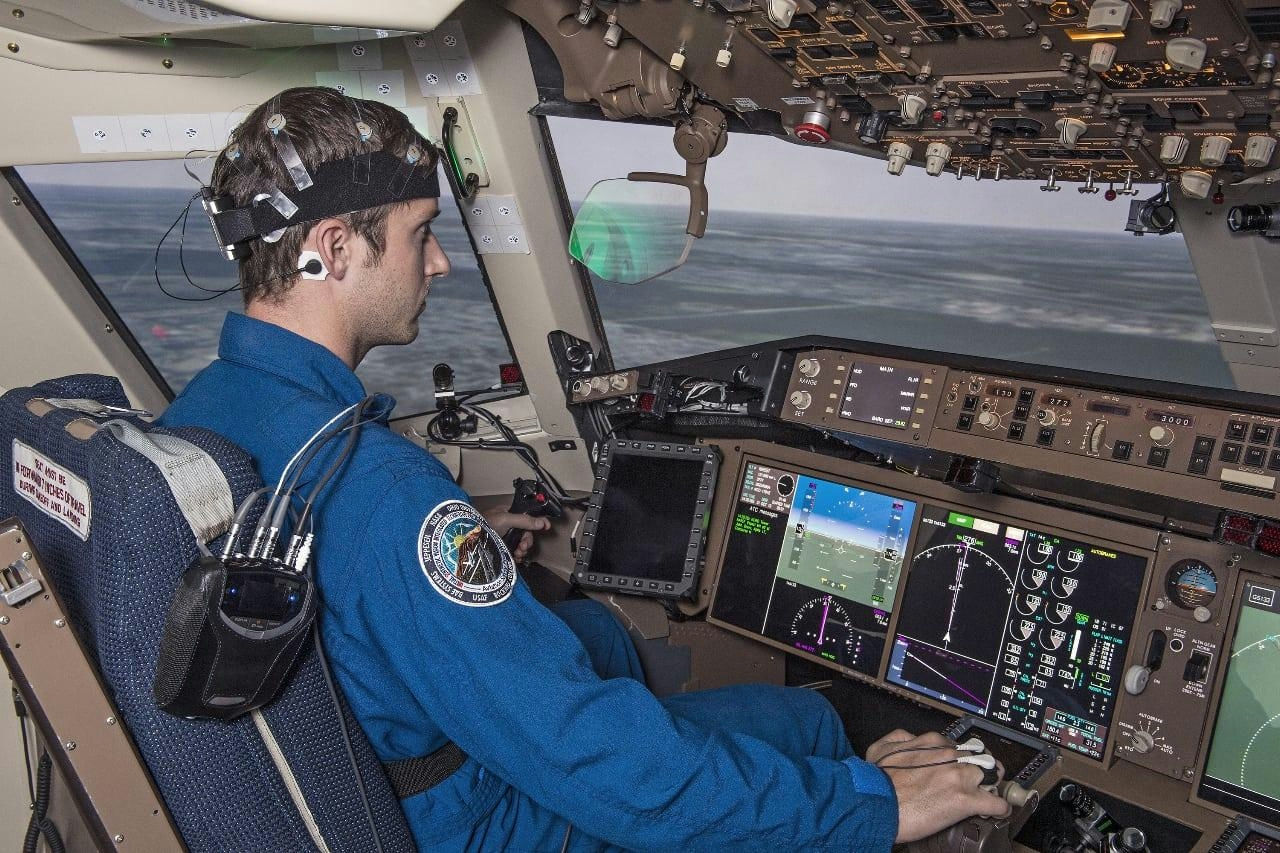
Georgia Tech and NASA Collaborate on Autonomous Flight Innovation at New Aviation Laboratory
ATLANTA, Ga. — In a significant step toward transforming urban transportation, Georgia Tech has partnered with NASA to advance autonomous flight research through the newly established Aircraft Prototyping Laboratory on its West Campus. This collaboration centers on the “RAVEN” project, which aims to develop next-generation electric and autonomous air vehicles that could revolutionize air mobility in metropolitan areas.
Advancing Air Mobility Through Electrification and Automation
Under the leadership of aerospace engineer Professor Brian German, the RAVEN project is focused on overcoming critical technical challenges associated with autonomous air taxis. These include reducing aircraft noise and enhancing battery performance—complex issues that extend well beyond the incremental scaling of current drone technologies. The laboratory will serve as a dedicated hub for addressing propulsion and integration obstacles, with the ultimate goal of making air taxis a viable and practical option for mass transit.
The autonomous air vehicles envisioned by the project resemble tilt-rotor helicopters, such as the V-22 Osprey, but are designed to operate at a fraction of the cost and with the efficiency required for widespread rideshare applications. German described the initiative as a major advancement in aviation, noting that private companies like Joby Aviation and Archer Aviation are already developing manned tilt-rotor prototypes and seeking certification from the Federal Aviation Administration (FAA).
Challenges and Industry Implications
Despite the promising outlook, the path to fully autonomous flight remains fraught with challenges. Regulatory approval processes, technological integration complexities, and funding limitations pose significant hurdles for both Georgia Tech and NASA. The research team anticipates that extensive testing and development will be necessary over several years before these vehicles can be deployed commercially. Public acceptance also remains uncertain, with German acknowledging the unpredictability of societal response to autonomous air travel.
The broader aviation industry is closely watching these developments, as the demand for flexible, cost-effective alternatives to traditional crewed aircraft grows. Some companies are exploring partnerships to accelerate technological progress, while others are competing to establish market leadership. Recent industry data highlights the increasing emphasis on technology readiness as the sector evolves toward autonomous solutions.
As the RAVEN project progresses, the collaboration between Georgia Tech and NASA has the potential to lay the foundation for a new era of urban air mobility, fundamentally altering how people navigate cities and their surrounding regions.

Etihad Airways Suspends Airbus A380 Flights on Key Route

Aditya Birla Group Seeks Approval for Aircraft Leasing in GIFT City

Qatar Airways Highlights Innovation and Connectivity at Arabian Travel Market 2026

Hong Kong's Five-Year Plan Includes Andrew Fan's Aircraft Parts Processing Hub Proposal

ACIA Aero Leasing Delivers ATR72-600 to Air Nostrum

RTX Appoints Jill Albertelli as Head of Pratt & Whitney

TAT Technologies Joins Beyond Aero Hydrogen Aircraft Program

AURAK Study Highlights Barriers to Air Taxi Adoption in Emerging Economies

Xiamen Air Selects Altitude for 787 Maintenance at Heathrow

Etihad and Swissport Extend Global Partnership
