
Orchestrate AI insights into action

Trending
Categories
Inside a Plane Engine: A Testament to Human Ingenuity
Inside a Plane Engine: A Testament to Human Ingenuity
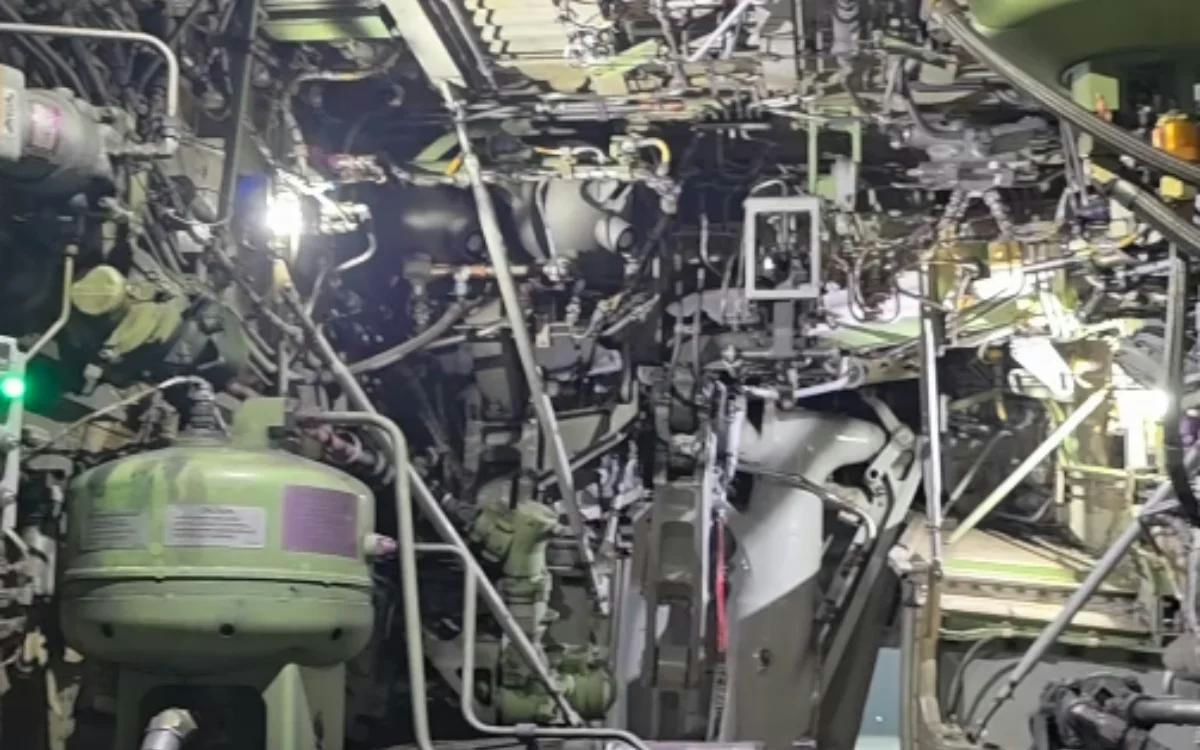
Peering inside a plane engine reveals far more than a mere assembly of metal and wires; it is a remarkable demonstration of human innovation and engineering precision. While passengers typically see only the spinning fan blades at the front, beneath the surface lies a complex and meticulously designed network of pipes, sensors, and reinforced components. These elements are engineered to endure extreme heat, pressure, and vibration, contributing significantly to the safety and reliability of commercial aviation.
The Complexity Beneath the Surface
Removing the engine casing exposes a dense array of fuel lines, hydraulic systems, and control units, each fulfilling a critical function. Every component is required to operate flawlessly for thousands of hours under conditions that would quickly degrade ordinary machinery. Modern jet engines are equipped with an extensive array of sensors that continuously monitor temperature, pressure, and rotational speed. This real-time data is fed into sophisticated control systems that automatically adjust fuel flow and other parameters to maintain optimal performance and safety. Airlines depend on this information, combined with rigorous inspections, to identify wear and address potential issues before they escalate into serious problems.
What may appear as a chaotic tangle of wires is, in fact, a carefully layered system of redundancies. Hoses, actuators, and control units are designed with contingency in mind; if one system fails, another seamlessly assumes its function, often without passengers being aware. This layered approach to safety is fundamental to the aviation industry’s commitment to reliability.
Engineering Excellence and Industry Challenges
The engineering behind jet engines is extraordinary. These machines are built to withstand extreme scenarios, including bird strikes, temperature fluctuations exceeding 1,000°F, and continuous operation over long-haul flights. Advanced materials, specialized coatings, and sophisticated cooling systems work in unison to ensure durability under these punishing conditions. The sheer scale of components, from engines to landing gear, reflects the ambition and complexity of modern aviation.
Beyond the engines themselves, the aerospace industry faces evolving challenges. As Airbus and Boeing prepare for 2026, they must increase production rates, make strategic decisions regarding future aircraft models, and respond to shifting market dynamics. Airbus currently leads in single-aisle aircraft sales, while Boeing focuses on widebody jets and seeks to regain competitiveness in the narrowbody sector. Meanwhile, the engine maintenance, repair, and overhaul (MRO) market is undergoing rapid transformation, with technological advancements reshaping the competitive landscape.
Emerging technologies also promise to revolutionize aircraft manufacturing. Innovations such as software-defined fuselages, developed by companies like Saab and Divergent Technologies, have the potential to alter production processes significantly. These advancements may influence market dynamics and the design of future aircraft.
Ultimately, the intricate workings inside a plane engine—and the broader aviation ecosystem—stand as a testament to relentless human ingenuity. Every wire, sensor, and bolt contributes to a larger mission: delivering safe, reliable flight worldwide while continuously adapting to the challenges and innovations that shape the future of air travel.

Etihad Airways Suspends Airbus A380 Flights on Key Route

Aditya Birla Group Seeks Approval for Aircraft Leasing in GIFT City

Qatar Airways Highlights Innovation and Connectivity at Arabian Travel Market 2026

Hong Kong's Five-Year Plan Includes Andrew Fan's Aircraft Parts Processing Hub Proposal

ACIA Aero Leasing Delivers ATR72-600 to Air Nostrum

RTX Appoints Jill Albertelli as Head of Pratt & Whitney

TAT Technologies Joins Beyond Aero Hydrogen Aircraft Program

AURAK Study Highlights Barriers to Air Taxi Adoption in Emerging Economies

Xiamen Air Selects Altitude for 787 Maintenance at Heathrow

Etihad and Swissport Extend Global Partnership
