
Orchestrate AI insights into action

Trending
Categories
Japan Successfully Tests Mach 5 Hypersonic Engine for Pacific Travel
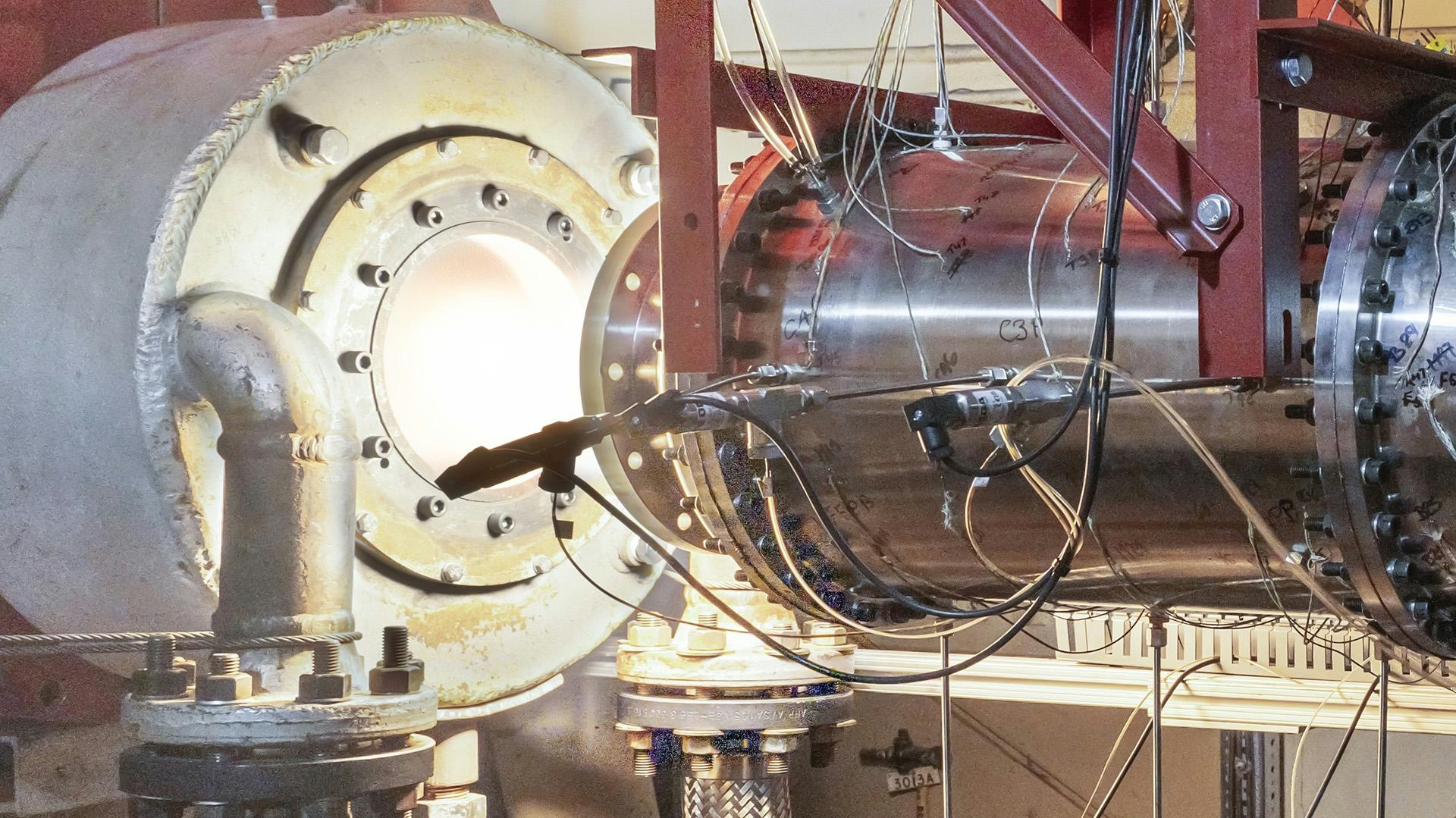
Japan Advances Hypersonic Technology with Successful Mach 5 Engine Test
Japan has reached a pivotal milestone in the development of hypersonic transportation by successfully conducting a ground combustion test of a Mach 5-class ramjet engine. This achievement, led by the Japan Aerospace Exploration Agency (JAXA) in partnership with Waseda University, The University of Tokyo, and Keio University, represents a significant step toward realizing ultra-high-speed travel and reusable spaceflight capabilities.
Testing at Extreme Conditions
The test was carried out at JAXA’s Kakuda Space Center in Miyagi Prefecture, where an experimental aircraft was installed within a specialized ramjet engine testing facility. By simulating flight conditions at five times the speed of sound, the research team was able to validate critical components including the aircraft’s thermal protection system, control surfaces, and ramjet combustion performance under intense hypersonic conditions. During the test, temperatures surrounding the aircraft reached nearly 1,832°F, yet the heat-shielding structure effectively maintained near-normal internal temperatures, ensuring the proper operation of onboard avionics and control electronics.
In addition to assessing thermal protection, researchers analyzed surface temperature distribution to verify advanced thermal-structure analysis techniques essential for future hypersonic vehicle designs. The team also measured exhaust-temperature distribution from the hydrogen-fueled ramjet to evaluate the environmental impact of next-generation propulsion systems.
Collaborative Innovation and Future Prospects
The aircraft was developed through a collaborative initiative between universities and JAXA, funded by the Japan Society for the Promotion of Science. The broader project aims to establish a hypersonic flight testbed using sounding rockets, focusing on demonstrating integrated airframe-propulsion control during flight. Unlike conventional aircraft, hypersonic vehicles require a tightly coupled design where the propulsion system and airframe function as a single integrated unit. This integration is necessary to manage the complex interactions between shock waves and propulsion activity at extreme speeds, ensuring aerodynamic stability and sustained thrust.
Looking ahead, the next phase of development may involve mounting the experimental aircraft onto a sounding rocket to conduct a real-world Mach 5 flight demonstration.
Strategic Implications and Global Context
Japan’s breakthrough occurs amid an intensifying global race to develop ultra-fast transportation technologies. JAXA envisions future aircraft capable of reducing trans-Pacific flight times between Japan and the United States to approximately two hours, a dramatic improvement over current durations. Beyond commercial aviation, this technology holds potential for spaceplanes operating near the edge of space.
Despite the promise, scaling hypersonic engines for commercial use presents formidable challenges, including managing extreme thermal environments and ensuring passenger safety. The successful test is likely to attract increased interest from airlines aiming to shorten intercontinental travel times. Meanwhile, competitors such as Stratolaunch and Anduril are advancing their own hypersonic programs, potentially accelerating development efforts in response to Japan’s progress.
The strategic importance of hypersonic technology is further underscored by recent defense contracts, such as the U.S. Army’s $2.7 billion investment in hypersonic weapons. This convergence of commercial innovation and national security priorities highlights the critical role hypersonic advancements will play in the coming years. Japan’s successful test underscores its commitment to overcoming the complex engineering challenges inherent in hypersonic flight, including maintaining stable propulsion, structural integrity, and thermal protection at unprecedented speeds.

Etihad Airways Suspends Airbus A380 Flights on Key Route

Aditya Birla Group Seeks Approval for Aircraft Leasing in GIFT City

Qatar Airways Highlights Innovation and Connectivity at Arabian Travel Market 2026

Hong Kong's Five-Year Plan Includes Andrew Fan's Aircraft Parts Processing Hub Proposal

ACIA Aero Leasing Delivers ATR72-600 to Air Nostrum

RTX Appoints Jill Albertelli as Head of Pratt & Whitney

TAT Technologies Joins Beyond Aero Hydrogen Aircraft Program

AURAK Study Highlights Barriers to Air Taxi Adoption in Emerging Economies

Xiamen Air Selects Altitude for 787 Maintenance at Heathrow

Etihad and Swissport Extend Global Partnership
