
Orchestrate AI insights into action

Trending
Categories
Long-Haul Airlines Transform Business Class on Narrowbody Aircraft
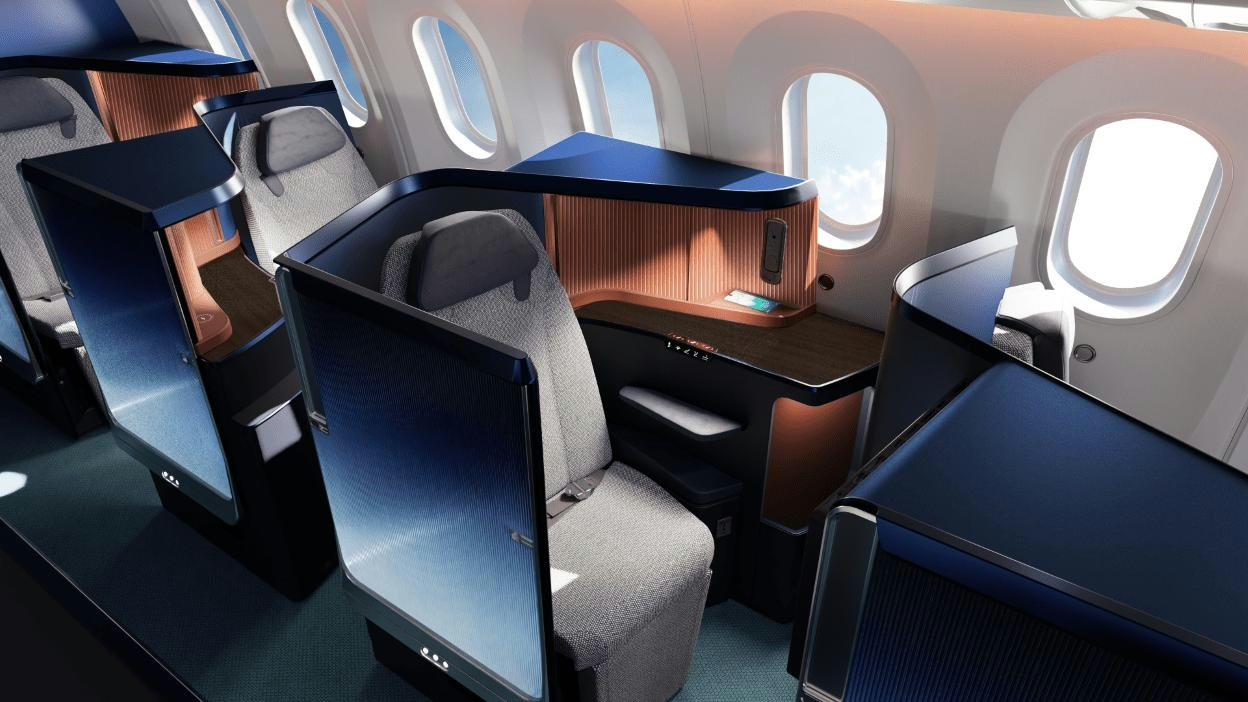
Long-Haul Airlines Transform Business Class on Narrowbody Aircraft
The Evolution of Business Class on Narrowbody Jets
Traditionally, business class on short- and medium-haul flights has been characterized by modest enhancements such as slightly larger seats and blocked middle seats, while long-haul business class offered lie-flat beds and significantly more personal space. However, airlines are now redefining business class on narrowbody aircraft to meet evolving passenger expectations while simultaneously increasing revenue. Advances in aircraft design and technology have played a pivotal role in this transformation, enabling carriers to offer premium services on more fuel-efficient, long-range narrowbody jets. This shift marks a departure from the conventional reliance on widebody aircraft for long-haul routes, presenting new opportunities for both airlines and travelers.
The Rise of the Airbus A321XLR
For many years, the Boeing 757 served as a popular choice for mid-haul routes, but with the aircraft aging and Boeing’s New Midsize Aircraft (NMA) project on indefinite hold, airlines have sought alternatives to fill the gap in the middle-market segment. Airbus capitalized on this opportunity by expanding its A320 family, focusing on the larger A321 model to serve transcontinental and medium-haul routes. This development culminated in the introduction of the A321neo (new engine option), followed by the A321LR (Long Range), and ultimately the A321XLR (Extra Long Range), which debuted in 2019.
The A321XLR has quickly gained prominence, with over 500 orders placed within five years of its announcement at the Paris Air Show. As of late 2025, 15 of these aircraft have been delivered to four airlines. The single-aisle A321XLR boasts a range of approximately 5,400 miles and can accommodate around 220 passengers on nonstop flights lasting up to ten or eleven hours. This capability makes it an attractive option for airlines seeking to launch new long-haul routes without the financial risks associated with widebody aircraft. The A321XLR’s operational flexibility and lower costs are reshaping the economics of long-haul air travel, enabling better point-to-point connectivity and the servicing of long, thin routes that were previously uneconomical.
Redefining Premium Cabins on Narrowbody Aircraft
Long-haul carriers are now reimagining business class offerings on narrowbody aircraft such as the Airbus A321LR and A321XLR. These aircraft typically feature around 180 seats divided between two cabins, with business and premium economy classes targeting high-yield passengers. The introduction of these aircraft allows airlines to tailor their premium products to meet the demands of long-haul travelers while maintaining operational efficiency.
Several airlines have already integrated the A321XLR into their fleets. Qantas has taken delivery of two aircraft, Aer Lingus and Iberia each operate four, and American Airlines has received two of the fifty units it ordered. This growing adoption underscores the industry’s confidence in the narrowbody long-haul model and its potential to redefine premium air travel on routes traditionally served by larger widebody jets.

Etihad Airways Suspends Airbus A380 Flights on Key Route

Aditya Birla Group Seeks Approval for Aircraft Leasing in GIFT City

Qatar Airways Highlights Innovation and Connectivity at Arabian Travel Market 2026

Hong Kong's Five-Year Plan Includes Andrew Fan's Aircraft Parts Processing Hub Proposal

ACIA Aero Leasing Delivers ATR72-600 to Air Nostrum

RTX Appoints Jill Albertelli as Head of Pratt & Whitney

TAT Technologies Joins Beyond Aero Hydrogen Aircraft Program

AURAK Study Highlights Barriers to Air Taxi Adoption in Emerging Economies

Xiamen Air Selects Altitude for 787 Maintenance at Heathrow

Etihad and Swissport Extend Global Partnership
