
Orchestrate AI insights into action

Trending
Categories
Orlando Airport Announces Major Changes Planned for 2028
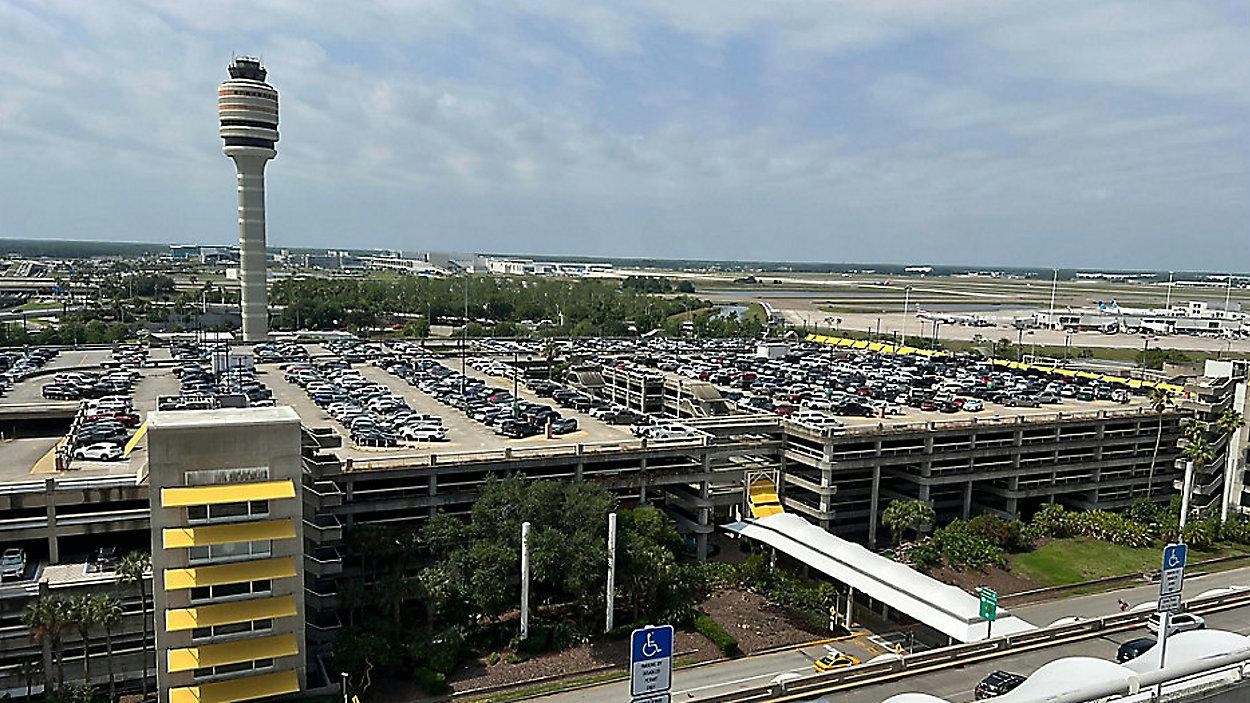
Orlando International Airport Announces Transformative Plans for 2028
Orlando International Airport (MCO), one of the busiest airports in the United States due to its proximity to major tourist destinations, has unveiled a comprehensive plan to revolutionize the passenger experience by 2028. Central to this vision is the introduction of electric air taxis and significant infrastructure enhancements aimed at positioning MCO as a leader in advanced air mobility.
Pioneering Electric Air Taxi Integration
MCO is actively developing advanced air mobility services, including electric vertical takeoff and landing (eVTOL) aircraft, with a targeted launch date in 2028. In collaboration with the Federal Aviation Administration (FAA), airport traffic controllers recently completed successful simulations to assess the integration of eVTOL operations alongside conventional air traffic. These tests, conducted around the East Airfield and the proposed vertiport sites near the Brightline station, demonstrated the capacity for up to 22 eVTOL aircraft to operate simultaneously without causing air traffic conflicts or wake turbulence issues.
Bradley Friel, Senior Vice President of Planning and Environmental at the Greater Orlando Aviation Authority, emphasized that the simulations validated the safety and feasibility of operating from the two designated vertiport locations within the national airspace system. Orange County Mayor Jerry Demings underscored the significance of these advancements, remarking, “The age of The Jetsons will be upon all of us,” reflecting the airport’s commitment to futuristic transportation solutions.
Challenges and Collaborative Efforts
While the airport advances feasibility studies and finalizes vertiport locations, it faces several challenges. Securing regulatory approvals for infrastructure expansion, managing the financial demands of sustainability initiatives, and maintaining competitive positioning among regional airports are critical considerations. MCO is working closely with the FAA, the Florida Department of Transportation, and the City of Orlando to address infrastructure requirements, including vertiport design and electrical capacity enhancements. Technology companies and vertiport operators are actively submitting proposals, with FAA certification expected in the latter half of 2026.
The anticipated market impact includes potential shifts in airline partnerships, variations in passenger volumes, and increased operational costs. Competing airports may respond by upgrading their own facilities, such as introducing new hotel brands like the PAN AM Hotel to enhance airport accommodations or relocating sports teams to nearby cities to boost local tourism and economic development.
Broader Airport Improvements and Future Outlook
The introduction of air taxis is projected to create new revenue streams and employment opportunities, while providing passengers with seamless connections to commercial flights and Brightline rail services. However, the Orlando Business Journal notes that demand for short-haul flights within Florida may be limited due to the state’s extensive ground transportation network, with business travelers and urban commuters expected to be the primary users of the new air taxi services.
These initiatives complement a series of recent and ongoing improvements at MCO, including the expansion of Terminal C, installation of new moving walkways, and bathroom renovations scheduled for completion by 2027. Additionally, a pedestrian bridge linking key airport facilities has recently opened. Security procedures have also evolved, with the elimination of mandatory shoe removal, stricter regulations on lithium-ion batteries, and the introduction of automatic screening and family lanes.
As Orlando International Airport embarks on this ambitious transformation, it aims to establish a new benchmark for innovation and passenger convenience while navigating the complexities of growth and competition in the rapidly evolving aviation sector.

Etihad Airways Suspends Airbus A380 Flights on Key Route

Aditya Birla Group Seeks Approval for Aircraft Leasing in GIFT City

Qatar Airways Highlights Innovation and Connectivity at Arabian Travel Market 2026

Hong Kong's Five-Year Plan Includes Andrew Fan's Aircraft Parts Processing Hub Proposal

ACIA Aero Leasing Delivers ATR72-600 to Air Nostrum

RTX Appoints Jill Albertelli as Head of Pratt & Whitney

TAT Technologies Joins Beyond Aero Hydrogen Aircraft Program

AURAK Study Highlights Barriers to Air Taxi Adoption in Emerging Economies

Xiamen Air Selects Altitude for 787 Maintenance at Heathrow

Etihad and Swissport Extend Global Partnership
