
Orchestrate AI insights into action

Trending
Categories
Review of Task A43 Report on Airborne Collision Severity and Engine Ingestion
Review of Task A43 Report on Airborne Collision Severity and Engine Ingestion
The rapid proliferation of uncrewed aircraft systems (UAS) has introduced significant safety challenges to commercial aviation, particularly concerning airborne collisions and the risk of engine ingestion. Recreational UAS operators, often lacking comprehensive knowledge of airspace regulations, exacerbate these hazards. Unlike traditional airborne threats such as birds or ice, UAS components—including lithium-polymer batteries and electric motors—are denser and more rigid, rendering existing aviation certification standards inadequate for assessing their impact.
In response to these emerging concerns, the Federal Aviation Administration (FAA) sponsored the Task A43 research program, conducted by The Ohio State University (OSU) in collaboration with the National Institute for Aviation Research (NIAR). The program’s primary objective was to perform a live UAS engine ingestion test to validate computational models previously employed in collision severity studies.
The Live Ingestion Experiment
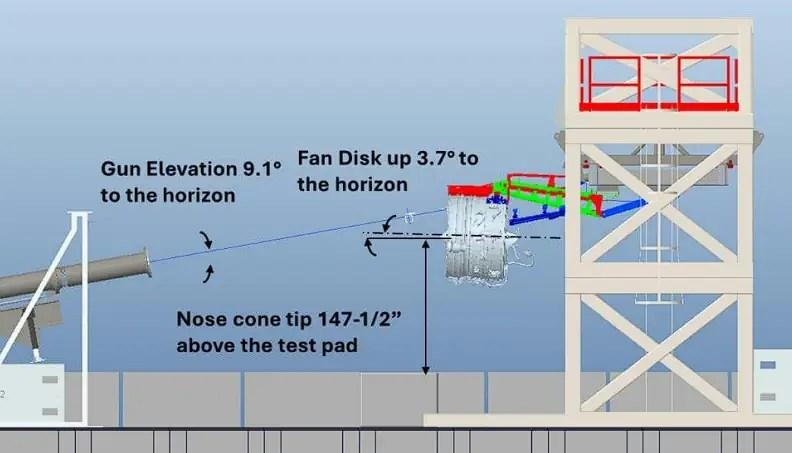
The live ingestion test was carried out at the Naval Air Warfare Center (NAWC) in China Lake, California. Researchers selected a CFM56-7B high-bypass turbofan engine, a model representative of modern commercial fleets and exclusively used on the Boeing 737 Next Generation series. The projectile was a DJI Phantom 3 Standard quadcopter, chosen for its representative rigid components and the availability of a validated computational model. The drone weighed 1.216 kilograms (2.68 pounds).
To replicate a severe takeoff collision scenario, the engine was operated at 5,175 revolutions per minute (RPM), while the UAS was launched at a relative velocity of 92.6 meters per second (180 knots). The impact targeted 75 percent of the fan blade’s radial span, a location known to cause maximum fan damage while minimizing the risk of core engine ingestion.
Computational Modelling and Validation
A central focus of Task A43 was to evaluate the accuracy of computational simulations, particularly those utilizing LS-DYNA software, in predicting real-world engine damage resulting from UAS ingestion. Researchers developed a finite element model of the CFM56-7B fan assembly and compared the simulated outcomes with data obtained from the live test. Additionally, they assessed an “open representative fan assembly model” from prior research, designed to emulate typical high-bypass engines without relying on proprietary designs.
Data collection employed high-speed cameras, digital image correlation (DIC), and strain gauges affixed to the fan blades. Although some lighting limitations affected the resolution of the DIC measurements, the high-speed cameras effectively captured the UAS’s orientation, velocity, and trajectory immediately prior to impact.
Damage Severity and Industry Implications
The live ingestion test resulted in significant damage to multiple fan blades. Both physical observations and computational analyses classified the event as severity level 3, indicating substantial material loss and visible cracking above the blade mid-span. Despite this damage, the resulting imbalance remained within the engine’s certification limits.
These findings emphasize the necessity for comprehensive safety reviews and potential modifications to training aircraft, such as the T-38 Talon II, to mitigate future collision risks. The aviation industry is expected to respond with heightened scrutiny of safety protocols for similar aircraft. Concurrently, competitors may accelerate advancements in engine technology to reduce ingestion hazards, as exemplified by GE Aerospace’s recent dust ingestion tests on the Leap-1A engine.
The Task A43 report underscores the critical importance of updating certification standards and adopting advanced modelling techniques to address the evolving risks posed by UAS to commercial aviation safety.

Etihad Airways Suspends Airbus A380 Flights on Key Route

Aditya Birla Group Seeks Approval for Aircraft Leasing in GIFT City

Qatar Airways Highlights Innovation and Connectivity at Arabian Travel Market 2026

Hong Kong's Five-Year Plan Includes Andrew Fan's Aircraft Parts Processing Hub Proposal

ACIA Aero Leasing Delivers ATR72-600 to Air Nostrum

RTX Appoints Jill Albertelli as Head of Pratt & Whitney

TAT Technologies Joins Beyond Aero Hydrogen Aircraft Program

AURAK Study Highlights Barriers to Air Taxi Adoption in Emerging Economies

Xiamen Air Selects Altitude for 787 Maintenance at Heathrow

Etihad and Swissport Extend Global Partnership
