
Orchestrate AI insights into action

Trending
Categories
Spirit Aero Issues Delay A350 Deliveries
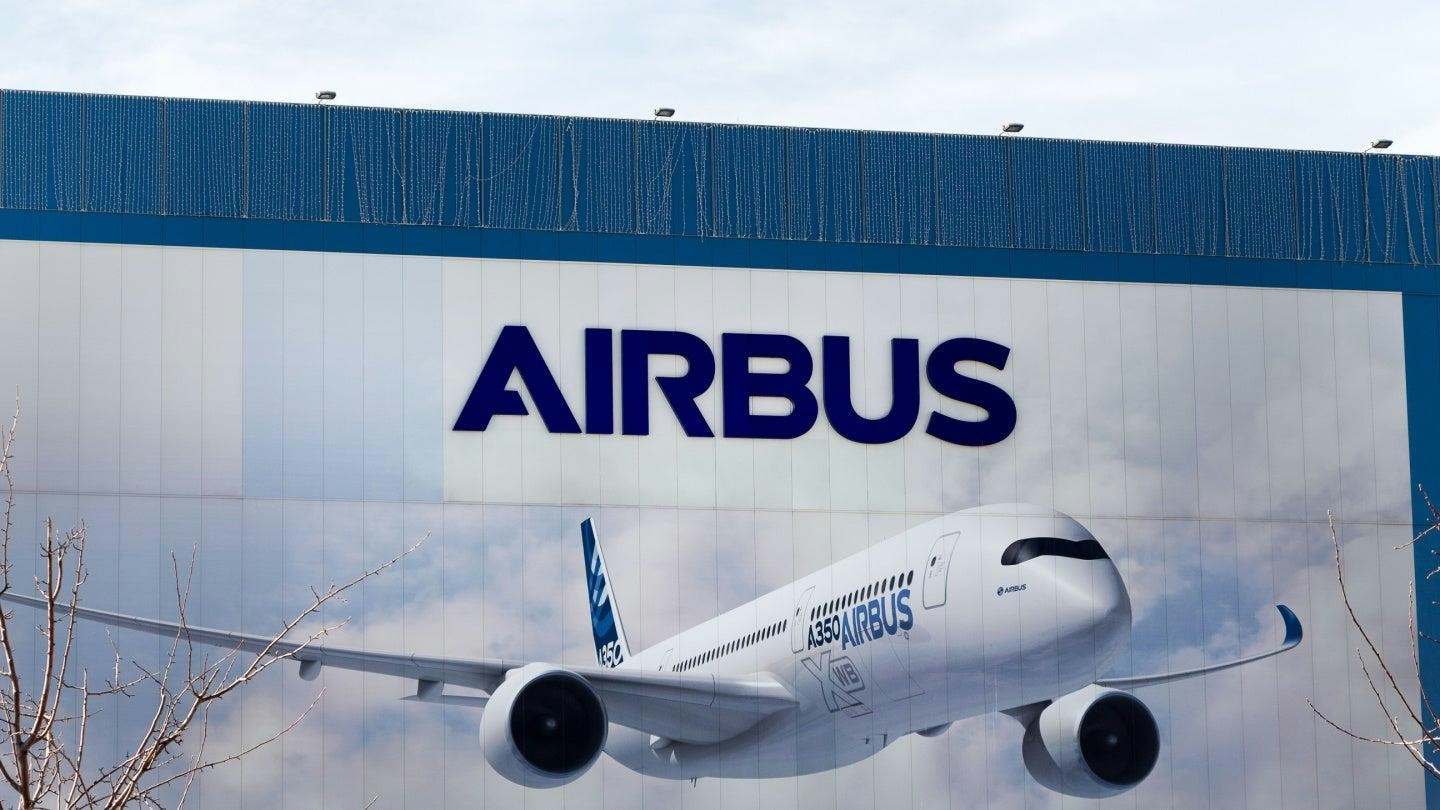
Spirit AeroSystems Delays Impact Airbus A350 Deliveries
Deliveries of the Airbus A350 experienced a notable decline in 2025 compared to the previous year, highlighting persistent supply chain challenges within the aerospace sector. Christian Scherer, former CEO of Airbus Commercial Aircraft, clarified that the slowdown was not due to diminished market demand but rather production difficulties linked to a critical supplier. He explained during Airbus’s annual media briefing that the bottleneck centered on the fuselage’s center section, manufactured by the company formerly known as Spirit AeroSystems. “They ran into trouble. They were the pacing item,” Scherer stated, emphasizing that the issue was rooted in production rather than customer interest.
Following Spirit AeroSystems’ merger with Boeing in December, Airbus acquired Spirit’s Airbus-related business to regain control over essential components. Scherer expressed confidence that this strategic move would facilitate the resumption of the A350 production ramp-up. “Now that we have regained, let’s say, control of that particular center fuselage piece on section 15 of the A350, you will see the A350 continue its ramp up,” he said.
Delivery Figures Reflect Supply Chain Strains
The repercussions of these supply chain disruptions were evident in Airbus’s 2025 delivery statistics. The company delivered a total of 793 aircraft, marking its third-highest annual output after 2019 and 2018. While single-aisle aircraft deliveries exceeded pre-pandemic levels—reaching 700 compared to 690 in 2019—widebody deliveries lagged considerably. Only 93 widebody aircraft were delivered in 2025, a sharp decline from the 2019 peak of 173 and even below figures recorded in 2008. The majority of year-on-year growth was driven by the A220 program, whereas the A350 faced the most significant production hurdles.
Scherer highlighted Airbus’s ongoing efforts to resolve these bottlenecks and quality concerns by working closely with its supply chain partners. He noted substantial investments aimed at modernizing and expanding Airbus’s industrial capabilities worldwide. “We managed to further solidify our ramp-up and our industrial system. To achieve this, we made and continue to make substantial investments, modernizing our industrial capabilities by upgrading and expanding our global system,” Scherer said. All final assembly lines are now capable of producing the A321, and two new A320 family assembly lines were inaugurated in Asia and America in 2025 to support the planned increase in production rates to 75 aircraft per month by 2027.
Strategic Acquisition and Industry Implications
The acquisition of Spirit AeroSystems’ Airbus-related work is viewed as a strategic initiative to secure the production ramp-up of both the A350 and A220 programs. By bringing key work packages such as wings, pylons, and fuselage sections in-house, Airbus aims to mitigate supplier risks and enhance control over its manufacturing processes. This development occurs amid broader industry concerns, as Spirit AeroSystems has faced ongoing supply chain disruptions and production delays affecting not only Airbus but also Boeing, which relies heavily on Spirit for components.
These challenges have contributed to market volatility, with Boeing’s stock experiencing fluctuations amid regulatory scrutiny, including the Federal Aviation Administration’s ongoing review of the 737 MAX 10. Such factors add further uncertainty to Boeing’s delivery schedules.
In response, Airbus is streamlining its industrial flow from parts manufacturing to final assembly, upgrading customer delivery lines, and expanding its facilities. Notably, a new site in Germany dedicated to the A321XLR rear center tank was established in 2025. These measures are designed to reduce supplier risks and ensure that production targets are met, even as competitors and regulators closely monitor the evolving aerospace landscape.

Etihad Airways Suspends Airbus A380 Flights on Key Route

Aditya Birla Group Seeks Approval for Aircraft Leasing in GIFT City

Qatar Airways Highlights Innovation and Connectivity at Arabian Travel Market 2026

Hong Kong's Five-Year Plan Includes Andrew Fan's Aircraft Parts Processing Hub Proposal

ACIA Aero Leasing Delivers ATR72-600 to Air Nostrum

RTX Appoints Jill Albertelli as Head of Pratt & Whitney

TAT Technologies Joins Beyond Aero Hydrogen Aircraft Program

AURAK Study Highlights Barriers to Air Taxi Adoption in Emerging Economies

Xiamen Air Selects Altitude for 787 Maintenance at Heathrow

Etihad and Swissport Extend Global Partnership
