
Orchestrate AI insights into action

Trending
Categories
St. Petersburg Officials Discuss Electric Air Taxi Network Plans
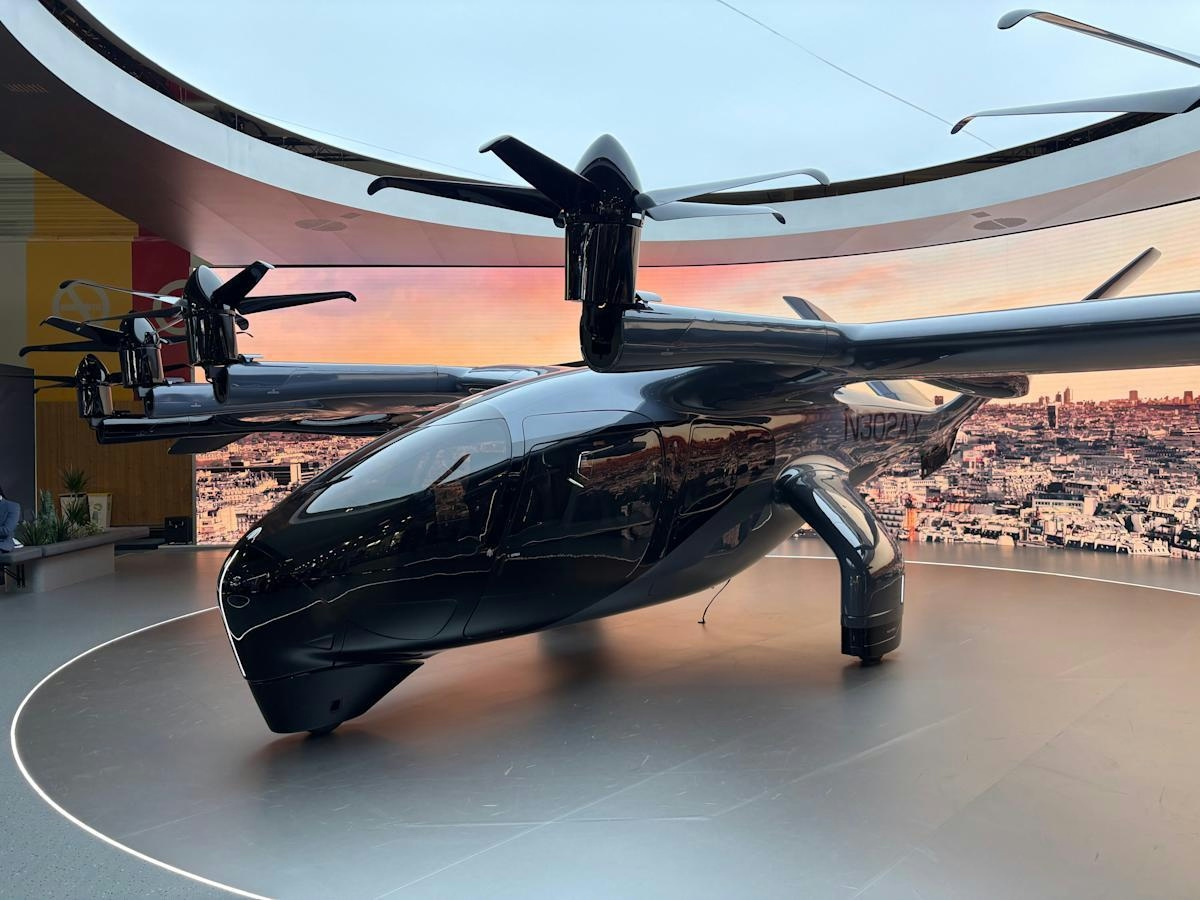
St. Petersburg Officials Discuss Electric Air Taxi Network Plans
Advancing Urban Air Mobility in Tampa Bay
St. Petersburg city officials are preparing to meet with manufacturers on Monday at 5 p.m. to deliberate on the development of an electric air taxi network intended to connect local airports by 2026. Spearheaded by the city’s Advanced Air Mobility Task Force, the initiative envisions a system of vertical-lift aircraft stops across the Tampa Bay region, with Albert Whitted Airport designated as the central hub. These hybrid vehicles, combining elements of planes, helicopters, and drones, represent a new frontier in urban transportation.
Rich Lesniak, director of Albert Whitted Airport, has initiated coordination efforts with neighboring airports to address critical issues such as air traffic control and operational logistics. Ed Montanari, leader of the task force and the originator of the concept in 2024, has drawn inspiration from futuristic visions of travel, notably referencing the animated series The Jetsons. The task force provided its initial progress report in August 2025 and plans to issue a subsequent update in November, with a comprehensive proposal slated for January 2026.
Technical and Regulatory Challenges Ahead
The upcoming meeting will concentrate on establishing technical standards, safety protocols, and ensuring compliance with federal aviation regulations. Proposed routes are expected to connect St. Pete-Clearwater Airport with Tampa International Airport, utilizing specialized landing facilities known as vertiports. These vertiports are designed to accommodate both passenger transport and emergency service operations. However, key questions remain regarding whether the aircraft will be piloted manually or operate autonomously.
Despite the city’s ambitious vision, the project faces considerable obstacles. Regulatory approval processes, the need for substantial infrastructure development, and the high costs associated with electric air taxi technology present significant challenges. Furthermore, the market is becoming increasingly competitive, with established companies such as Japan’s ANA Holdings and the U.S.-based Joby Aviation advancing similar initiatives. Joby Aviation’s recent acquisition of Blade Air Mobility’s urban air taxi business for up to $125 million is expected to intensify competition and accelerate efforts toward commercialization.
Investor sentiment toward the sector remains cautious, reflecting concerns over technological uncertainties and the scale of investment required. Meanwhile, traditional airlines like Southwest Airlines are exploring partnerships with advanced air mobility firms, signaling a potential expansion of their service offerings in response to this emerging mode of transportation.
Monitoring Global Developments
St. Petersburg officials are closely observing progress in other metropolitan areas where electric air taxi services have already been introduced, including Los Angeles, New York, and Dubai. The city’s ability to navigate the complex regulatory environment and overcome technical and financial challenges will be critical in determining whether Tampa Bay can establish itself as a leader in the next generation of urban air transportation.

Etihad Airways Suspends Airbus A380 Flights on Key Route

Aditya Birla Group Seeks Approval for Aircraft Leasing in GIFT City

Qatar Airways Highlights Innovation and Connectivity at Arabian Travel Market 2026

Hong Kong's Five-Year Plan Includes Andrew Fan's Aircraft Parts Processing Hub Proposal

ACIA Aero Leasing Delivers ATR72-600 to Air Nostrum

RTX Appoints Jill Albertelli as Head of Pratt & Whitney

TAT Technologies Joins Beyond Aero Hydrogen Aircraft Program

AURAK Study Highlights Barriers to Air Taxi Adoption in Emerging Economies

Xiamen Air Selects Altitude for 787 Maintenance at Heathrow

Etihad and Swissport Extend Global Partnership
