
Orchestrate AI insights into action

Trending
Categories
The Role of Digital Twins in Maintenance, Repair, and Overhaul
The Role of Digital Twins in Maintenance, Repair, and Overhaul
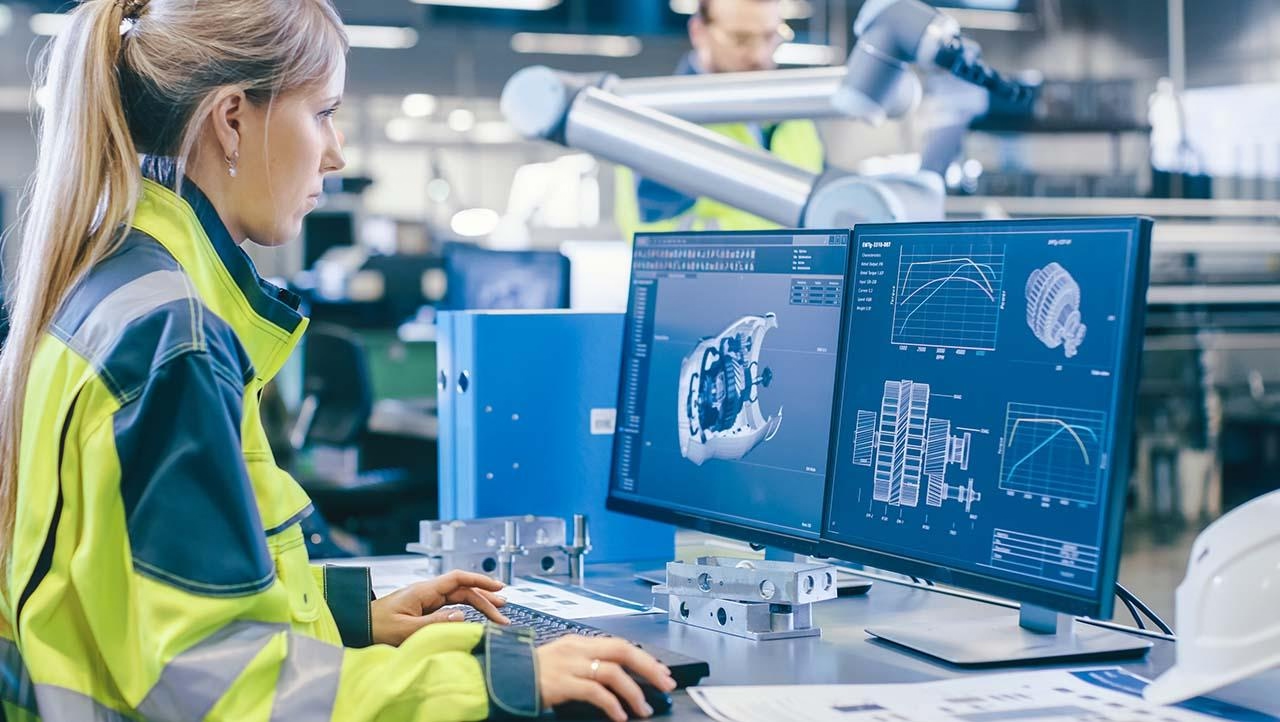
Digital twins—virtual replicas of aircraft or their components—are poised to revolutionize maintenance, repair, and overhaul (MRO) operations across the aviation industry. This technology offers the potential to significantly enhance operational efficiency and decision-making by providing detailed, data-driven insights into the condition and performance of physical assets.
From Virtual Reality to Digital Twins: A New Paradigm
The concept of preparing for maintenance challenges has long been integral to aircraft design and operation. Traditionally, virtual reality (VR) has played a key role in ensuring maintainability by allowing technicians to virtually access and interact with aircraft and engine components. However, digital twins represent a more advanced evolution of this approach.
Pete Boeskov, director of commercial training, digital and analytics at Boeing Global Services, distinguishes digital twins from VR models by emphasizing their relationship to physical objects. While VR is used to interact with digital models during the design phase, a digital twin is a dynamic digital representation of an actual, physical asset. It is created only after the physical object exists and continuously collects data throughout its operational life. This comprehensive data includes details such as the materials used, manufacturing processes, and operational history, enabling analysts to extract precise insights.
Boeckov highlights that digital twins facilitate superior data-driven decision-making by providing enhanced operational understanding, accurate simulations, and predictive capabilities. These features support integrated vehicle health management systems that surpass current standards, allowing for more effective maintenance planning and risk mitigation.
Industry Perspectives on Digital Twin Applications
Airbus echoes this perspective, noting that VR is primarily used to simulate costly or hazardous scenarios and to optimize assembly processes in confined spaces. According to an Airbus spokesperson, VR helps ensure that technicians can maneuver and perform tasks efficiently within tight environments. Meanwhile, the digital twin serves as a tool to model complex elements—ranging from entire aircraft to individual parts or processes—enabling scenario testing and impact analysis. This approach underpins data-driven decision-making throughout the lifecycle of the asset.
Similarly, Dinakar Deshmukh, vice president of data science at GE Aerospace, points out that the company has been developing and applying digital twin technology for over a decade. GE Aerospace leverages these digital replicas to enhance predictive maintenance and operational performance, underscoring the growing importance of digital twins in the aerospace sector.
As digital twin technology continues to mature, its integration into MRO processes promises to transform how the aviation industry anticipates, manages, and resolves maintenance challenges, ultimately improving safety, reliability, and cost efficiency.

Etihad Airways Suspends Airbus A380 Flights on Key Route

Aditya Birla Group Seeks Approval for Aircraft Leasing in GIFT City

Qatar Airways Highlights Innovation and Connectivity at Arabian Travel Market 2026

Hong Kong's Five-Year Plan Includes Andrew Fan's Aircraft Parts Processing Hub Proposal

ACIA Aero Leasing Delivers ATR72-600 to Air Nostrum

RTX Appoints Jill Albertelli as Head of Pratt & Whitney

TAT Technologies Joins Beyond Aero Hydrogen Aircraft Program

AURAK Study Highlights Barriers to Air Taxi Adoption in Emerging Economies

Xiamen Air Selects Altitude for 787 Maintenance at Heathrow

Etihad and Swissport Extend Global Partnership
