
Orchestrate AI insights into action

Trending
Categories
Uber Stock Rises to Record High Following Joby and Blade Air Mobility Agreement
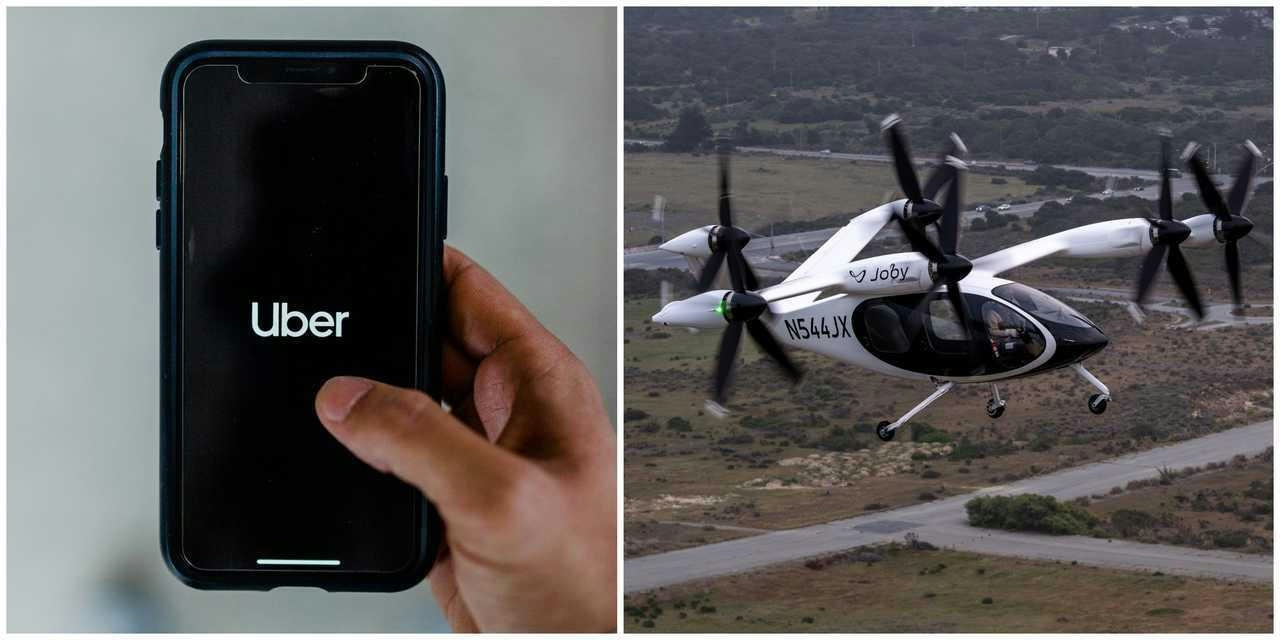
Uber Stock Reaches Record High Amid Joby and Blade Air Mobility Partnership
Uber Technologies’ shares surged to an unprecedented $98.85 on September 16, reflecting strong investor confidence in the company’s strategic evolution. Over the past year, Uber’s stock has appreciated by more than 70%, driven by increasing demand across its ride-hailing, delivery, and premium service segments. The company’s revenue has expanded nearly 18% year over year, supported by a global user base exceeding 150 million monthly active customers.
Strategic Partnership Signals Expansion into Urban Air Mobility
The recent surge in Uber’s stock price follows a landmark agreement involving Joby Aviation’s $125 million acquisition of Blade Air Mobility’s passenger business. This transaction is poised to integrate Blade’s helicopter and seaplane services—utilized by over 50,000 passengers in 2024—directly into the Uber app by 2026. This integration will enable users to seamlessly book combined ground and air transportation, such as helicopter transfers from Manhattan to airports, within a single platform.
Joby Aviation, a pioneer in electric vertical take-off and landing (eVTOL) aircraft, intends to gradually replace Blade’s helicopters with quieter, lower-emission eVTOL planes. This transition aligns with broader environmental objectives and positions Uber as one of the first major ride-hailing companies to embed air mobility into its core offerings. The partnership provides Joby with immediate access to Uber’s extensive customer network, while Blade benefits from enhanced operational scale and market reach.
Market Response and Industry Challenges
Investor reaction to the deal has been overwhelmingly positive, interpreting it as a clear indication that Uber is preparing for the next phase of mobility innovation. The global urban air mobility (UAM) market, valued at $5.4 billion in 2023, is projected to grow at an annual rate exceeding 30%, reaching an estimated $30 billion by 2030. For Uber, entering this premium segment could substantially increase average fares, as short urban flights often command prices in the hundreds of dollars, thereby boosting revenue per passenger.
Nonetheless, the ambitious integration faces significant challenges. Regulatory hurdles related to aviation certification may delay the deployment of eVTOL services. Additionally, competition within the sector is intensifying, with companies such as Archer Aviation, Lilium, and Vertical Aerospace developing their own air taxi solutions, while aerospace giants Boeing and Airbus maintain close scrutiny of the market. This competitive environment could trigger pricing pressures or accelerate technological innovation as firms vie for dominance in urban air mobility.
Despite these uncertainties, Uber’s record stock performance underscores a shift in market perception. The company is increasingly viewed not merely as a ride-hailing and food delivery platform but as a diversified mobility provider at the forefront of future transportation. The Joby-Blade agreement represents a pivotal milestone in Uber’s transformation, as it seeks to capture a significant share of the rapidly expanding urban air mobility market.

Etihad Airways Suspends Airbus A380 Flights on Key Route

Aditya Birla Group Seeks Approval for Aircraft Leasing in GIFT City

Qatar Airways Highlights Innovation and Connectivity at Arabian Travel Market 2026

Hong Kong's Five-Year Plan Includes Andrew Fan's Aircraft Parts Processing Hub Proposal

ACIA Aero Leasing Delivers ATR72-600 to Air Nostrum

RTX Appoints Jill Albertelli as Head of Pratt & Whitney

TAT Technologies Joins Beyond Aero Hydrogen Aircraft Program

AURAK Study Highlights Barriers to Air Taxi Adoption in Emerging Economies

Xiamen Air Selects Altitude for 787 Maintenance at Heathrow

Etihad and Swissport Extend Global Partnership
