Image

Orchestrate AI insights into action

Join the AeroGenie waitlist today!

Trending

Categories

WestJet Accused of Swapping Aircraft to Avoid Passenger Compensation
May 18, 2026By ePlane AI
WestJet Accused of Swapping Aircraft to Avoid Passenger Compensation
0
0
WestJet
Air Passenger Protection Regulations
Flight Compensation

WestJet Faces Allegations of Aircraft Swapping to Evade Passenger Compensation

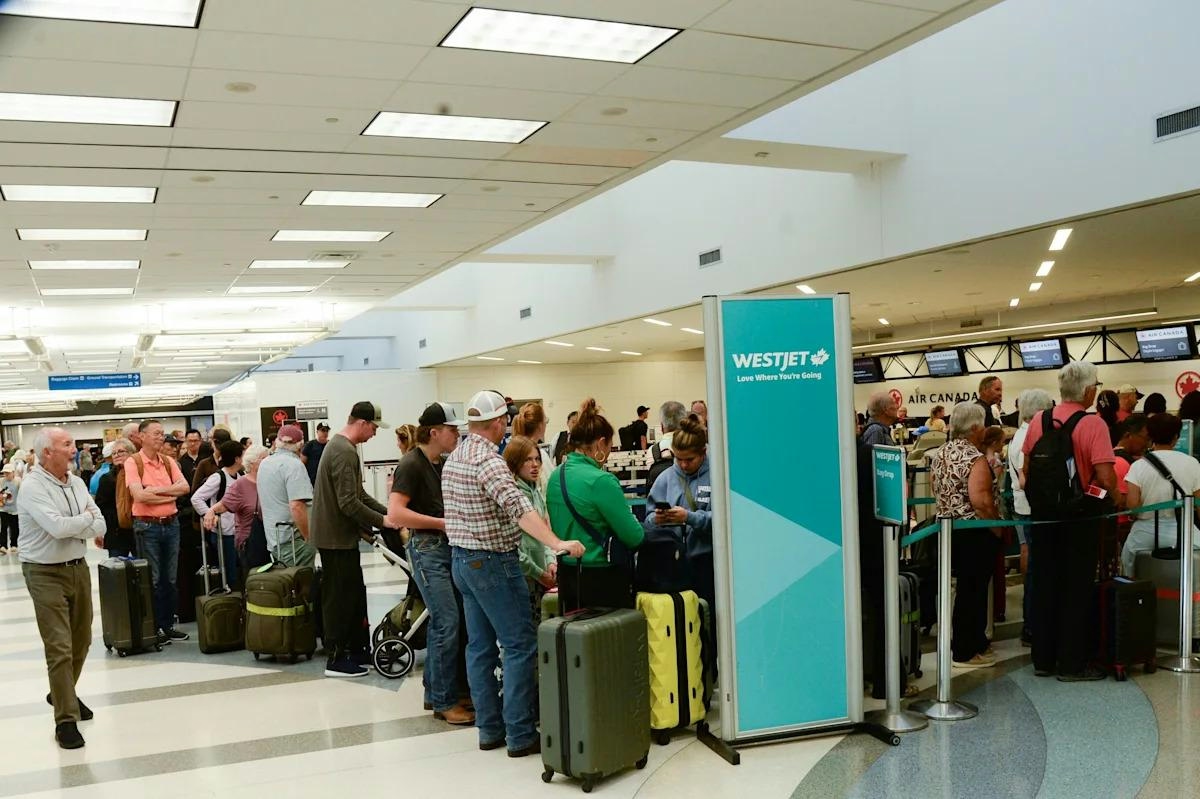
WestJet has come under scrutiny following accusations that the airline deliberately swapped aircraft and cited “unscheduled maintenance” as a pretext to avoid compensating passengers for delayed or cancelled flights. A joint investigation by CBC and Radio-Canada uncovered at least 34 instances where passengers were denied compensation after their flights were cancelled, often within minutes of an aircraft change. In each case, WestJet attributed the disruption to safety-related maintenance issues.

Regulatory Framework and Airline Response

Under Canada’s Air Passenger Protection Regulations (APPR), airlines are obligated to compensate passengers up to CAD 1,000 (approximately USD 727) for delays exceeding nine hours, provided the delay is within the airline’s control and not necessary for safety reasons. WestJet, however, maintains that the APPR explicitly recognizes unplanned aircraft maintenance as a routine aspect of airline operations, categorizing related delays as safety-required and therefore exempt from compensation. The airline further stated that when unexpected maintenance issues arise, management carefully evaluates options to minimize disruption for the greatest number of passengers.

Investigation and Industry Implications

The Canadian Transportation Agency has initiated an enforcement investigation into WestJet’s practices following these allegations. This development follows a 2022 ruling in which the agency found against WestJet in a similar case involving an aircraft swap and denied compensation to affected passengers.

The controversy poses significant challenges for WestJet, exposing the airline to potential regulatory penalties and reputational damage. It has also attracted the attention of competitors such as Delta and United Airlines, who may leverage the situation by offering alternative flights and refunds to dissatisfied customers, thereby intensifying competition within the Canadian aviation market. Additionally, the case could prompt regulatory authorities to reassess and potentially strengthen the rules governing airline compensation policies.

As the investigation proceeds, WestJet’s management of maintenance-related cancellations and its approach to passenger compensation remain under close observation by regulators and the public alike.

More news
Challenges Facing Asia's Aviation Maintenance Sector

Challenges Facing Asia's Aviation Maintenance Sector

Challenges Facing Asia's Aviation Maintenance Sector The September–October edition of *Asian Aviation* offers a comprehensive analysis of the maintenance, repair, and overhaul (MRO) landscape in Asia, coinciding with key industry events such as MRO Asia (22–24 September) and MRO Europe (27–28 October). With the sector poised to surpass a market value of US$150 billion by 2035, operators and service providers are confronting a complex mix of challenges and opportunities that will shape the future of aviation maintenance in the region. Rising Costs and Supply Chain Pressures Asia’s aviation maintenance industry is grappling with a substantial 15–20% increase in costs related to labor, parts, and logistics. The scarcity of essential materials, including titanium and semiconductors, is exerting additional pressure on profit margins. Facilities capable of delivering rapid turnaround times are commanding premium rates, reflecting the heightened demand for efficiency. Although supply chains are beginning to stabilize, the lingering effects of recent disruptions continue to impact original equipment manufacturers (OEMs) and MRO providers alike, many of whom are still addressing significant backlogs. Fleet Age and Maintenance Demand Delays in aircraft deliveries from major manufacturers such as Boeing and Airbus are anticipated to raise the average fleet age in the Asia-Pacific region to 11.4 years by 2026. An aging fleet necessitates more frequent and intensive maintenance checks, including heavy D-checks, which place additional strain on MRO capacity. Airlines like Qantas have already encountered unscheduled corrosion repairs that sidelined 737-800 aircraft for up to six weeks. This situation underscores a broader backlog affecting maintenance facilities in critical hubs such as Bangkok, Kuala Lumpur, and Jakarta. Regulatory and Sustainability Shifts Emerging sustainability regulations are increasingly influencing the sector’s trajectory. Singapore’s forthcoming mandate requiring a 1% sustainable aviation fuel (SAF) blend from 2026 is driving demand for retrofit packages that integrate fuel-system inspections with cabin reconfigurations. MRO providers are adapting their service offerings to incorporate these environmental compliance requirements, reflecting a growing emphasis on sustainability within the industry. Technology, Connectivity, and Business Models The issue also examines advancements in satellite technology and in-flight entertainment and connectivity (IFEC) systems, which are enhancing passenger experiences through faster internet access and richer content offerings. Concurrently, the traditional exclusivity in engine sourcing is diminishing, as airlines and lessors expand their options for engine support and maintenance agreements, signaling a shift toward more flexible business models. Operational Inefficiencies and Digitalization Shifting international trade policies are introducing new operational complexities across Asia’s aviation sector. The persistence of disconnected platforms for maintenance records, inventory management, and flight scheduling is generating inefficiencies and missed opportunities. This highlights an urgent need for greater digital integration to streamline operations and improve overall sector performance. Spotlight on Talent and Regional Growth The publication also highlights the increasing prominence of women in aviation, from cockpit roles to executive leadership positions. Additionally, it explores India’s rapidly expanding helicopter sector, where major manufacturers such as Airbus and Leonardo are investing alongside a new generation of MRO providers, component suppliers, and training organizations. As Asia’s aviation maintenance sector navigates these multifaceted challenges, industry leaders are prioritizing innovation, operational efficiency, and sustainability to maintain competitiveness in a dynamic and evolving market.
Ryanair Warned to Reinforce Engine Part Before Incident of Passenger Sucked Into Window

Ryanair Warned to Reinforce Engine Part Before Incident of Passenger Sucked Into Window

Ryanair Urged to Strengthen Engine Components Following Passenger Incident Background and Regulatory Warnings The hazardous condition that led to a Ryanair passenger being partially sucked out of an aircraft window was a known risk prior to the flight. The US Federal Aviation Administration (FAA) had issued three separate airworthiness directives mandating reinforcement of engine casing components on this generation of Boeing 737 aircraft. These directives were prompted by two earlier fan-blade failures in 2016 and the fatal 2018 Southwest Airlines incident, in which a passenger lost their life after being pulled partially through a shattered window. Details of the Ryanair Incident According to the National Transportation Safety Board (NTSB), the recent Ryanair event involved broken engine parts striking and shattering a cabin window, mirroring the circumstances of the Southwest tragedy. Ryanair’s CEO has suggested that the engine damage may have been caused by a foreign object. Nonetheless, the airline now faces intensified scrutiny regarding the maintenance of its 18-year-old fleet and the overall safety of its engines. Compliance Deadlines and Industry Implications Despite the FAA’s directives, airlines—including Ryanair—have until 2028 to complete the required retrofits, a full decade after the Southwest accident that triggered the regulations. At the time of the Ryanair engine failure, the compliance deadline was still two years away. The NTSB has not yet indicated whether earlier adherence to the directives would have averted this incident, but the delay between regulatory issuance and fleet-wide implementation remains a significant concern. The incident has generated market unease about Ryanair’s safety record, potentially affecting passenger confidence and the airline’s stock performance. Competitors may leverage this moment to emphasize their own safety protocols and the benefits of operating newer aircraft, thereby increasing pressure on Ryanair. As investigations continue to determine the precise cause—including whether maintenance shortcomings or external factors contributed—the gap between regulatory warnings and mandatory compliance highlights an ongoing risk for airlines and their insurers. Industry experts emphasize that such vulnerabilities should be incorporated into current risk assessments rather than deferred until after final investigation findings are released.
China Unveils 800-Passenger Jet Featuring ‘Flying Wing’ Design

China Unveils 800-Passenger Jet Featuring ‘Flying Wing’ Design

China Unveils 800-Passenger Jet Featuring ‘Flying Wing’ Design A Chinese research team has introduced an innovative aerodynamic model for a flying-wing passenger aircraft capable of accommodating over 800 passengers, marking a significant advancement in China’s efforts to transform the global aviation landscape. Developed by the China Aerodynamics Research and Development Centre (CARDC), the design diverges from traditional aircraft structures by integrating the fuselage, wings, and tail into a unified, broad lifting body. Design and Specifications The proposed aircraft spans 85 metres (280 feet) in width and 43 metres in length, boasting a wingspan approximately 1.6 times greater than that of the U.S. B-2 Spirit stealth bomber, which also utilizes a flying-wing configuration. By comparison, the Airbus A380—the largest passenger jet currently in operation—typically accommodates around 555 passengers, highlighting the unprecedented scale of China’s new concept. CARDC, a national institute instrumental in key Chinese aviation projects such as the C919 narrowbody airliner and the Y-20 military transport aircraft, characterizes the flying-wing passenger jet as a pioneering initiative exploring radical new configurations. Although the aircraft has yet to receive an official name, it forms part of a broader strategy to expand China’s footprint in the commercial aviation sector. Other notable projects include the C929, a 280-seat long-range widebody jet anticipated to debut around 2030, and the C949 supersonic airliner, which draws on NASA’s X-59 supersonic technology demonstrator. Challenges and Market Implications Despite its ambitious design, the flying-wing project faces considerable obstacles before it can enter commercial service. A primary challenge is the absence of type certification from U.S. and European aviation authorities, a prerequisite for accessing critical international markets. Without such certification, the aircraft’s commercial deployment may be confined to domestic or limited international routes. The introduction of this high-capacity jet also escalates competition within the global aviation market, historically dominated by Airbus and Boeing. Industry analysts suggest that Boeing, in particular, could encounter increased strategic and financial pressures as Chinese manufacturers accelerate the development of large passenger aircraft. While direct responses from these competitors have not been publicly disclosed, the emergence of advanced Chinese designs is poised to disrupt the longstanding duopoly and alter market dynamics. As China continues to invest heavily in aviation innovation, the flying-wing passenger jet symbolizes the nation’s resolve to become a major contender in the next generation of commercial aircraft, notwithstanding the regulatory and market access challenges that remain.
Starlux Airlines to Establish $132 Million Training Base in Taiwan

Starlux Airlines to Establish $132 Million Training Base in Taiwan

Starlux Airlines to Establish $132 Million Training Base in Taiwan Starlux Airlines has unveiled plans to invest TWD4.2 billion (approximately USD132 million) in a state-of-the-art multipurpose training facility located within the Taoyuan Aerotropolis in Taiwan. Scheduled for completion in 2029, this new complex will function as a comprehensive training hub for pilots, cabin crew, and other frontline personnel, underscoring the airline’s dedication to operational excellence and workforce development. Expansion of Taoyuan Campus and Strategic Investments The training center forms a critical component of Starlux’s broader vision for its Taoyuan campus, which encompasses corporate headquarters, crew accommodations, logistics operations, and maintenance, repair, and overhaul (MRO) facilities. Recently, the airline revised the budget for foundational work on its corporate headquarters at the site, reducing the allocation from TWD505 million (USD15.8 million) to TWD278 million (USD8.7 million), reflecting a strategic reallocation of resources. Challenges and Market Implications While the establishment of this ambitious training base marks a significant advancement for Starlux, it also presents notable challenges. The substantial upfront investment necessitates a strong return, hinging on the airline’s ability to recruit highly skilled instructors and develop training programs that comply with stringent international aviation standards. Nevertheless, the market response has been predominantly positive. The announcement has generated heightened interest among aspiring pilots and cabin crew, indicating the facility’s potential to alleviate talent shortages within Taiwan’s aviation industry. Industry analysts suggest that competitors may respond by enhancing their own training initiatives or expanding international routes to sustain their competitive edge. Starlux’s substantial investment highlights its long-term strategy to bolster operational capabilities and support future growth, positioning the airline as a prominent player in the region’s dynamic aviation sector.
Which Airlines Offer Lounge Access with Premium Economy?

Which Airlines Offer Lounge Access with Premium Economy?

Which Airlines Offer Lounge Access with Premium Economy? Premium economy has become a widely adopted cabin class on long-haul flights, yet the experience it offers varies significantly among airlines. While amenities such as extra legroom and priority boarding have become standard, the defining feature that distinguishes a true mid-tier product from a basic upgrade often lies in lounge access. Many travelers are surprised to discover that paying a premium over standard economy fares does not necessarily guarantee entry to airport lounges—facilities increasingly regarded as essential for comfort and productivity during travel. Airlines Providing Lounge Access as a Standard Benefit A select group of carriers incorporate lounge access as a core component of their premium economy offering. Leading this group are Japan’s flag carriers, Japan Airlines (JAL) and All Nippon Airways (ANA), alongside Scandinavian Airlines (SAS) and South America’s LATAM Airlines. These airlines grant business lounge access to premium economy passengers as a standard benefit, distinguishing themselves from major global carriers such as Emirates, Qantas, Lufthansa, and the principal US legacy airlines. The latter typically restrict lounge entry to business and first-class travelers or offer access only as a paid add-on. Japan’s Benchmark for Premium Economy Lounges JAL and ANA exemplify the integration of lounge access into the premium economy experience. Japan Airlines provides complimentary access to its Sakura Lounges at key Japanese airports including Haneda (HND) and Narita (NRT), as well as select partner lounges worldwide. This privilege extends even to full-fare Flex Y economy ticket holders, albeit with strict limitations: access is confined to the departure airport, guests are not permitted, and same-day airport upgrades are excluded. Similarly, ANA admits premium economy passengers on its international flights to business lounges at Haneda, Narita, Osaka Kansai, and Honolulu, in addition to select partner lounges across Asia, Europe, and North America. By offering lounge access as a default perk, both airlines leverage ground services as a competitive advantage to attract discerning international travelers. Despite these generous policies, operational constraints are increasingly evident. To manage growing demand and maintain service quality, airlines are imposing tighter entry conditions. Common restrictions now include prohibitions on guest access and the exclusion of passengers who have upgraded their seats at the airport. Industry Trends and Global Exceptions Outside of Japan, only a few airlines, notably SAS and LATAM, include lounge access with premium economy fares. In most other cases, lounge entry remains a privilege reserved for higher classes or elite frequent flyers, often requiring additional payment. The airline industry is responding to evolving passenger expectations and rising demand through several measures. Stricter access controls are being implemented to regulate lounge occupancy and preserve the premium environment. Partnerships with banks, credit card companies, and independent lounge operators are expanding, sometimes resulting in new lounges that blur traditional class distinctions. Concurrently, many airlines are adjusting fare structures by reducing included perks in base premium economy tickets, making lounge access an optional extra. Competition among carriers to offer superior lounge experiences continues, although delays in certifying new premium products and resistance to standardization have slowed the introduction of enhanced offerings. For travelers, lounge access with premium economy remains the exception rather than the norm. While JAL, ANA, SAS, and LATAM set a high standard, most airlines maintain lounges as exclusive spaces, leaving mid-cabin passengers to navigate a complex landscape of restrictions, additional fees, and shifting industry practices.
Four Aircraft Leasing Firms Control Majority of Global Widebody Fleet

Four Aircraft Leasing Firms Control Majority of Global Widebody Fleet

Four Aircraft Leasing Firms Dominate Global Widebody Fleet Nearly half of all commercial aircraft in operation worldwide are leased rather than owned outright by the airlines that fly them. When passengers board aircraft such as Delta Air Lines’ Airbus A330-900neo or Ryanair’s Boeing 737 MAX 8, there is approximately a 50% chance that the plane is owned by a leasing company. These lessors purchase aircraft directly from manufacturers like Airbus or Boeing and lease them to airlines under long-term contracts. Airlines pay monthly lease fees, operate the aircraft with their own crews on their own routes, and return the planes to the lessors at the end of the lease term. Ownership remains with the lessor, who typically reassigns the aircraft to another operator once the lease expires. Leasing Structures and Market Dynamics The predominant leasing arrangement is the dry lease, also known as an operating lease. Under this model, the lessor provides the aircraft alone, while the airline is responsible for flight and cabin crews, maintenance, insurance, and ground handling. Dry leases for widebody aircraft generally span 8 to 12 years, enabling airlines to avoid the substantial capital expenditure of purchasing aircraft valued between $100 million and $300 million. This approach also keeps the asset off the airline’s balance sheet. Lessors, in turn, generate returns by leasing the same aircraft to multiple operators over its typical 25 to 30-year service life. In contrast, wet leases—or ACMI leases (aircraft, crew, maintenance, and insurance)—involve the lessor supplying not only the aircraft but also the crew, maintenance, and insurance. The airline covers fuel, airport fees, and ground handling. Wet leases are typically short-term arrangements used to manage seasonal demand surges, aircraft groundings, or delivery delays. The Leading Lessors in the Widebody Market Four major aircraft leasing firms—SMBC Aviation Capital, Avolon, AerCap, and BOC Aviation—now control the majority of the global widebody fleet. These companies primarily operate in the dry lease market, owning extensive fleets and placing aircraft with airlines on long-term contracts across all major regions. AerCap holds the world’s largest fleet, with a portfolio heavily weighted toward new-generation narrowbody aircraft such as the Airbus A320neo family, A330neo, A350, Boeing 737 MAX, and 787. Avolon similarly focuses on new-generation narrowbodies but maintains a significant widebody presence, including Airbus A330s and Boeing 787s. SMBC Aviation Capital notably expanded its scale through the acquisition of Sumisho Air Lease Corporation in 2026, solidifying its position as a key player in the global leasing market. BOC Aviation, headquartered in Singapore and the only non-Irish firm among the top four, operates as a subsidiary of Bank of China. As of the first quarter of 2026, BOC Aviation owned 461 aircraft and managed an additional 13, serving 88 airlines across 46 countries. Its fleet is among the youngest in the industry, with an average age of 5.1 years and an average remaining lease term of 7.7 years. Challenges and Opportunities in a Shifting Landscape These leading lessors face ongoing challenges, including geopolitical pressures that impact airline profit margins and persistent supply chain disruptions affecting aircraft availability and maintenance. Nonetheless, they also benefit from emerging opportunities in areas such as aeroderivative turbines and strategic partnerships. Several firms have reported strong revenue growth or pursued diversification strategies in response to evolving market conditions. The aviation financing landscape continues to be shaped by fluctuating jet fuel prices, airline profitability, and the strategic initiatives of these dominant leasing companies. Industry competitors closely monitor their developments as the sector adapts to changing global dynamics.
American Airlines to Operate Airbus A321XLR on Nine Transatlantic and Transcontinental Routes in 2026

American Airlines to Operate Airbus A321XLR on Nine Transatlantic and Transcontinental Routes in 2026

American Airlines to Operate Airbus A321XLR on Nine Transatlantic and Transcontinental Routes in 2026 American Airlines is poised to transform its long-haul network by introducing the Airbus A321XLR on nine select transatlantic and transcontinental routes starting in 2026. This strategic deployment replaces larger widebody aircraft with a premium-focused, 155-seat narrowbody configuration, aiming to enhance profitability on routes characterized by moderate demand. Fleet Configuration and Passenger Experience The A321XLR will feature a significantly lower-density layout compared to the standard A321, which typically accommodates around 190 passengers. American Airlines’ configuration includes 20 Flagship Suite business class seats arranged in a 1-1 layout, each offering lie-flat beds and privacy doors. The premium economy cabin will consist of 12 seats equipped with enhanced recline, dedicated leg rests, and footrests. The main cabin will provide 123 seats, all fitted with seatback entertainment systems, Bluetooth connectivity, and high-speed Wi-Fi. This cabin arrangement is designed to replicate a widebody experience within a single-aisle aircraft, prioritizing premium seating options for corporate and luxury leisure travelers. By limiting total capacity, American aims to reduce unit costs while increasing the proportion of high-yield seats, thereby optimizing revenue on these routes. Route Deployment and Strategic Implications The A321XLR will be introduced on a mix of high-frequency domestic corridors and select European international routes. Domestically, the aircraft will serve flagship transcontinental routes including New York (JFK) to Los Angeles (LAX) and San Francisco (SFO), both of which cater to strong business travel demand. Additionally, the Boston (BOS) to Los Angeles (LAX) route will be operated exclusively with A321XLRs during peak summer months, offering multiple daily flights. These deployments will replace the aging 102-seat A321T fleet, increasing capacity while maintaining a three-cabin premium standard. On the transatlantic front, the A321XLR will debut on the New York (JFK) to Edinburgh (EDI) route, marking its first overseas service. The aircraft will also serve East Coast gateways to Barcelona (BCN), Lisbon (LIS), and Amsterdam (AMS), with daily service planned across both winter and summer schedules. These routes are targeted where widebody demand is insufficient, particularly during off-peak seasons, allowing American to maintain year-round connectivity with a more efficient aircraft. Market Challenges and Competitive Dynamics American Airlines’ decision to operate a 155-seat, low-density aircraft on traditionally widebody routes introduces several challenges. The airline must ensure consistent demand to justify the premium-heavy cabin configuration while managing operational costs and maintaining competitive pricing. Industry analysts are closely monitoring passenger response to the use of a single-aisle jet on long-haul routes historically served by larger aircraft. Competitors may adjust their fleet strategies or expand similar routes in response to American’s initiative, potentially intensifying market competition. Passenger Rights and Considerations For travelers, the A321XLR offers enhanced seating in Business and Premium Economy cabins, though main cabin passengers may experience a higher passenger-to-lavatory ratio compared to widebody aircraft. Under U.S. Department of Transportation and EU261/2004 regulations, passengers are entitled to compensation in cases of flight cancellations or significant delays caused by aircraft substitutions or technical issues. Should American replace the A321XLR with a lower-class aircraft, affected passengers may be eligible for partial refunds or downgrade compensation. As American Airlines prepares for the 2026 introduction of the A321XLR, the aviation industry will be closely observing how this innovative fleet strategy influences the future landscape of transatlantic and transcontinental air travel.
Beyond Turbulence: Examining the Air India Aircraft Incident

Beyond Turbulence: Examining the Air India Aircraft Incident

Beyond Turbulence: Examining the Air India Aircraft Incident On August 4, 2026, Air India flight AI2379, operating from Phuket to Delhi with 137 passengers and eight crew members on board, experienced a sudden and alarming event that has since drawn intense scrutiny. Initially reported as an episode of turbulence, the aircraft’s abrupt 300-foot altitude drop resulted in injuries to 17 passengers and has now been reclassified as a “serious incident” following the emergence of evidence pointing to multiple technical failures. Technical Malfunctions and Ongoing Investigations Preliminary investigations reveal that the Airbus A320neo encountered a series of malfunctions during the flight. These included faults in the hydraulic system, issues with the elevator flight controls, disconnection of the autopilot, warnings related to emergency-exit doors, and an engine anti-ice alert. Data provided by Airbus corroborate these anomalies, which collectively contributed to the sudden loss of altitude and subsequent passenger injuries. The Directorate General of Civil Aviation (DGCA) promptly launched an inquiry, which has since expanded to include the Aircraft Accident Investigation Bureau, France’s Bureau d’Enquêtes et d’Analyses (BEA), and technical experts from Airbus. Their joint efforts aim to identify the root causes of the incident and assess any systemic vulnerabilities. The Airline Pilots Association of India has emphasized the necessity of grounding conclusions in verified evidence rather than conjecture. This call for a transparent and comprehensive investigation comes amid growing concerns within the aviation market regarding Air India’s safety standards. Industry analysts note that competitors are closely monitoring the situation for potential impacts on consumer confidence and regulatory responses. Crew Fitness and Substance Screening Protocols In addition to technical factors, the incident has brought renewed attention to the protocols governing crew fitness and substance screening. The pilot-in-command underwent post-flight testing for psychoactive substances, prompting Air India—a joint venture between Tata Group and Singapore Airlines—to institute immediate mandatory screening of all flight deck personnel for unprescribed medications and substances. This move highlights a critical gap in existing procedures: while routine breathalyser tests for alcohol are standard before and after flights, screening for psychoactive substances remains less rigorous despite requirements outlined in the Civil Aviation Requirements (CAR) Section 5-Air Safety Series F Part V. These regulations, which also apply to Air Traffic Controllers, mandate random and post-shift testing accompanied by a system of graded disciplinary actions. However, as India’s aviation sector expands and crew members face increasing occupational stress, the availability and use of both medicinal and recreational substances present new regulatory challenges. The DGCA’s Medical Circular No. 02 of 2021 underscores the dangers associated with over-the-counter drugs and self-medication, referencing fatal accidents in Mangaluru (2010) and Kozhikode (2020) as cautionary precedents. International incidents further illustrate that even minimal impairment can significantly degrade a pilot’s judgment, reaction time, and decision-making—capabilities essential to maintaining flight safety. Ensuring that only fully fit and unimpaired crew members operate aircraft remains a cornerstone of aviation safety. As investigations into the Air India incident proceed, the episode serves as a stark reminder that operational compliance and stringent crew screening are indispensable. Although the event concluded without loss of life, reliance on fortuity is an untenable approach to safeguarding passengers and crew in the future.
The Changing Landscape of Electric Air Taxis

The Changing Landscape of Electric Air Taxis

The Changing Landscape of Electric Air Taxis This week has witnessed a flurry of developments in the electric vertical takeoff and landing (eVTOL) sector, highlighting the rapid evolution and consolidation within the industry. As companies contend with protracted regulatory approval processes and strive to generate near-term revenue, strategic partnerships and significant acquisitions are reshaping the competitive landscape. Strategic Acquisitions and Industry Consolidation In a notable and unexpected development, Archer Aviation announced the acquisition of its former competitor Wisk Aero, along with two Boeing subsidiaries: SkyGrid, a digital airspace management company, and Insitu, a drone manufacturer. In return, Boeing has acquired a 16.5 percent stake in Archer. This transaction marks a dramatic shift in the relationship between Archer and Wisk, who were previously engaged in a high-profile legal dispute in 2021 over allegations of intellectual property theft. The two-year lawsuit concluded with an unusual settlement that not only resolved the conflict but also laid the groundwork for future collaboration. Wisk Aero’s trajectory has been complex. Initially founded as Kitty Hawk by Sebastian Thrun and financially supported by Google co-founder Larry Page, the company’s Cora program survived the 2022 shutdown of Kitty Hawk by transitioning into a joint venture with Boeing. This partnership was later rebranded as Wisk Aero. Now, under Archer’s leadership, Wisk is positioned to expand its portfolio and forge new partnerships, potentially accelerating innovation in the sector. Meanwhile, Joby Aviation has made headlines with its $500 million acquisition of Resonant Sciences, a firm specializing in radio frequency and sensor technologies. This acquisition signals Joby’s intensified focus on the defense sector, with Resonant Sciences set to operate as Joby Defense. While Joby continues to prioritize the certification and manufacturing of eVTOLs for urban air taxi services, the company recognizes substantial revenue opportunities within defense applications. This dual approach reflects broader industry trends, with Joby emphasizing manufacturing and certification, and Archer pursuing growth through defense and autonomous technology ventures. Market Challenges and Shifting Priorities Despite these advances, the electric air taxi market faces considerable obstacles. Regulatory approval remains a significant barrier, compounded by the complexities of integrating eVTOLs into existing urban infrastructure. Market responses have been mixed: Joby Aviation has reported strong revenue growth, whereas Archer is banking on diversification and strategic partnerships to secure its future. Competitors are adopting varied strategies in response to these challenges. Some, like Joby, are concentrating on manufacturing and certification, while others, such as Archer, are leveraging acquisitions to broaden their capabilities in defense and autonomous systems. These shifting priorities are also reflected in policy decisions. For example, Florida recently redirected federal funds initially allocated for electric vehicle chargers to the construction of air taxi pads, underscoring evolving investment strategies and the increasing significance of urban air mobility. In a related development within the broader mobility sector, Uber unexpectedly divested its entire stake in Serve Robotics, the autonomous delivery robot company it had spun off more than five years ago. Sources indicate that Serve Robotics was taken by surprise by this decision, highlighting the unpredictable dynamics of the transportation industry. As electric air taxis move closer to commercial reality, the sector’s future will hinge on regulatory progress, infrastructure adaptation, and the ability of companies to balance innovation with viable revenue models.
Russia Uncertain About PD-8 Engine Longevity on Superjets

Russia Uncertain About PD-8 Engine Longevity on Superjets

Russia Faces Challenges in Establishing PD-8 Engine Longevity for Superjets Russia’s domestically developed PD-8 engine, designed to power the Superjet, confronts a critical obstacle: the absence of extensive long-term operational data. While bench testing provides valuable insights, it cannot substitute for the comprehensive real-world statistics necessary to fully assess the engine’s durability and reliability. This shortfall raises concerns about the PD-8’s certification timeline and its ability to compete effectively in both domestic and international aviation markets, particularly as Russia pursues import substitution strategies. Data Deficiency and Its Implications Andrey Patrakov, founder of the flight safety service RunAvia and a former Airbus auditor, highlights the advantage Western engine manufacturers hold due to decades of accumulated operational data. He points out that hundreds of thousands of Western engines operate globally, generating vast datasets that enable manufacturers to identify structural vulnerabilities and incrementally extend engine service life through continuous improvements. In stark contrast, Russian engines are produced and operated in far smaller quantities, making it impossible to amass comparable data within a short timeframe. This data gap is especially problematic as Russia expedites the introduction of new engines like the PD-8, which must not only secure certification but also prove reliable across a range of climatic conditions, flight profiles, and operational intensities. By the end of April 2026, PD-8 prototypes had logged over 6,100 hours of total operating time, a figure that exceeds that of comparable foreign engines at similar development stages. In May, the PD-8’s documentation was submitted to Rosaviatsiya, Russia’s aviation authority, marking a crucial step toward obtaining a type certificate. Market and Certification Challenges Ahead Despite these milestones, the lack of long-term operational data may delay certification, potentially disrupting production schedules and undermining confidence among investors and potential customers. Industry analysts suggest that skepticism regarding the PD-8’s service life could influence airline purchasing decisions, thereby affecting the Superjet’s market prospects. Competitors may exploit this uncertainty by promoting alternative engines with established reliability records, seeking to capture market share while Russia continues to validate its new powerplant. As the PD-8 advances through the certification process, its real-world performance will be closely scrutinized. The engine’s success or failure will not only reflect on Russian engineering capabilities but also serve as a barometer of the country’s broader efforts to reduce dependence on foreign technology and assert itself in the global aviation industry.
line









