
Orchestrate AI insights into action

Trending
Categories
Why Airlines Are Unable to Sue Engine Manufacturers Over Failures
Why Airlines Are Unable to Sue Engine Manufacturers Over Failures
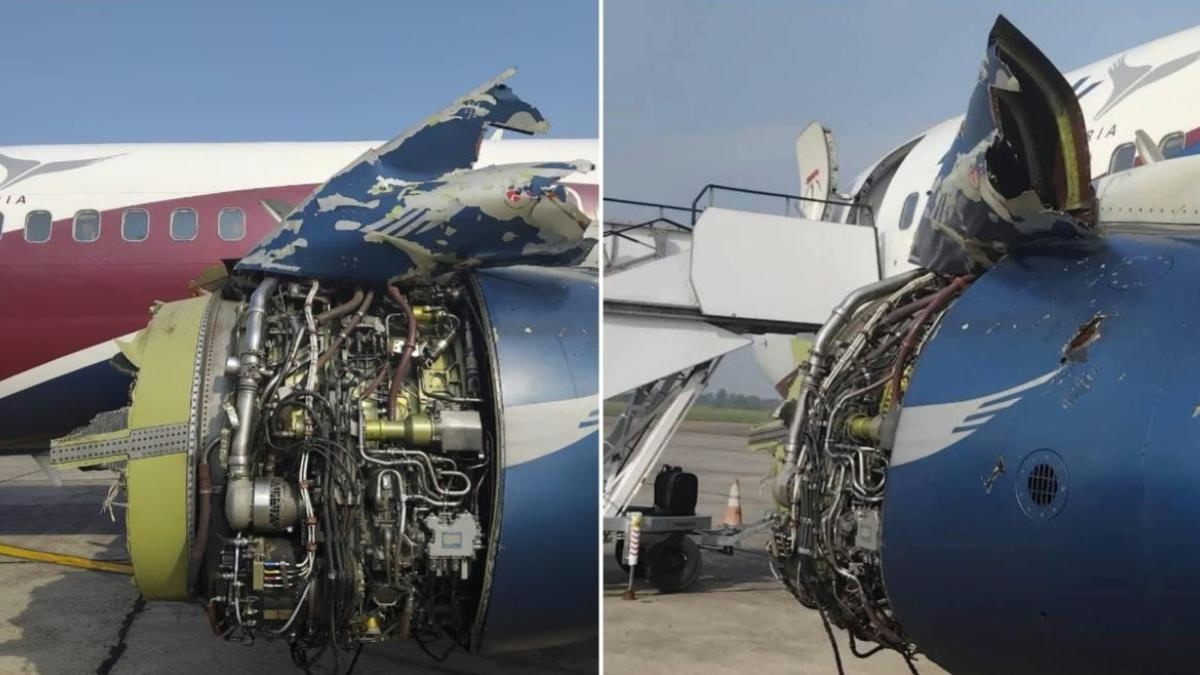
The outgoing director of the International Air Transport Association (IATA), Willie Walsh, delivered a pointed critique of the ongoing engine reliability challenges confronting the aviation sector. Speaking at the June 2026 IATA Annual General Meeting in Rio de Janeiro, Walsh highlighted the persistent disruptions caused by engine failures, maintenance-related groundings, and production delays. These issues have severely impacted airline operations, while engine manufacturers continue to report robust profits.
Walsh emphasized the disparity in accountability, noting that if airlines failed to meet their commitments to passengers, such lapses would be intolerable. However, when engine manufacturers fall short, airlines find themselves with limited avenues for recourse. He attributed this imbalance primarily to the lack of competition among original equipment manufacturers (OEMs). “We’ve got very little competition when it comes to engine suppliers, so you could argue they can get away with it,” Walsh remarked.
A Monopolized Market and Limited Legal Options
This problem is particularly evident in the case of Pratt & Whitney’s PW1100G geared turbofan engines, which power widely used aircraft such as the Airbus A320neo, A220, and Embraer E-Jet series. Following the discovery of defects in turbine blades that risk premature or catastrophic engine failure, airlines have faced extensive groundings and operational disruptions. Pratt & Whitney has struggled to resolve the backlog, with some aircraft expected to remain grounded until late 2027 or beyond.
For certain aircraft models, including the Airbus A220 and Embraer E2, Pratt & Whitney holds exclusive engine supply contracts. Such exclusivity is common in the industry and is often reinforced by complex contractual agreements that severely restrict airlines’ options. These contracts typically contain clauses that prevent airlines from seeking alternative suppliers or pursuing legal action for compensation, even in the face of significant engine failures.
Industry-Wide Impact and Executive Frustration
The scarcity of alternatives leaves airlines with minimal leverage. United Airlines CEO Scott Kirby has publicly identified engine shortages as a critical constraint on airline operations, echoing Walsh’s concerns. While some airlines have attempted to renegotiate terms or explore alternative suppliers—as demonstrated by United’s dispute with Rolls-Royce over alleged contract breaches—such efforts are infrequent and challenging due to the binding nature of exclusivity agreements.
The operational and financial consequences for airlines are substantial, manifesting in grounded aircraft, delayed flights, and dissatisfied customers. Despite these setbacks, major engine manufacturers including Pratt & Whitney, General Electric, CFM International, and Rolls-Royce continue to generate strong profits. Although all have faced recalls and quality control issues, the latest generation of engines has yet to deliver significant improvements in reliability.
A Dysfunctional Dynamic
The current structure of the jet engine market exposes airlines to risks they are ill-equipped to manage. With a limited number of suppliers and restrictive contractual frameworks, airlines lack effective legal mechanisms to hold engine manufacturers accountable, even when failures have widespread operational and financial repercussions. As Walsh and other industry leaders have underscored, until competition intensifies or contractual practices evolve, airlines will remain vulnerable to the performance and decisions of engine manufacturers.

Etihad Deploys Widebody Fleet to Meet Strong Demand

Korean Air Finalizes $36.2 Billion Deal with Boeing

Australia’s RFDS Queensland Section Orders Six King Air 260Cs

Korean Air Finalizes Order for 103 Boeing Jets and Engines

Embraer E195-E2 Features Distinctive Engine Placement Among Regional Jets

What Passengers Can Expect on Boeing’s New 777X Jet

How Ethiopian Airlines Became Africa’s Leading Carrier Amid Gulf Competition

Joby Aviation Extends Autonomous Flight Capabilities with Cross-Country Tour

Strengthening Europe's Aviation Supply Chain Amid Uncertainty
The Evolution of the Aircraft Maintenance Engineer Role
