
Orchestrate AI insights into action

Trending
Categories
Wisk Aero Advances Testing of Second-Generation Autonomous Air Taxi
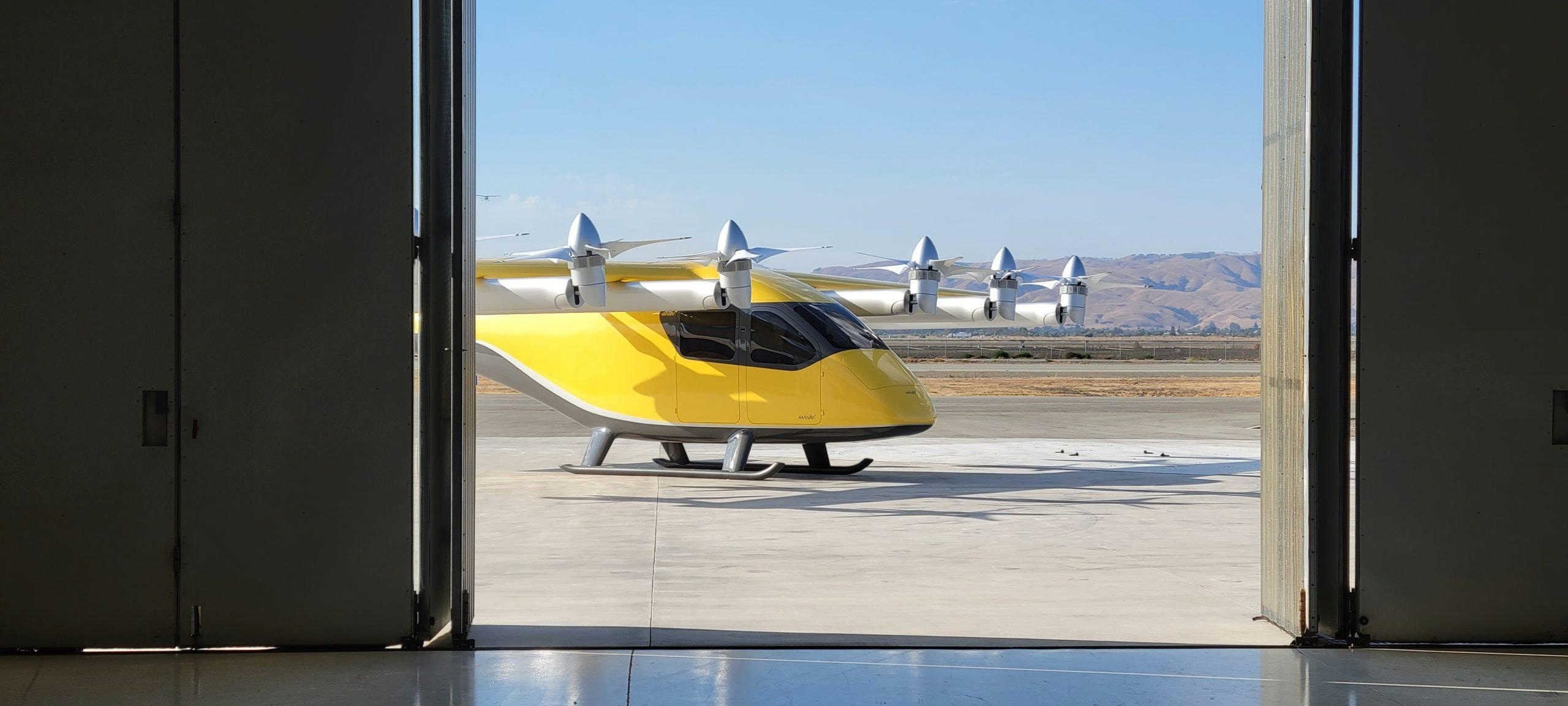
Wisk Aero Advances Testing of Second-Generation Autonomous Air Taxi
Wisk Aero has achieved a significant milestone in its certification campaign with the successful flight of its second Generation 6 autonomous air taxi. The flight, conducted on May 4 at the company’s test facility in Hollister, California, effectively doubles the active test fleet of the Boeing subsidiary and accelerates its progress toward regulatory approval.
The newly flown Gen 6 aircraft, registered as N607WA, completed a series of initial maneuvers including vertical takeoff, hover, and “chirp” tests—controlled frequency sweeps designed to evaluate the aircraft’s structural loads and flight control precision. This accomplishment comes just four and a half months after the first Gen 6’s maiden hover flight in December 2025, marking a pace that outstrips most electric vertical takeoff and landing (eVTOL) programs between first and second airframe flights.
Expanding the Flight Envelope and Certification Efforts
Operating two aircraft simultaneously provides Wisk with a strategic advantage in its certification process. Aircraft certification is inherently data-driven, requiring the Federal Aviation Administration (FAA) to verify safe performance across a broad range of conditions, including variations in airspeed, altitude, temperature, weight, and system failure scenarios. The dual-airframe approach enables Wisk to conduct parallel testing campaigns, thereby gathering data more efficiently and expediting the certification timeline.
The current testing phase aims to broaden the Gen 6’s flight envelope by transitioning from hover to wing-borne flight while refining control laws and system performance. The Gen 6 model features twelve propellers mounted on a fixed-wing airframe, engineered to operate at altitudes between 760 and 1,220 meters (2,500 to 4,000 feet) and speeds ranging from 160 to 195 kilometers per hour (100 to 120 miles per hour), with a maximum range of approximately 145 kilometers (90 miles). Notably, the aircraft functions without an onboard pilot; instead, a ground-based Multi-Vehicle Supervisor monitors operations and can intervene if necessary.
Regulatory Challenges and Market Competition
Wisk’s autonomy-first strategy distinguishes it from other U.S. eVTOL developers such as Joby Aviation, Archer Aviation, and Beta Technologies, which are pursuing certification for piloted aircraft where human pilots remain central to the safety case. In contrast, Wisk seeks FAA certification for an aircraft whose autonomous system itself constitutes the safety case—a regulatory challenge that demands extensive and rigorous evidence. The deployment of two aircraft in testing is critical to generating the comprehensive data required to satisfy these regulatory demands.
The competitive landscape is intensifying, with rivals advancing their own projects and, in some instances, engaging in legal disputes, exemplified by Joby’s lawsuit against Archer over alleged trade secret theft. Wisk’s collaboration with Aurora Flight Sciences highlights the importance of deep engineering expertise and robust subsystem integration to meet the complex technical and safety requirements of autonomous flight.
Industry Partnerships and Integration Initiatives
Wisk’s accelerated testing program aligns with its participation in the FAA’s eVTOL Integration Pilot Program (eIPP). In March, the U.S. Department of Transportation selected the Texas Department of Transportation as an eIPP participant, with Wisk serving as the primary private-sector partner. This partnership is expected to support Wisk’s efforts to integrate autonomous air taxis into the national airspace system, addressing the regulatory, technological, and operational challenges that lie ahead.
As Wisk progresses with its Gen 6 program, the company confronts not only the technical complexities of autonomy and certification but also the pressures of a rapidly evolving and highly competitive eVTOL market.
Embraer Delivers 2,000th E-Jet as Airbus A220 Seeks Market Share
iniBuilds Releases Second In-Depth A380 Video
Ryanair and Alaska Airlines Apply AI to Operational Decision-Making

Digital Payments, AI, and Aviation Strengthen Philippines-India Relations
PlaneSense Suspends PC-12 Jet Card Sales
How AI Could Transform Bird-Strike Prevention for Business Aviation
American Airlines and Boeing Complete First 737 MAX Landing Gear Swap

Vietjet and Thales sign major MRO and AI deals in Paris
Etihad CEO Cites Aircraft Capacity as Limiting Factor Amid Growth in China and Africa
Artificial Intelligence Enters the Cockpit
