Image

Orchestrate AI insights into action

Join the AeroGenie waitlist today!

Trending

Categories

Boeing Surpasses Airbus in Deliveries Amid Ongoing Recovery Challenges
April 6, 2026By ePlane AI
Boeing Surpasses Airbus in Deliveries Amid Ongoing Recovery Challenges
0
0
Boeing Deliveries
Airbus Competition
787 Dreamliner

Boeing Surpasses Airbus in Deliveries Amid Ongoing Recovery Challenges

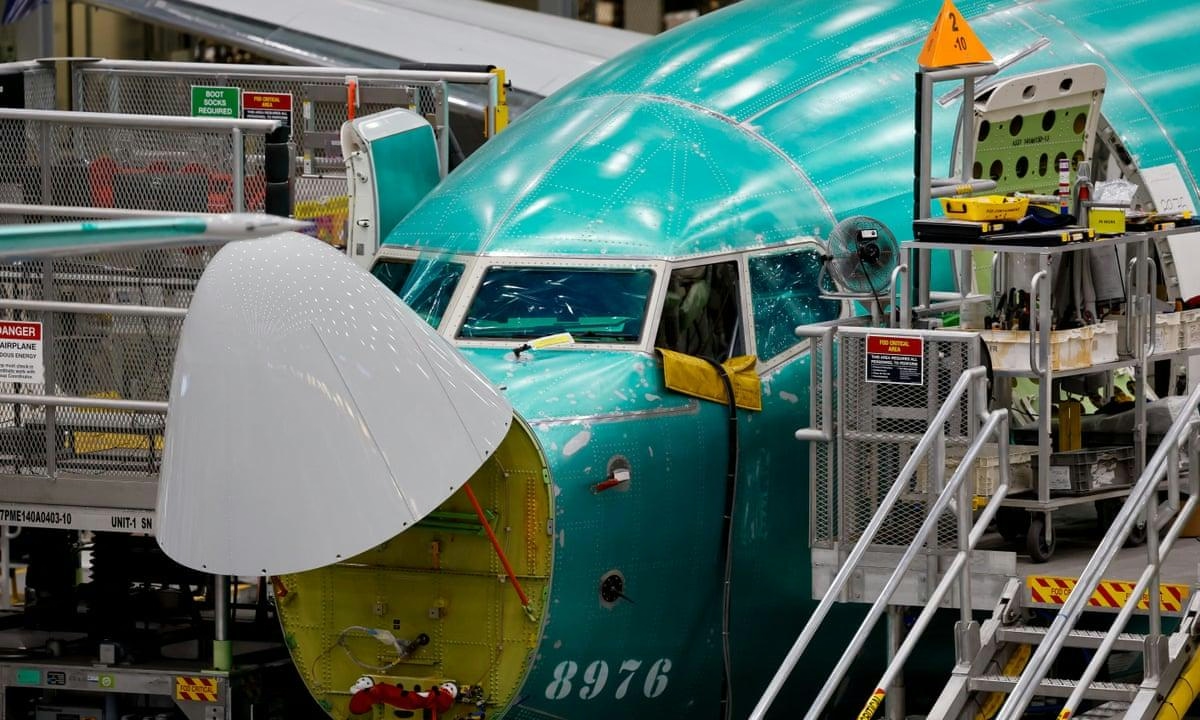
In a notable development within the global aerospace industry, Boeing (NYSE:BA) has overtaken Airbus in aircraft deliveries, signaling a significant shift after years marked by production setbacks and regulatory obstacles. In February 2026, Boeing delivered 51 aircraft, its highest monthly total since 2018, surpassing Airbus and reaching a nine-year peak. This achievement comes despite persistent challenges, including ongoing quality concerns related to premium class seats on the 787 Dreamliner.

Production Momentum and Strategic Wins

The increase in deliveries reflects renewed momentum in Boeing’s production system, which has faced considerable difficulties in recent years. The company’s operational progress is further highlighted by key successes in its defense and space divisions. Boeing recently secured a PAC-3 missile seeker contract and played a pivotal role in the successful launch of the Artemis Space Launch System (SLS) core stage, underscoring its strategic importance in national security and space exploration efforts.

Regulatory developments have also worked in Boeing’s favor. Authorities have approved higher takeoff weights for the 787 series, enhancing payload capacity and range options for airlines. This regulatory approval strengthens Boeing’s competitive position against long-haul rivals such as Airbus, as well as engine and systems partners including General Electric and Rolls Royce.

Challenges and Market Implications

Despite these positive indicators, Boeing’s outlook remains cautious due to several ongoing challenges. Recurring quality issues, delays in the certification of the 777X, rising fuel costs, and geopolitical tensions continue to exert pressure on both its commercial and defense operations. These factors affect production timelines, customer demand, and the pace at which order backlogs can be converted into deliveries and revenue.

The recent shift in delivery figures may influence market sentiment in Boeing’s favor, while Airbus could face increased scrutiny over its own production delays. Industry analysts anticipate that Airbus will respond by intensifying efforts to improve delivery rates and resolve bottlenecks in order to reclaim market share.

For investors, Boeing presents a complex profile. Operational gains, new defense contracts, and regulatory approvals may enhance the company’s competitiveness for future orders. However, unresolved quality concerns and certification delays pose risks that could impact program costs and delivery schedules.

As airlines and governments continue to prioritize fleet renewal, national security, and space initiatives, Boeing’s performance remains a critical factor in the broader aviation sector. Assessing the interplay of these elements is essential for understanding Boeing’s long-term trajectory as it navigates both recovery opportunities and persistent challenges.

More news
Republic Airways Pilots Test Electric Aircraft in Florida

Republic Airways Pilots Test Electric Aircraft in Florida

Republic Airways Pilots Test Electric Aircraft in Florida Pioneering Electric Aviation in South Florida Republic Airways pilots recently took to the skies over South Florida to operate Beta Technologies’ Alia CX300, a cutting-edge electric aircraft designed for diverse applications including passenger transport, cargo delivery, medical missions, and military use. In collaboration with FBO Signature Aviation, Beta and Republic conducted a series of intensive demonstration flights last week, culminating in a significant arrival at Orlando International Airport (KMCO) on Sunday. Orlando is among the first U.S. airports actively developing an electrified vertiport to support next-generation electric vertical takeoff and landing (eVTOL) aircraft. These demonstration flights represent an early phase in a broader initiative to advance electric aviation. Over the coming months, Beta and other manufacturers plan to expand operations across Florida and 25 additional states as part of the Federal Aviation Administration’s (FAA) eVTOL Integration Pilot Program (eIPP). This program will facilitate operational testing for at least three years. Earlier this year, Beta and Republic completed cold-weather trials in Plattsburgh, New York, and at Beta’s headquarters in Burlington, Vermont, conducting 34 flights over four days to assess performance under varying conditions. Technical Capabilities and Operational Testing Matt Koscal, president of Republic Airways, highlighted the importance of these tests, stating, “They’re helping illuminate what’s possible as we explore new ways to expand local air services in Florida and beyond.” In 2025, Republic took delivery of a “precertified” CX300, equipped with Beta’s H500A electric motor—currently undergoing type certification—and Hartzell’s FAA-certified electric propeller. The CX300 offers a demonstrated range of 336 nautical miles, a projected top speed of 135 knots, and can accommodate a pilot plus five passengers or up to 1,250 pounds of cargo. The aircraft can recharge in under an hour and is projected to be significantly more cost-effective to operate than traditional jet-fueled planes. To prepare for real-world deployment, Beta delivered the CX300 to Republic for route studies, pilot training, and use-case testing that spans passenger shuttles to cargo delivery. Three pilots from Republic’s Brickyard Connection unit completed coursework, simulator sessions, and check rides before flying up to nine legs daily during the demonstration period. Each flight incurred approximately $16.80 in energy costs. According to FlightAware data, the aircraft—tail number N916LF—completed 27 out-and-back flights at Kissimmee Gateway Airport (KISM) over three days, followed by flights to Orlando International, Daytona Beach, Jacksonville, and further north to Georgia and North Carolina. Challenges and Industry Implications Despite the promise of electric aviation, Republic Airways faces several challenges. Regulatory approval for electric aircraft remains a significant obstacle, alongside the need to develop robust charging infrastructure at airports. Comprehensive pilot training programs will be critical to ensuring safety and operational efficiency. The growing market interest in sustainable aviation has prompted competitors to accelerate their own electric aircraft initiatives or invest in related technologies. Some industry players may pursue favorable regulatory frameworks through lobbying or form strategic partnerships to share the substantial costs associated with development and deployment. Beta Technologies continues to expand its fleet, which includes N214BT, recently involved in a European test campaign with Bristow Group, and N401NZ, formerly a test aircraft for Air New Zealand and now operating in Japan. The company’s first type-conforming aircraft, N889CD, along with N336MR, remain in testing phases in Burlington and Plattsburgh, reflecting the rapid progress in electric aviation. As Republic and Beta advance their efforts, they are laying the groundwork for a new era of cleaner, more efficient air travel—one that has the potential to transform the aviation industry and inspire innovation among competitors worldwide.
Air France Deploys Large Long-Haul Jets to Budapest

Air France Deploys Large Long-Haul Jets to Budapest

Air France Deploys Large Long-Haul Jets to Budapest Amid Champions League Surge As excitement mounts ahead of the UEFA Champions League final, Air France is implementing a notable operational adjustment to manage the surge in passenger demand to Budapest. The French flag carrier is temporarily deploying its Boeing 777-300ER widebody aircraft—typically reserved for long-haul flights—on the short-haul route between Paris Charles de Gaulle and Budapest Ferenc Liszt International Airport. This strategic move aims to accommodate the unprecedented influx of football fans traveling to the Hungarian capital. Responding to Exceptional Demand The decision comes as tens of thousands of supporters from Paris Saint-Germain F.C. and Arsenal F.C. prepare to attend the final at Budapest’s Puskás Aréna on May 30, 2026. With accommodation and airfare prices across Europe soaring well above seasonal norms, the increased seating capacity provided by the larger aircraft offers essential relief to travelers facing congested airports and overbooked flights. European civil aviation authorities recognize the deployment of widebody jets on short-haul routes as an effective measure to manage sudden spikes in passenger volume. The use of these larger aircraft helps alleviate terminal congestion and mitigates the risk of air traffic delays, facilitating smoother transit for fans and tourists alike. Operational and Market Challenges This capacity enhancement arrives amid significant challenges for Air France and the wider airline industry. Jet fuel prices have doubled over the past two months, sharply increasing operating costs. Air France-KLM has already projected a potential $2.4 billion rise in fuel expenses for the year, highlighting the financial pressures associated with such fleet adjustments. Concurrently, the competitive environment is intensifying. American Airlines is introducing new routes to Budapest and Prague, prompting potential shifts in pricing strategies and service offerings as carriers compete for a share of the burgeoning trans-European travel market. These developments are likely to heighten competition and exert further pressure on profit margins for airlines operating in the region. Despite these hurdles, Air France’s deployment of its flagship long-haul jets underscores its commitment to maintaining service quality and meeting the extraordinary demand generated by one of Europe’s most anticipated sporting events. For thousands of fans, this operational upgrade provides a crucial lifeline, ensuring that their journey to the Champions League final is as seamless and memorable as the event itself.
Engine Fire Reported on Air India Bengaluru-Delhi Flight; All Passengers Safe

Engine Fire Reported on Air India Bengaluru-Delhi Flight; All Passengers Safe

Engine Fire on Air India Bengaluru-Delhi Flight: All Passengers Safe An Air India flight operating from Bengaluru to Delhi declared a full emergency on Thursday night after the cockpit crew received an engine fire warning during the aircraft’s final approach. The Airbus A321, registered VT-CIO and operating as Flight AI 2802, landed safely on runway 29R at Indira Gandhi International Airport at 9:30 pm. Airport operations were temporarily suspended as emergency protocols were activated. Incident Details and Response According to sources, the engine fire indication was received just before landing. The cockpit crew confirmed the warning and adhered to standard operating procedures to extinguish the fire after touchdown. Following the safe landing, the aircraft was towed off the runway, and all 180 passengers and crew disembarked without injury. Emergency services were on standby throughout the process, ensuring passenger safety and swift response. The Directorate General of Civil Aviation (DGCA) has initiated an investigation into the incident. In an official statement, Air India confirmed that the crew received a fire indication from one of the engines during the final approach and followed all prescribed safety protocols to land the aircraft safely. The airline emphasized that all passengers and crew are safe and have disembarked normally. Broader Context and Implications This event occurs amid increased scrutiny of aviation safety both within India and internationally. Recent incidents, including a Swiss flight aborting takeoff in Delhi and a Turkish Airlines aircraft catching fire in Nepal, have heightened concerns over airline safety standards. For Air India, the engine fire incident may prompt intensified regulatory oversight, potential compensation claims from passengers, and reputational challenges. Market analysts suggest that such occurrences can influence airline stock valuations and encourage competitors to highlight their own safety records. Air India has committed to conducting a thorough investigation in coordination with relevant authorities and pledged to provide verified updates as the inquiry progresses. The airline reaffirmed its dedication to passenger safety and compliance with regulatory standards while authorities work to determine the cause of the engine fire.
New Engines Central to Night Stalker MH-60M Black Hawk Upgrade

New Engines Central to Night Stalker MH-60M Black Hawk Upgrade

New Engines Central to Night Stalker MH-60M Black Hawk Upgrade The Role of the T901 Engine in Modernization Efforts The U.S. Army’s plans to upgrade its elite MH-60M Black Hawk helicopters, operated by the 160th Special Operations Aviation Regiment—commonly known as the Night Stalkers—are intrinsically linked to the progress of the Army’s Improved Turbine Engine Program (ITEP). Central to these efforts is the development and integration of General Electric’s T901 engine, which remains under development amid ongoing uncertainty regarding the program’s long-term viability. At the recent SOF Week conference, officials from U.S. Special Operations Command (SOCOM) underscored the pivotal role the T901 engine will play in defining the next generation of MH-60M helicopters. Lt. Col. Aron Hauquitz, head of the Technology Applications Program Office (TAPO), stated, “We are following very closely what the Army is doing with ITEP. We are hoping that we will get it. We’ll be able to put it in our aircraft, and we’ll create the Block 2 variant of the MH-60M.” Flight testing of the T901 engine on a modified Black Hawk is slated to commence in May 2025. SOCOM’s Program Manager for the MH-60, Lt. Col. Cameron Keogh, emphasized that the timeline for the next major upgrade—whether Block 1.2 or Block 2, anticipated to begin in Fiscal Year 2030—will depend heavily on the success of the T901 program. “It’s going to hinge on what’s going on with the Improved Turbine Engine, the T901 program that the Army’s running. We’re closely following that. If it continues to be successful, we will integrate that engine,” Keogh explained. Enhancements and Challenges in Upgrading the MH-60M The Night Stalker MH-60Ms are already equipped with a suite of specialized systems, including terrain-following and terrain-avoidance radar, advanced sensors, defensive countermeasures, and sophisticated communications equipment. Certain variants, configured as Direct Action Penetrators (DAP), carry an array of weapons such as guns, missiles, and rockets to provide close air support. While these enhancements significantly boost mission capability, they have also increased the aircraft’s weight compared to standard H-60 models. To address this, the 160th’s Black Hawks currently employ YT706 engines, which offer greater power than the T701 engines used in conventional Army Black Hawks. Integrating the new T901 engine presents a complex set of challenges. The process requires the seamless incorporation of advanced technology into existing airframes, ensuring both reliability and tangible performance improvements. Additionally, the substantial costs associated with such a comprehensive upgrade must be carefully managed. These challenges are compounded by broader issues in military aviation, where the maintenance and modernization of legacy systems remain ongoing concerns, as evidenced by the Army’s current investigation into transmission problems within the Apache helicopter fleet. Strategic and Market Implications The MH-60M upgrade carries significant implications for the defense market. The anticipated demand for advanced helicopter technology could influence future defense contracts and procurement strategies. Competitors may accelerate similar modernization efforts within their own fleets, as demonstrated by the U.S. Navy’s acquisition of the MH-60R Seahawk and South Korea’s expressed interest in the platform. As the Army and SOCOM continue to monitor the development of the T901 engine, the program’s outcome will not only determine the future operational capabilities of the Night Stalker fleet but may also set important precedents for military helicopter modernization on a global scale.
Why Boeing’s Most-Tested Aircraft Is Seven Years Behind Schedule

Why Boeing’s Most-Tested Aircraft Is Seven Years Behind Schedule

Why Boeing’s Most-Tested Aircraft Is Seven Years Behind Schedule Prolonged Certification Amid Heightened Regulatory Scrutiny Boeing’s 777X program is entering a critical phase as the company advances toward certification after enduring years of delays and intensified regulatory oversight. The 777X flight test fleet has accumulated over 4,500 hours across 1,600 flights, a figure that far surpasses the scope of a typical certification campaign. This extensive testing regimen is largely a consequence of more stringent Federal Aviation Administration (FAA) requirements introduced in the wake of the 737 MAX groundings, which have fundamentally altered the evaluation process for Boeing’s new aircraft. The 777X stands as a pivotal element in Boeing’s commercial aircraft lineup and represents a substantial investment for major airline customers, including Lufthansa. Initially scheduled to enter service in 2020, the aircraft’s debut has been postponed to 2027. These delays have compelled Boeing to absorb billions of dollars in development costs as certification demands have escalated. Technical Complexity and Regulatory Challenges The expanded testing program reflects both the evolving regulatory landscape and the inherent technical complexity of the 777X. The aircraft incorporates an all-new composite wing with folding wingtips, updated avionics, and the GE9X engine—the largest commercial jet engine ever produced. During rigorous high-stress testing, structural issues and concerns over engine durability emerged, prompting the FAA to mandate significantly more operational data than Boeing had originally anticipated. Consequently, Boeing expanded its test fleet and extended flight hours to satisfy these enhanced certification standards. These setbacks have reverberated throughout the airline industry. Lufthansa, for instance, has been forced to retain older Airbus A340s and Boeing 747s in active service longer than planned due to the absence of replacement aircraft. Similarly, Qantas, citing uncertainty surrounding the 777X timeline, opted to select the Airbus A350 for its Project Sunrise, representing a notable competitive setback for Boeing. Broader Implications for Boeing’s Aircraft Programs The 777X is not the only Boeing program experiencing significant delays. The MQ-25 Stingray, an autonomous refueling drone and Boeing’s most-tested aircraft, is now seven years behind schedule. Despite this, Boeing recently completed the first test flight of an operationally configured MQ-25, indicating progress within the program. Meanwhile, Boeing’s commercial backlog surged in April, supported by robust orders for both the 787 and 777X models. In addition, Boeing is actively pursuing certification for the long-delayed 737 MAX 7 and MAX 10 variants, with certification expected this year and deliveries slated to begin in 2027. The company remains on course to deliver the 777-9 and new MAX models next year, despite ongoing challenges. The 777X certification campaign has become one of the most exhaustive in Boeing’s history, shaped by FAA special conditions that require direct validation of systems, structures, and flight performance. Unlike previous programs, the 777X is the first major Boeing widebody developed entirely under these more rigorous standards, transforming what began as a conventional development effort into a protracted and costly process. For Boeing, the extended testing and certification requirements have evolved beyond an engineering challenge into a significant financial and competitive concern, with enduring implications for its standing in the global widebody market.
Dubai Unveils Advanced AI and Robotics for Mega ATM 2026 Aviation Event

Dubai Unveils Advanced AI and Robotics for Mega ATM 2026 Aviation Event

Dubai Unveils Advanced AI and Robotics for Mega ATM 2026 Aviation Event Dubai is once again positioning itself at the forefront of global aviation and tourism innovation with the announcement of advanced artificial intelligence (AI) and robotics technologies to be showcased at the Arabian Travel Market (ATM) 2026. Scheduled to take place from September 14 to 17 at the Dubai World Trade Centre, the event represents a strategic realignment aimed at maximizing international participation and reinforcing Dubai’s reputation as a premier hub for innovation, hospitality, and commerce. The decision to shift ATM 2026 to the autumn season follows extensive consultations with key exhibitors, regional partners, and stakeholders across the international travel sector. Organizers from RX have emphasized that the revised timing is designed to optimize commercial opportunities and facilitate seamless global engagement, reflecting Dubai’s adaptability to the evolving demands of the industry. Pioneering AI and Robotics in Aviation A centerpiece of ATM 2026 will be the unveiling of state-of-the-art AI and robotics solutions intended to revolutionize aviation and smart mobility. These technologies are poised to enhance passenger experiences, streamline airport operations, and establish new standards for efficiency and safety. Dubai’s commitment to integrating these innovations highlights its ambition to function as a living laboratory for the future of travel, combining luxury hospitality with cutting-edge business infrastructure. Nonetheless, the rapid integration of AI and robotics presents significant challenges. Industry experts note the substantial costs associated with embedding these systems into existing aviation and hospitality frameworks. Additionally, there is a critical need for comprehensive staff training to effectively manage and maintain these technologies, alongside potential resistance from traditional sectors cautious of swift digital transformation. Despite these obstacles, market responses have been predominantly positive, with growing investor interest in AI-driven solutions—a trend supported by recent analyses from CNBC underscoring the increasing significance of AI expenditure in global markets. Competitive Landscape and Global Implications Dubai’s ambitious initiative is already eliciting reactions from competitors worldwide. Cities and countries are accelerating their own AI and robotics programs to sustain competitive advantages, exemplified by recent developments such as PAL Robotics’ new robotic arm platforms. The broader movement of AI transitioning from research environments to practical applications is reshaping the global travel and financial technology sectors. Shaping the Future of Travel Under the theme “Travel 2040 Visionary Framework,” ATM 2026 will concentrate on the long-term evolution of the industry, emphasizing digital transformation and sustainable tourism models. The event is expected to draw thousands of tourism professionals, hospitality brands, and major airlines, all eager to explore emerging trends and establish cross-border partnerships. As Dubai prepares to host global stakeholders this autumn, the city continues to solidify its status as a visionary destination where innovation, strategic foresight, and world-class infrastructure converge to influence the trajectory of international travel over the coming decade.
GE to Release Leap-1B Update This Year to Address Cabin Smoke Issue

GE to Release Leap-1B Update This Year to Address Cabin Smoke Issue

GE to Release Leap-1B Software Update This Year to Address 737 Max Cabin Smoke Issue Background and Cause of the Issue GE Aerospace is preparing to introduce a software update for the CFM International Leap-1B engines that power Boeing 737 Max aircraft, targeting a cabin smoke risk identified following two Southwest Airlines flights in 2025. These incidents involved bird strikes, where large birds were ingested into the engines, triggering the activation of the Leap-1B’s load reduction device (LRD). This safety mechanism is designed to prevent further engine damage by causing the engine fan to separate during severe imbalances. However, the activation of the LRD revealed a critical flaw. It could open a flange connected to an oil sump and dislodge oil supply tubes, allowing oil to enter the compressor section. When exposed to the high temperatures within the engine, this oil generated smoke that the aircraft’s environmental control system could circulate into the cabin or cockpit, depending on which engine was affected. Development and Certification of the Software Fix In response, GE, in collaboration with Safran Aircraft Engines through their CFM joint venture, developed a software solution intended to reduce smoke by accelerating the closure of a valve during such events. Carlos Perez, GE’s vice-president of product safety, quality, and engineering, confirmed on May 19 that the software is currently undergoing certification processes involving both the engine and aircraft. He indicated that the update is expected to enter service within the year. The certification process involves regulatory authorities including the Federal Aviation Administration (FAA), Boeing, and the European Union Aviation Safety Agency (EASA). While GE anticipates a prompt rollout following certification, the timeline for updating the global 737 Max fleet remains uncertain. A report from the U.S. Department of Transportation’s Office of Inspector General in April highlighted that the FAA and Boeing have agreed to complete fleet updates by 2026 but cautioned that this extended timeline could pose additional risks to public safety. GE has not provided a detailed schedule for the software’s in-service implementation, though Perez noted that software updates generally proceed more rapidly than hardware modifications. Regulatory and Industry Implications The National Transportation Safety Board (NTSB) has recommended enhanced cockpit smoke training for pilots and updated airline procedures to mitigate risks. The NTSB has also urged regulators—including the FAA, EASA, and China’s civil aviation authority—to evaluate whether similar risks exist in other Leap engine variants, such as the Leap-1A used on Airbus A320neo-family jets and the Leap-1C on the Comac C919, both of which incorporate the LRD system. This issue arises amid increased scrutiny of engine manufacturers. Market concerns have emerged regarding the safety of Leap-1B engines and the potential reputational impact on GE. Meanwhile, competitors such as Pratt & Whitney are addressing durability challenges with their PW1000G engines, and CFM International is striving to increase Leap engine production despite ongoing supply chain difficulties. As the certification process advances, industry stakeholders remain attentive to both the technical resolution and regulatory responses, given the significant implications for passenger safety and the broader commercial aviation sector.
Airbus Order Talks Highlight Ongoing Demand in Aerospace Sector

Airbus Order Talks Highlight Ongoing Demand in Aerospace Sector

Airbus Order Talks Highlight Ongoing Demand in Aerospace Sector Renewed speculation surrounding a significant Airbus order from Ethiopian Airlines has brought Boeing back into the spotlight, underscoring the persistent global demand for commercial aircraft. Recent discussions within the aviation industry emphasize that airline fleet expansion and replacement remain central to the outlook for major manufacturers such as Boeing and Airbus. Market Dynamics and Competitive Landscape Although Boeing shares have not reacted to any formal announcements, the broader context holds considerable importance for U.S. investors. Boeing and Airbus are direct competitors in securing global airline orders, particularly in the wide-body and single-aisle segments. These markets are characterized by long production cycles and substantial backlogs, which heavily influence expectations for future deliveries and cash flow. Even mere speculation about a new Airbus order—potentially involving the A350 and A220 models—can swiftly affect sentiment across the aerospace sector, as recent aviation media coverage has demonstrated. For Boeing, commercial airplanes remain the most visible revenue driver. The 787 and 777X wide-body aircraft are critical to meeting long-haul demand, while the 737 family dominates short- and medium-haul markets. Although Boeing’s defense, space, and services divisions provide a degree of balance, investor focus often centers on airline fleet plans and order developments from competitors. The company’s business model depends on long-term customer relationships and production visibility, making it highly sensitive to shifts in airline expansion strategies and rival activities. Airbus Challenges and Strategic Initiatives Airbus faces its own challenges despite strong sales in the narrow-body segment and a growing North American services market, which is projected to expand from $38 billion in 2025 to $54.4 billion by 2044. The European manufacturer is currently grappling with a delivery bottleneck, fulfilling only 70.4% of planned deliveries. This constraint contributed to a 7% year-on-year decline in first-quarter 2026 revenues, following the delivery of just 114 aircraft. In response, Airbus is advancing the development of the A350F freighter, with first deliveries expected in 2026, aiming to challenge Boeing’s dominance in the cargo aircraft segment. Implications for Investors and Industry Outlook Competitor responses continue to shape the aerospace market landscape. Boeing is focused on stabilizing production of its 737 MAX to capitalize on sustained demand for single-aisle jets. Meanwhile, Airbus’s order book and delivery performance remain closely monitored indicators of the sector’s overall health. For U.S. investors, Boeing’s exposure to both commercial aviation recovery and defense spending renders it particularly sensitive to changes in airline fleet strategies, supply chain execution, and government budgets. Market reactions tend to be swift when either manufacturer secures or discusses new large orders, as these developments signal active airline investment and fleet renewal—key indicators for industrial companies with a global footprint. Ongoing order discussions and delivery challenges at both Airbus and Boeing reflect a dynamic aerospace sector where fleet renewal and expansion continue to be top priorities for airlines worldwide.
Mid-Air AI Handoff: A New Era for Combat Aviation

Mid-Air AI Handoff: A New Era for Combat Aviation

Mid-Air AI Handoff: A New Era for Combat Aviation Advancing Flexibility in Autonomous Flight As autonomous aviation technology continues to evolve, achieving operational flexibility remains a critical challenge. Current systems predominantly rely on a single, tightly integrated artificial intelligence (AI) “brain” to control an aircraft. This approach limits adaptability, making it difficult to respond swiftly to new mission parameters, software updates, or shifting operational demands. Such rigidity can impede innovation and restrict the integration of specialized capabilities from diverse technology providers. Recent flight tests, however, suggest a transformative shift may be underway. Engineers utilizing a modified Model 437 Vanguard aircraft have successfully demonstrated that multiple AI systems can assume control of the same aircraft during flight without disrupting its operation. These trials confirmed that control could be transferred in real time between different autonomy software packages, with the aircraft maintaining stable and safe flight throughout the transitions. Modular Autonomy Architecture and Operational Benefits Central to this breakthrough is a modular autonomy architecture that divides missions into smaller functional elements, or “skills,” such as navigation, coordination, and specific mission actions. During testing, the aircraft initially operated under one autonomy system before seamlessly switching mid-flight to others, each assuming responsibility for selected functions. These transitions occurred without any instability, highlighting the robustness of the underlying framework. Beyond the handoff capability, the platform supports advanced features including real-time coordination between crewed and uncrewed assets, dynamic route adjustments, and safe operation within complex airspace environments. Employing a manned demonstrator as a testbed reduces both risk and cost, allowing developers to validate software under real flight conditions prior to deployment on fully autonomous platforms. The system’s plug-and-play design further facilitates the integration of third-party technologies, accelerating development cycles and fostering innovation. Strategic Implications and Emerging Challenges From a defense perspective, the implications of this technology are profound. Future operational environments are expected to feature a blend of crewed and autonomous systems working collaboratively under rapidly changing conditions. The ability to switch between different AI controllers mid-mission could enable military forces to adapt in real time, integrate new capabilities more rapidly, and maintain operational continuity even if one system fails or is compromised. Nonetheless, this technological advancement introduces new challenges. Experts such as David Petraeus and Isaac Flanagan have underscored the necessity for clear protocols governing the use, training, and maintenance of autonomous weapon systems to ensure their effectiveness and prevent unnecessary expenditures. The integration of conversational AI tools—such as the Maven Smart System and Palantir Artificial Intelligence Platform—within the U.S. Department of Defense and NATO is already accelerating battlefield decision-making, prompting market responses focused on enhancing operational readiness and training. Competitors in the defense sector are also responding to these developments, with other contractors expected to develop similar AI-driven coordination platforms to maintain their competitive edge in the rapidly evolving combat aviation landscape. The results of these recent tests point toward a more flexible and resilient model for autonomous aviation—one in which aircraft are no longer confined to a single control system but can dynamically evolve as mission requirements change.
Air Taxis Could Link Almaty, Konayev, and Alatau in Kazakhstan

Air Taxis Could Link Almaty, Konayev, and Alatau in Kazakhstan

Kazakhstan Advances Air Taxi Services Linking Almaty, Konayev, and Alatau Kazakhstan is moving forward with plans to introduce passenger and cargo air taxi services connecting the cities of Almaty, Konayev, and Alatau, with operations potentially commencing as early as 2027. Deputy Prime Minister Kanat Bozumbayev revealed that comprehensive aerotaxi testing is scheduled for 2026, following the Transport Ministry’s preparation of temporary regulations and the issuance of permits for trial flights, as reported by The Caspian Post via Kazinform. Route Planning and Safety Considerations Authorities and aviation experts are currently evaluating potential routes that would link key locations such as Almaty International Airport, the city’s railway station, Konayev, and the Kapshagai reservoir. Safety remains a paramount concern, with assessments focusing on factors including wind conditions, flight altitudes, terrain, aeromagnetic zones, and the proximity of high-voltage power lines. These evaluations aim to ensure the secure and efficient operation of air taxis within the region’s complex geographical and infrastructural landscape. Collaboration, Funding, and Challenges The project is being developed in partnership with leading aerotaxi companies and specialists from China and the United States, nations recognized for their advancements in urban air mobility. Notably, the initiative will be financed entirely through private investment and local companies, without reliance on state budget funds. Despite this promising collaboration, the rollout of air taxi services faces significant challenges. Regulatory hurdles, including the need to secure certifications from aviation authorities, must be addressed. Additionally, infrastructure development, such as the construction of vertiports for takeoff and landing, will be critical to the project’s success. Market reception may initially be cautious, as potential users weigh the novelty of air taxis against their potential to drastically reduce travel times. Furthermore, industry competitors may respond by developing similar services or lobbying for regulatory frameworks that favor established players. Context Within Global Urban Air Mobility Trends Kazakhstan’s initiative reflects broader global trends in urban air mobility. For instance, Joby Aviation is currently demonstrating its electric vertical takeoff and landing (eVTOL) air taxis in New York City, aiming to facilitate rapid urban commutes. These international efforts underscore common industry challenges, such as obtaining regulatory certification and securing public acceptance. The anticipated aerotaxi network in Kazakhstan is expected to transport both passengers and cargo, potentially transforming mobility and logistics in Almaty and its surrounding regions. This announcement follows Kazakhstan’s inaugural air taxi test flights, conducted in Alatau City on May 19, highlighting the country’s growing commitment to adopting advanced transportation technologies.
line









