
Orchestrate AI insights into action

Trending
Categories
China Continues to Rely on Western Technology for Advanced Innovations
China Continues to Rely on Western Technology for Advanced Innovations
Aerospace Ambitions and Persistent Challenges
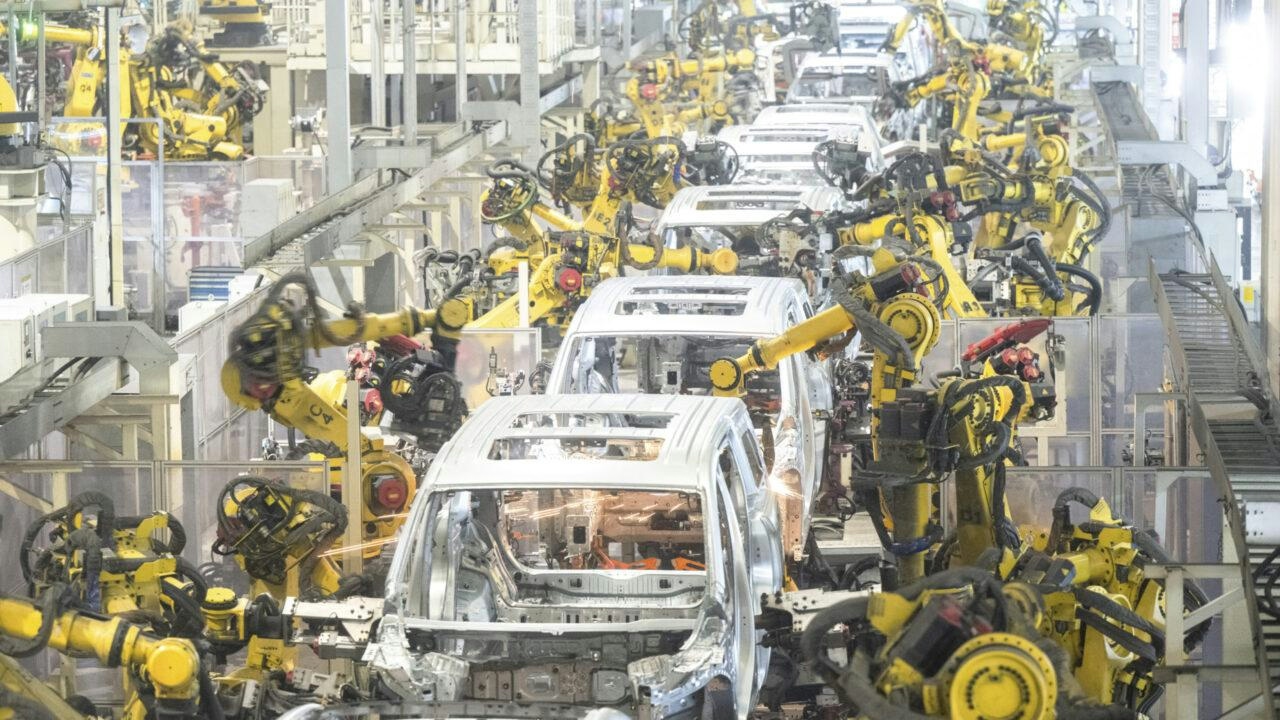
China has firmly established itself as a global manufacturing leader, producing a wide array of goods ranging from everyday household items to electric vehicles. However, when it comes to cutting-edge technologies, the nation continues to encounter significant obstacles. This dependence on Western expertise is exemplified by the recent announcement from the state-owned aerospace manufacturer COMAC. The company revealed that Aviage Systems, a US-Chinese joint venture, will be responsible for developing the core avionics processing system for its forthcoming C929 passenger jet. Often described as the aircraft’s “central brain,” this system highlights China’s ongoing reliance on Western technology for critical components.
COMAC presented the C929, which remains in the detailed design phase, at the Singapore Airshow last month. The jet is positioned as China’s response to Western widebody aircraft such as the Boeing 787 Dreamliner and Airbus A350. Despite this ambitious vision, the project is far from completion, with particular attention focused on the unresolved challenge of producing a suitable jet engine. China continues to grapple with the complex metallurgy and manufacturing precision required for large turbofan engines, a domain still dominated by Western companies. Internal reports dating back to 2017 reveal persistent quality issues and a strategy heavily reliant on imitation and reverse engineering, factors that have contributed to a technological lag in this sector.
Efforts to develop the CJ-2000 turbofan engine, intended as China’s domestic equivalent to the Rolls-Royce Trent-1000, have shown some progress, including record thrust achievements in recent tests. Nevertheless, the engine has yet to match the reliability and longevity of its Western counterparts. Rolls-Royce, recognizing China’s demand for advanced engines, has a longstanding history of cooperation with Beijing, dating back to Cold War-era technology transfers and a landmark 1975 agreement to supply Spey turbofan engines.
Advances in Artificial Intelligence and Strategic Implications
Despite the challenges faced in aerospace, China has made significant advances in other high-technology sectors, particularly artificial intelligence (AI). The country’s rapid progress in AI has narrowed the gap with Western nations, raising concerns among global technology leaders. Demis Hassabis, CEO of Google DeepMind, recently noted that Chinese AI companies are now only six months behind the most advanced Western laboratories. While the United States continues to control access to the most sophisticated semiconductor chips, China is developing an alternative AI ecosystem based on domestic hardware, efficient algorithms, and vast data resources.
This technological shift carries not only economic but also strategic and national security implications. China’s technology sector has demonstrated resilience, as evidenced by the strong performance of tech listings in Hong Kong amid Beijing’s push for self-reliance. Analysts warn that China’s rapid ascent in AI poses a challenge to U.S. dominance, as the country moves up the value chain and offers affordable, widely deployed AI solutions to developing economies.
China’s dual approach—leveraging foreign expertise where necessary while aggressively pursuing domestic innovation—reflects a broader strategy aimed at achieving technological self-sufficiency and enhancing global competitiveness. While the nation continues to depend on Western technology for its most advanced innovations, particularly in aerospace, it is simultaneously closing the gap in other critical sectors.

Etihad Airways Suspends Airbus A380 Flights on Key Route

Aditya Birla Group Seeks Approval for Aircraft Leasing in GIFT City

Qatar Airways Highlights Innovation and Connectivity at Arabian Travel Market 2026

Hong Kong's Five-Year Plan Includes Andrew Fan's Aircraft Parts Processing Hub Proposal

ACIA Aero Leasing Delivers ATR72-600 to Air Nostrum

RTX Appoints Jill Albertelli as Head of Pratt & Whitney

TAT Technologies Joins Beyond Aero Hydrogen Aircraft Program

AURAK Study Highlights Barriers to Air Taxi Adoption in Emerging Economies

Xiamen Air Selects Altitude for 787 Maintenance at Heathrow

Etihad and Swissport Extend Global Partnership
