
Orchestrate AI insights into action

Trending
Categories
Emirates A380 Serves Five U.S. Airports
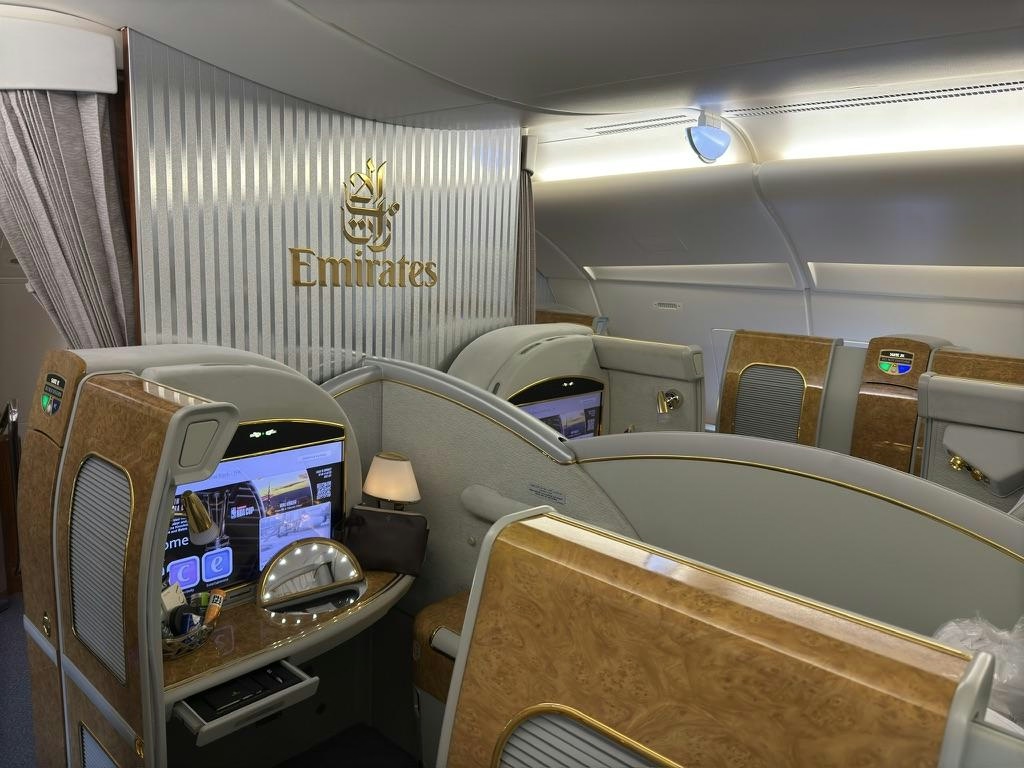
Emirates A380 Expands Presence Across Five Major U.S. Airports
The Airbus A380, renowned as one of the most iconic widebody aircraft in commercial aviation, was originally designed to serve high-density, long-haul routes from major global hubs. Despite the initial enthusiasm surrounding its debut, the superjumbo’s considerable size and elevated operating costs posed challenges for many airlines, particularly as the industry shifted toward more fuel-efficient twin-engine jets. Production delays and changing market conditions led several carriers to cancel their orders, culminating in Airbus’s decision to cease A380 manufacturing in 2021. Today, only a select few airlines continue to operate the aircraft, with Emirates emerging as the largest global operator of the A380.
Emirates, the United Arab Emirates’ flag carrier, was the launch customer for the A380 program in 2000, initially ordering five aircraft with options for an additional five. Over time, the airline significantly expanded its fleet, making the A380 a central component of its long-haul network. Currently, Emirates operates 118 A380s, deploying them on high-demand routes spanning Europe, Africa, Asia, and the United States.
Emirates’ Growing U.S. A380 Network
The United States remains a vital market for Emirates, which has maintained a strong presence there for more than two decades. The airline now operates the A380 on routes from Dubai to five major U.S. airports: Washington Dulles International, Houston George Bush Intercontinental, New York John F. Kennedy International (JFK), Los Angeles International, and San Francisco International. Most of these routes feature a daily A380 departure, with New York JFK receiving two daily flights. Emirates plans to sustain these services through at least the first quarter of next year.
Emirates’ inaugural U.S. A380 flight was to JFK, which remained its sole American A380 destination until 2013, when Los Angeles was added. Houston and San Francisco followed in 2014. Notably, the Houston route is now the only daily A380 operation in a U.S. market that no longer sees regular superjumbo flights from other carriers. This service, launched in 2007 with a Boeing 777-200LR, introduced the A380 in December 2014, although the aircraft type was temporarily replaced by the 777 between 2016 and 2018.
In addition to these routes, Emirates operates a significant fifth-freedom A380 service between Milan Malpensa and New York JFK. This route has grown in commercial importance and was upgraded from a 777 to an A380 as passenger demand increased.
Competitive Dynamics and Strategic Alliances
Emirates’ expansion of A380 services in the U.S. occurs amid intensifying competition within the transatlantic market. FlyDubai has announced ambitious growth plans, while recent remarks by United Airlines’ CEO regarding American Airlines have underscored the heightened rivalry among carriers. These developments have contributed to volatility in airline sector stocks, as reflected in the Skift Travel 200 index, which monitors the financial performance of nearly 200 travel companies.
In response to these evolving market conditions, Emirates and Air Canada have extended their strategic partnership through a major multi-year expansion agreement. This collaboration includes new routes connecting Canada and the United States, further enhancing Emirates’ North American network and competitive positioning.
As Emirates continues to deploy the A380 on key U.S. routes, its strategy underscores both the enduring appeal of the superjumbo and the shifting dynamics of international air travel.

Etihad Airways Suspends Airbus A380 Flights on Key Route

Aditya Birla Group Seeks Approval for Aircraft Leasing in GIFT City

Qatar Airways Highlights Innovation and Connectivity at Arabian Travel Market 2026

Hong Kong's Five-Year Plan Includes Andrew Fan's Aircraft Parts Processing Hub Proposal

ACIA Aero Leasing Delivers ATR72-600 to Air Nostrum

RTX Appoints Jill Albertelli as Head of Pratt & Whitney

TAT Technologies Joins Beyond Aero Hydrogen Aircraft Program

AURAK Study Highlights Barriers to Air Taxi Adoption in Emerging Economies

Xiamen Air Selects Altitude for 787 Maintenance at Heathrow

Etihad and Swissport Extend Global Partnership
