
Orchestrate AI insights into action

Trending
Categories
Final A-10 Engine Completed After 50 Years, Marking End of an Era in Military Aviation
Final A-10 Engine Completed After 50 Years, Marking End of an Era in Military Aviation
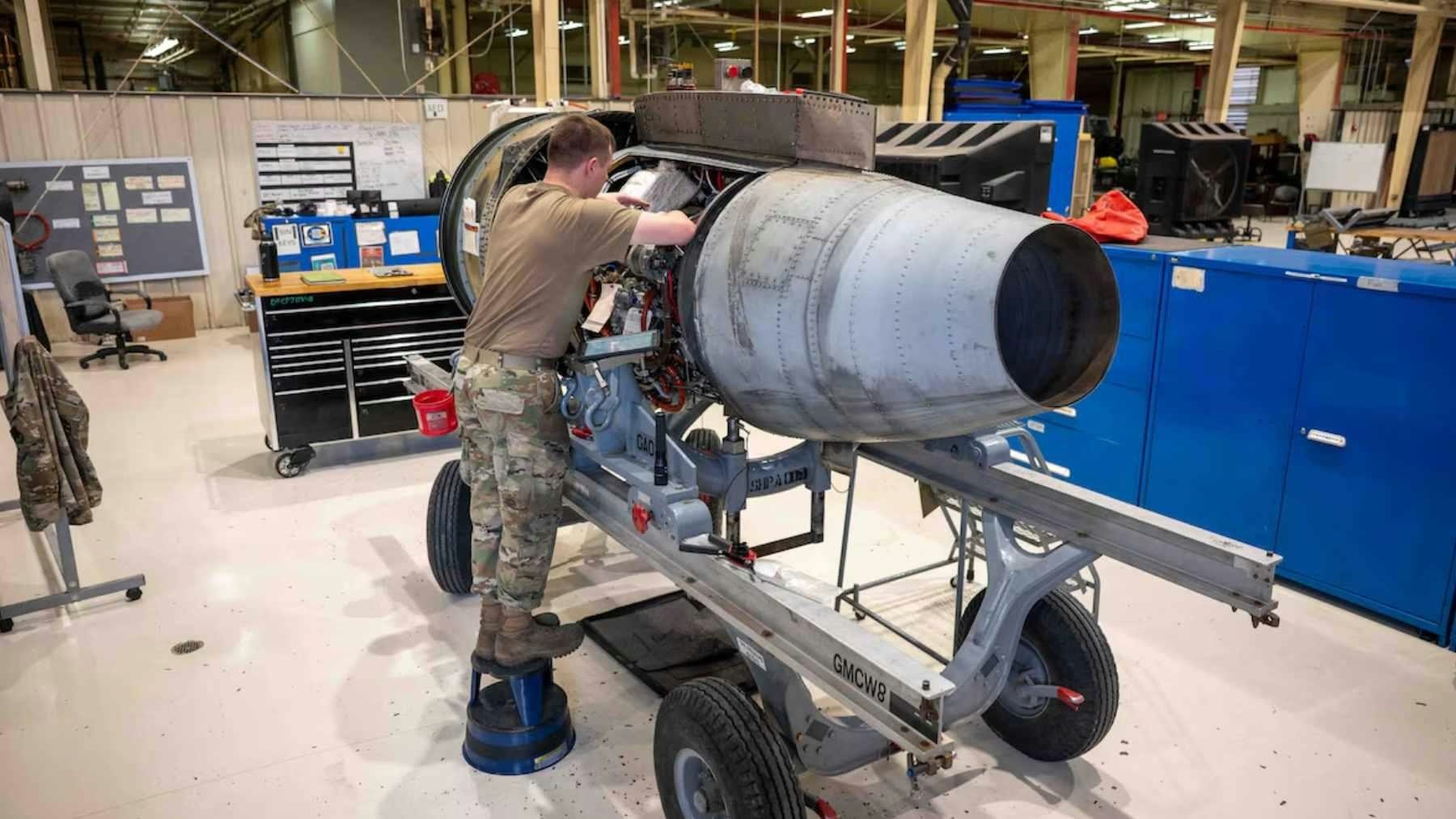
The completion of the final General Electric TF34 engine for the A-10 Thunderbolt II, known affectionately as the “Warthog,” at Davis-Monthan Air Force Base represents a significant milestone in the aircraft’s storied history. After nearly five decades of continuous support, this event signals the gradual winding down of the maintenance operations, expertise, and infrastructure that have sustained one of the United States’ most iconic close air support platforms.
A Milestone at Davis-Monthan Air Force Base
On May 21, 2026, personnel from the 355th Component Maintenance Squadron (CMS), alongside base leadership, gathered to mark the completion of the last A-10 engine build at Davis-Monthan. The engine had successfully passed its final test cell run on April 30, meeting the stringent standards required for operational readiness. The assembly of an A-10 engine is a painstaking process that typically spans a month, with each phase governed by exacting technical protocols, underscoring the critical nature of maintaining combat aircraft.
Master Sgt. Eugene Rich III, propulsion flight chief for the 355th CMS, emphasized the collective effort behind this final build, noting that the entire maintenance shop contributed rather than the usual smaller team. He highlighted the life-saving impact of these engines, reflecting on the vital role maintainers have played throughout the A-10’s operational tenure.
Davis-Monthan’s association with the A-10 dates back to the 1970s, establishing the base as a central hub for the aircraft’s daily operations. For decades, maintainers at the base have supported deployments, training exercises, and routine missions—work that, while often unseen, has been indispensable to both pilots and ground forces. The A-10 was the first Air Force aircraft specifically engineered for close air support, a mission that requires flying low and slow in proximity to ground troops engaged in combat.
The Warthog’s Legacy and the Future of Close Air Support
The A-10’s distinctive capabilities have long fueled debate regarding its retirement. Its ability to loiter over battlefields, operate from austere environments, and deliver a combination of precision-guided and unguided munitions has made it a uniquely effective platform. The aircraft’s signature GAU-8/A Gatling gun, capable of firing 3,900 rounds per minute, alongside its capacity to carry up to 16,000 pounds of ordnance, established the Warthog as a formidable ground-attack asset.
However, the completion of the final engine also symbolizes a broader transition within military aviation. The U.S. Air Force is moving toward replacing the A-10 with newer platforms such as the F-35 and F-15, which are expected to assume its close air support and combat search-and-rescue roles. Although the A-10’s retirement has been postponed amid ongoing discussions in Congress and the Pentagon, the shift toward next-generation aircraft is underway.
This transition is prompting strategic adjustments across the defense industry. Companies like MTU are pursuing new partnerships, including collaborations with AeroDesignWorks, to realign their military engine development strategies toward future combat aircraft. Meanwhile, Europe’s ambitions for a sixth-generation fighter have encountered setbacks, with France and Germany dissolving their joint program, reflecting evolving alliances and priorities in global military aviation.
As the last A-10 engine leaves the assembly line, it not only closes a chapter for Davis-Monthan Air Force Base but also marks the end of an era for the Warthog and the generations of Airmen who have maintained its mission readiness over the past fifty years.

Etihad Deploys Widebody Fleet to Meet Strong Demand

Korean Air Finalizes $36.2 Billion Deal with Boeing

Australia’s RFDS Queensland Section Orders Six King Air 260Cs

Korean Air Finalizes Order for 103 Boeing Jets and Engines

Embraer E195-E2 Features Distinctive Engine Placement Among Regional Jets

What Passengers Can Expect on Boeing’s New 777X Jet

How Ethiopian Airlines Became Africa’s Leading Carrier Amid Gulf Competition

Joby Aviation Extends Autonomous Flight Capabilities with Cross-Country Tour
Strengthening Europe's Aviation Supply Chain Amid Uncertainty
The Evolution of the Aircraft Maintenance Engineer Role
