
Orchestrate AI insights into action

Trending
Categories
Human Factors: When Effort Falls Short
Human Factors: When Effort Falls Short
Engine Failure and Emergency Response
The National Transportation Safety Board’s (NTSB) final report on the March 2024 aviation accident begins with a stark account: approximately 30 minutes into the flight, the airplane’s engine abruptly emitted a loud noise before ceasing to produce power. This sudden failure was accompanied by oil spraying across the windscreen, severely impairing the pilot’s visibility. With the nearest airport beyond reach and the Altamaha River in Georgia swollen to flood stage below, the pilot swiftly established the best glide speed, issued a Mayday call, and maneuvered to avoid the river. The terrain ahead offered little reprieve, consisting of dense pine forests and hilly ground, conditions far from ideal for an emergency landing.
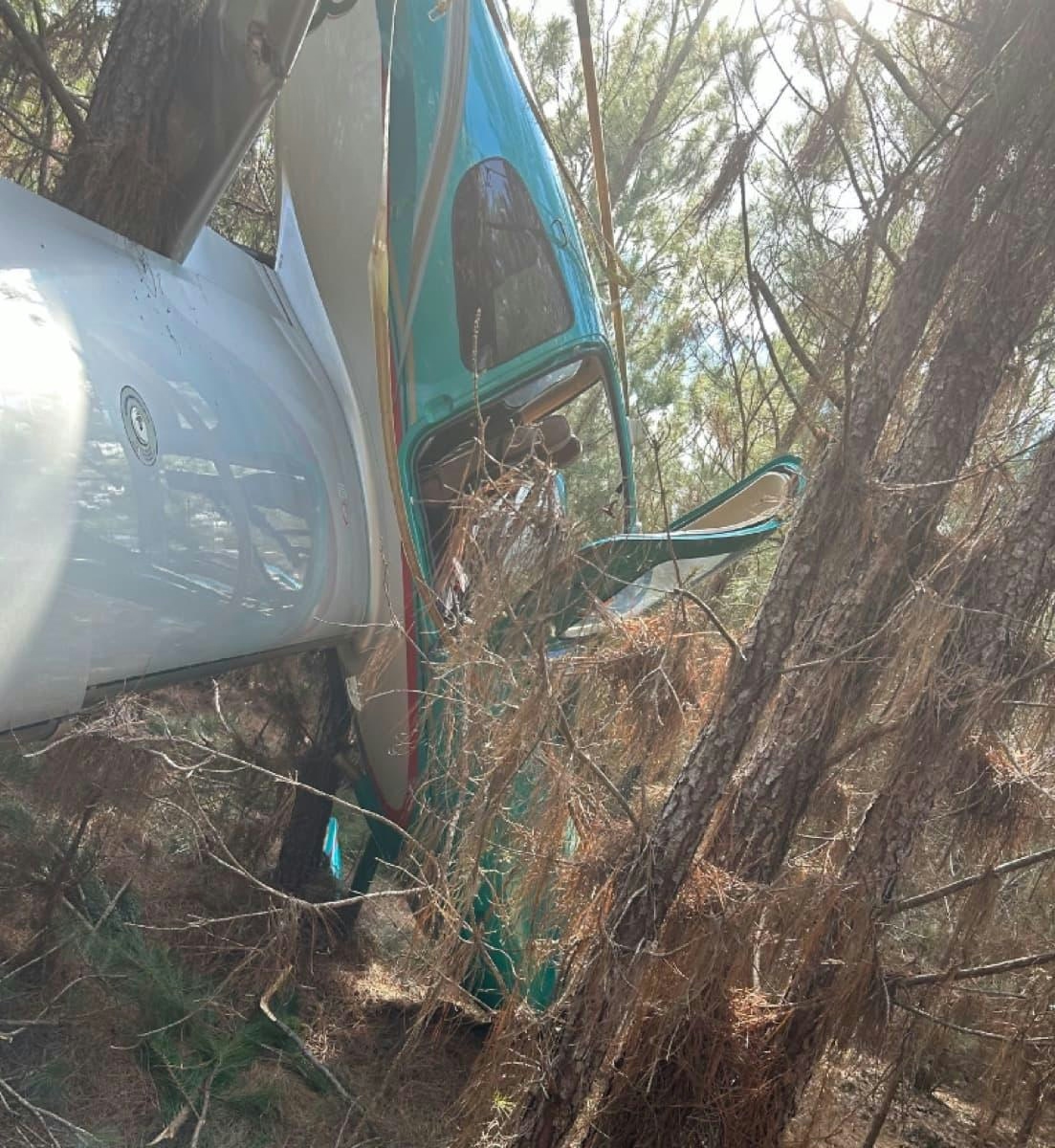
The aircraft involved, a 2015 Cirrus SR22 Xi Edition, was equipped with a full-frame parachute system. The pilot prudently waited until the last safe moment, ensuring clearance from the river and surrounding swamp, before deploying the parachute. The descent carried the pilot, his wife, and their dog into the forest canopy. The aircraft struck the trees, flipped nose down, and came to rest entangled among young pines, with its spinner nearly touching the ground. Remarkably, all occupants escaped without injury, though the aircraft sustained substantial damage, as later confirmed by NTSB investigators.
Mechanical Breakdown and Investigation Findings
The investigation quickly identified the cause of the engine failure. Upon removing the engine cowl, investigators discovered a catastrophic breach in the engine crankcase near cylinders Nos. 3 and 4. A large portion of the engine’s upper section was missing, including much of the base of the No. 4 cylinder. The connecting rod for the No. 4 piston was absent, with only fragments recovered from the crankcase and oil sump. Metal debris was found throughout the oil filter, and the oil pump exhibited internal scratches caused by circulating metal fragments. The remaining five connecting rods were also compromised, showing signs of bushing displacement, chipping, and in some cases, breakage.
This incident highlights a critical reality in aviation and other high-stakes industries: despite rigorous preparation and advanced technology, human factors and unforeseen mechanical failures can still precipitate critical breakdowns. The complex interplay between human decision-making and mechanical reliability remains a constant challenge.
Broader Implications: Human Factors in Technology and Markets
A parallel can be drawn between this aviation incident and the current volatility in financial markets, where human factors intersect with rapid technological change. Recent fluctuations in stock prices, particularly among technology companies, have been driven by investor reactions to advancements in artificial intelligence. Concerns over AI tools potentially displacing established software have led to sharp declines in share values. In response, competitors face the imperative to adapt—either by investing heavily in AI to maintain competitiveness or by emphasizing human-centric strategies to differentiate themselves.
Market reactions have been swift and severe, with analysts cautioning that volatility may persist amid unpredictable economic conditions and geopolitical tensions. Companies must carefully balance risks and opportunities, sometimes pivoting strategically to leverage human expertise or to mitigate uncertainties introduced by technological disruption.
Whether in the cockpit or the boardroom, the enduring lesson is clear: effort and preparation are indispensable but not always sufficient. Human factors—including decision-making under pressure and adaptability in the face of unforeseen challenges—continue to shape outcomes, for better or worse.

Etihad Airways Suspends Airbus A380 Flights on Key Route

Aditya Birla Group Seeks Approval for Aircraft Leasing in GIFT City

Qatar Airways Highlights Innovation and Connectivity at Arabian Travel Market 2026

Hong Kong's Five-Year Plan Includes Andrew Fan's Aircraft Parts Processing Hub Proposal

ACIA Aero Leasing Delivers ATR72-600 to Air Nostrum

RTX Appoints Jill Albertelli as Head of Pratt & Whitney

TAT Technologies Joins Beyond Aero Hydrogen Aircraft Program

AURAK Study Highlights Barriers to Air Taxi Adoption in Emerging Economies

Xiamen Air Selects Altitude for 787 Maintenance at Heathrow

Etihad and Swissport Extend Global Partnership
