
Orchestrate AI insights into action

Trending
Categories
New Aircraft Engines Aim to Reduce Fuel and Energy Use
New Aircraft Engines Aim to Reduce Fuel and Energy Use
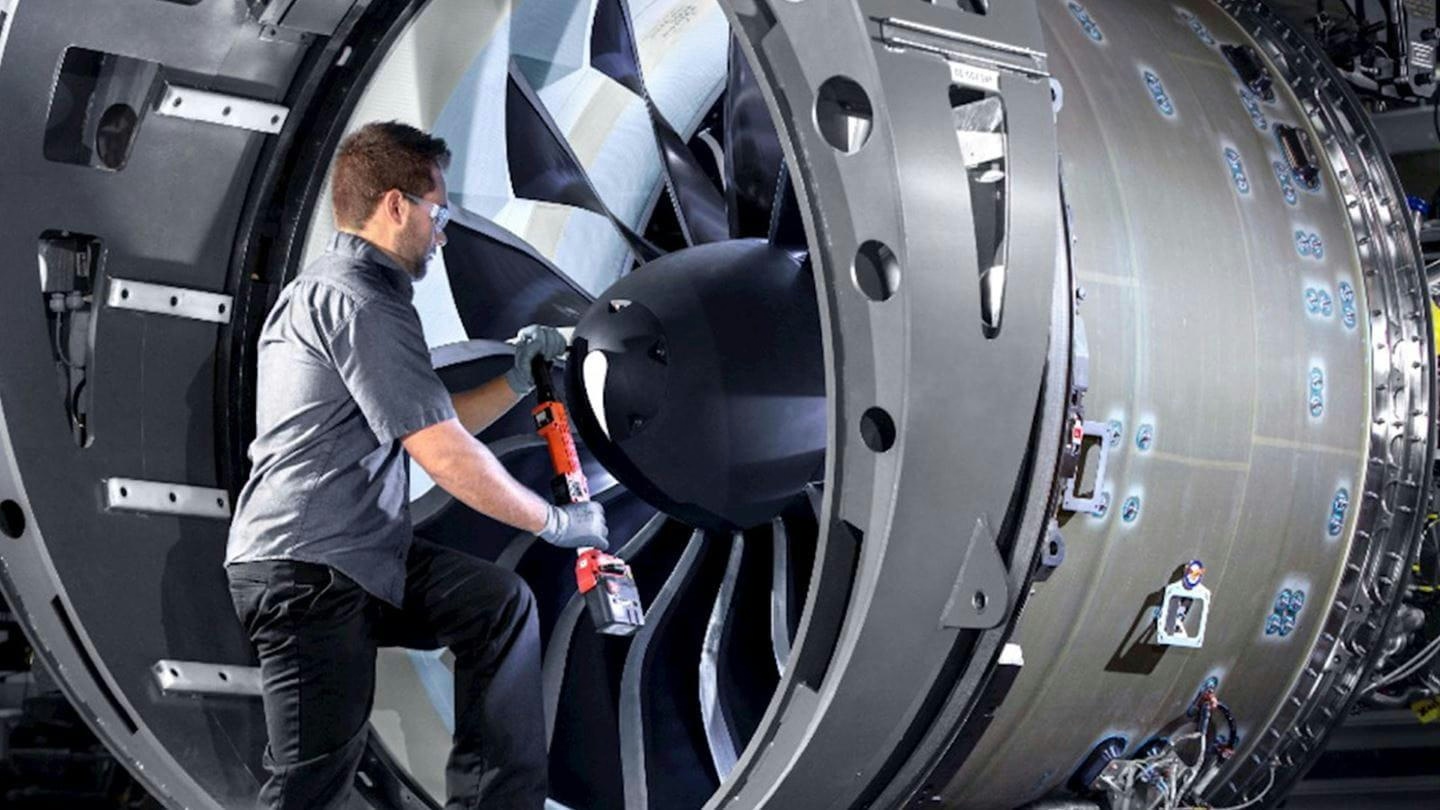
A research team at TU Graz has pioneered advanced methods to enhance aircraft engine efficiency through an AI-supported model developed in-house. This effort supports the European Commission’s “Flightpath 2050” strategy, which targets substantial reductions in emissions, fuel consumption, and overall energy use within the aviation sector. Meeting these ambitious goals necessitates the development of more efficient engine technologies, a challenge that the ARIADNE project is actively addressing by accelerating the creation of next-generation engines.
AI-Driven Optimisation of Turbine Components
The TU Graz researchers have integrated years of flow data on intermediate turbine ducts with artificial intelligence and machine learning techniques. Their model enables rapid evaluation of how variations in numerous geometric parameters influence engine efficiency, significantly streamlining a process that traditionally depended on extensive and time-consuming simulations.
Intermediate turbine ducts play a critical role in aircraft engines by directing airflow between high-pressure and low-pressure turbines, which operate at different rotational speeds. Wolfgang Sanz, project manager at the Institute of Thermal Turbomachinery and Machine Dynamics at TU Graz, emphasized the importance of these components: “They must be as short, small, and light as possible while maintaining high efficiency, given their weight. There remains considerable potential for optimisation.”
To leverage their comprehensive database of measurement data and flow simulations, the TU Graz team collaborated with Franz Wotawa’s group at the Institute of Software Engineering and Artificial Intelligence, alongside two industry partners. Together, they investigated three AI-supported approaches to engine optimisation.
Among these, reduced order models proved most promising. By identifying key similarities within the data and focusing on the most significant features, these models accelerate calculations by several orders of magnitude compared to full flow simulations. Although some accuracy is sacrificed, the models can swiftly predict performance trends and pinpoint optimisation opportunities. This capability allows rapid assessment of how modifications—such as adjusting the length of a transition duct—affect engine performance.
Other methods, including surrogate models, encountered limitations due to their dependence on interpolating existing data, which resulted in inaccuracies beyond validated ranges. Physics-Informed Neural Networks (PINNs), which embed physical equations into neural networks, were also explored but require further refinement before practical deployment.
Future Directions and Industry Challenges
Looking forward, the research team intends to expand their reduced order model to encompass three-dimensional simulations, building upon their extensive turbine duct database.
Despite these technological advancements, widespread adoption faces significant hurdles. The development of new, more efficient engine technologies demands substantial initial investment, and market responses remain cautious. Investors are closely monitoring the financial performance of companies such as HAL, which recently partnered with Russia to manufacture SJ-100 jets. Meanwhile, competitors like Airbus are intensifying research into engine and wing technologies to maintain competitive advantage. The emergence of sustainable fuels, including methanol and sustainable aviation fuels (SAF), is also reshaping the industry landscape, prompting established manufacturers like Boeing and Airbus to accelerate innovation.
As the aviation sector navigates these transformative shifts, breakthroughs in AI-driven engine optimisation combined with the adoption of sustainable fuels are poised to play a crucial role in reducing the environmental impact of air travel.

Etihad Airways Suspends Airbus A380 Flights on Key Route

Aditya Birla Group Seeks Approval for Aircraft Leasing in GIFT City

Qatar Airways Highlights Innovation and Connectivity at Arabian Travel Market 2026

Hong Kong's Five-Year Plan Includes Andrew Fan's Aircraft Parts Processing Hub Proposal

ACIA Aero Leasing Delivers ATR72-600 to Air Nostrum

RTX Appoints Jill Albertelli as Head of Pratt & Whitney

TAT Technologies Joins Beyond Aero Hydrogen Aircraft Program

AURAK Study Highlights Barriers to Air Taxi Adoption in Emerging Economies

Xiamen Air Selects Altitude for 787 Maintenance at Heathrow

Etihad and Swissport Extend Global Partnership
