
Orchestrate AI insights into action

Trending
Categories
The Twin-Engine L-1011 Prototype That Never Flew
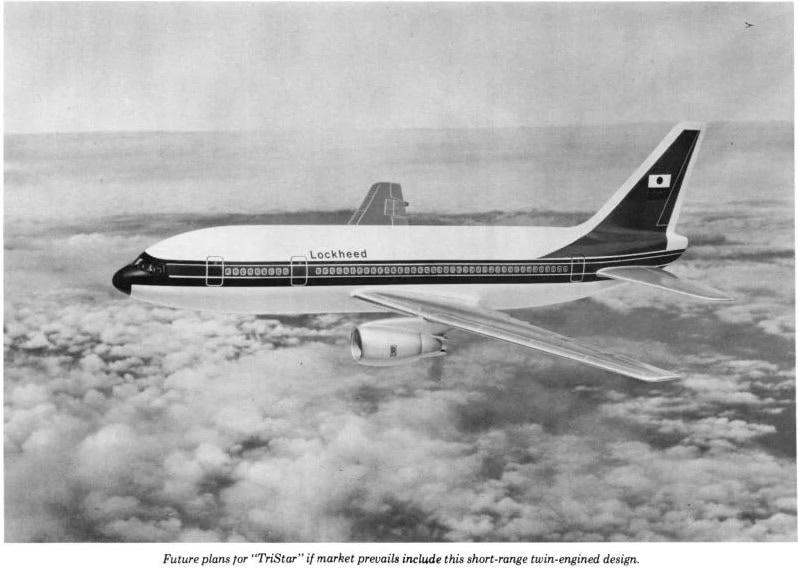
The Twin-Engine L-1011 Prototype That Never Flew
The Lockheed L-1011 TriStar is widely recognized as one of the most technologically advanced widebody airliners of the 1970s and 1980s. Celebrated for its quiet cabin, pioneering autoland system, and distinctive S-duct design, the TriStar’s development history is less well known for its initial twin-engine concept—a design that ultimately never progressed beyond the planning stage.
Origins and Early Development
In 1966, American Airlines issued a request for a widebody domestic airliner, prompting responses from both Lockheed and McDonnell Douglas. While McDonnell Douglas proceeded with what would become the DC-10, Lockheed initially pursued a twin-engine design internally designated as the CL-1011, with “CL” standing for California Lockheed. This early concept envisioned a short- to medium-haul, twin-aisle aircraft powered by two high-bypass turbofan engines.
However, the technological and regulatory environment of the late 1960s posed significant obstacles. Engine technology at the time was still maturing, with limitations in thrust capacity and reliability. Regulatory restrictions, particularly the Federal Aviation Administration’s “60-minute rule,” confined twin-engine aircraft to routes within one hour of a suitable diversion airport. This constraint severely limited operational flexibility, especially for overwater and transcontinental flights. Furthermore, performance requirements for operations at hot-and-high airports and shorter runways added complexity to the twin-engine approach. Confronted with these challenges, Lockheed abandoned the twinjet concept in favor of a trijet configuration, incorporating the now-iconic tail-mounted engine and S-duct that became hallmarks of the TriStar.
Revisiting the Twin-Engine Concept in the 1970s
By the early 1970s, advances in engine performance and evolving airline economics led Lockheed to reconsider the twin-engine design. The CL-1600 or Model 1600 study examined the possibility of removing the center engine from the TriStar airframe to reduce operating costs and simplify maintenance. Although there are reports of informal discussions with carriers such as Air Canada, no formal proposals or detailed documentation have surfaced publicly.
Despite the potential economic benefits, the engineering challenges of modifying an airframe originally optimized for three engines proved substantial. The project did not progress to the prototype stage or flight testing, and the twin-engine variant remained unrealized.
Market Impact and Industry Context
The failure to bring the twin-engine L-1011 prototype to fruition had significant repercussions for Lockheed. Beyond the direct financial and reputational costs associated with an unflown design, the company ceded competitive ground to rivals. Airbus, for instance, capitalized on this opportunity by introducing the A300—the world’s first twin-engine, twin-aisle widebody airliner—which first flew in 1971 and entered commercial service in 1974. The A300’s success validated the twin-engine widebody concept and established a new industry benchmark.
Both Boeing and Airbus leveraged Lockheed’s setbacks to consolidate their positions in the widebody market. Although initial airline skepticism regarding twin-engine widebodies may have slowed early adoption, competitive pressures ultimately accelerated advancements in engine reliability and aircraft safety standards across the industry.
While the twin-engine L-1011 never took to the skies, its development narrative underscores the complex interplay of technological innovation, regulatory frameworks, and market dynamics that have shaped the trajectory of modern commercial aviation.

Etihad Airways Suspends Airbus A380 Flights on Key Route

Aditya Birla Group Seeks Approval for Aircraft Leasing in GIFT City

Qatar Airways Highlights Innovation and Connectivity at Arabian Travel Market 2026

Hong Kong's Five-Year Plan Includes Andrew Fan's Aircraft Parts Processing Hub Proposal

ACIA Aero Leasing Delivers ATR72-600 to Air Nostrum

RTX Appoints Jill Albertelli as Head of Pratt & Whitney

TAT Technologies Joins Beyond Aero Hydrogen Aircraft Program

AURAK Study Highlights Barriers to Air Taxi Adoption in Emerging Economies

Xiamen Air Selects Altitude for 787 Maintenance at Heathrow

Etihad and Swissport Extend Global Partnership
