
Orchestrate AI insights into action

Trending
Categories
The Widebody Aircraft Hawaiian Airlines Ordered but Never Received
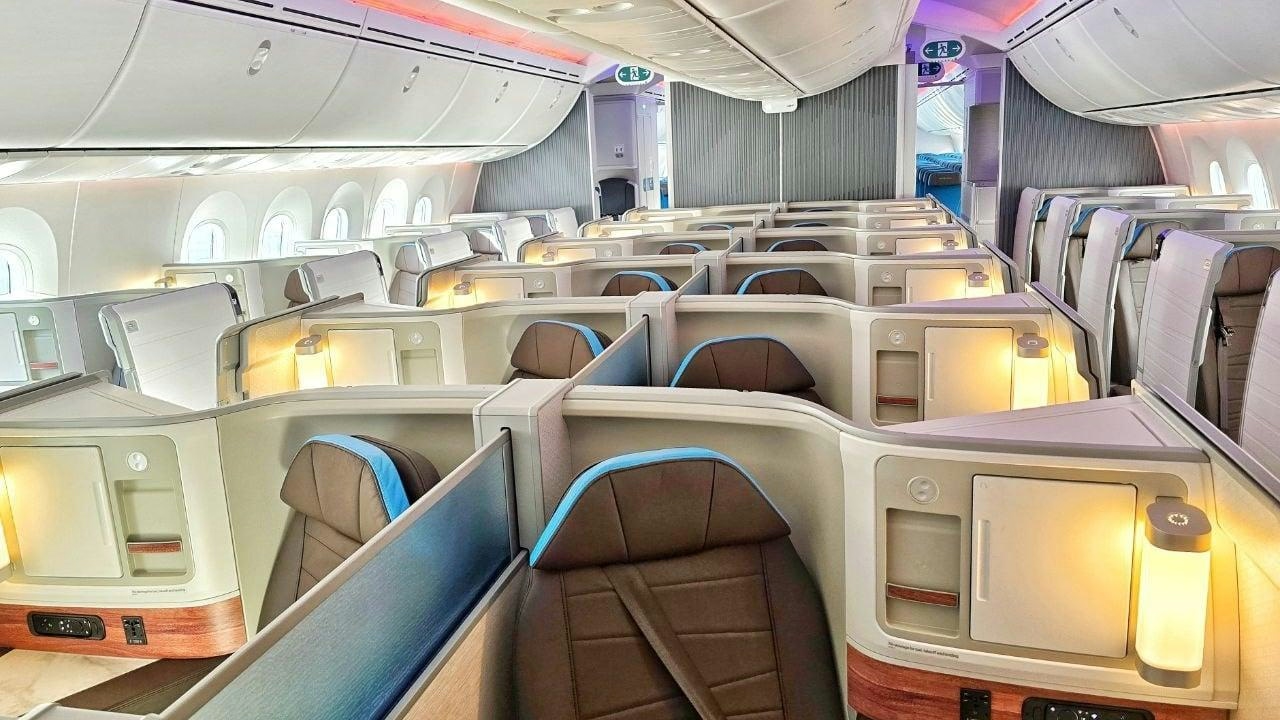
The Widebody Aircraft Hawaiian Airlines Ordered but Never Received
Ambitious Fleet Modernization Plans
In 2008, Hawaiian Airlines announced a significant order for six Airbus A350-800s alongside six Airbus A330-200s, marking a strategic effort to modernize its long-haul fleet and enhance operational capabilities. The airline intended to deploy the A330-200s immediately to increase transpacific capacity, while the A350-800s—then promoted as a next-generation, fuel-efficient widebody—were expected to support future growth and maintain cockpit commonality within the Airbus family. This dual approach was designed to balance immediate operational needs with long-term flexibility, securing future widebody availability during a period of strong market demand.
At the time, the A350-800 variant promised the range and fuel efficiency characteristic of the new A350 family but without the larger size of the A350-900, making it an ideal fit for Hawaiian’s Honolulu-based, long-and-thin routes. The split order reflected a carefully considered strategy to optimize fleet composition in line with the airline’s unique route structure and growth ambitions.
Program Challenges and Strategic Shifts
As the Airbus A350 program evolved, the smallest variant, the A350-800, failed to attract sufficient orders from the market. Airbus ultimately decided to discontinue the model, redirecting customers toward the re-engined A330neo family as an alternative. In 2014, Hawaiian Airlines exchanged its A350-800 order for six A330-800neos. However, this adjustment proved to be a temporary solution. The airline eventually canceled its Airbus order entirely, opting instead to acquire Boeing 787 Dreamliners to better align with its changing operational requirements.
This protracted process, spanning over a decade, highlights broader industry dynamics involving aircraft technology development, financing considerations, and risk management. Hawaiian’s experience underscores the critical importance of flexibility in fleet planning, particularly as manufacturers revise their product offerings and airlines confront shifting market conditions.
Competitive Pressures and Industry Trends
Hawaiian Airlines’ challenges were compounded by an increasingly competitive global landscape. While the airline grappled with uncertainty surrounding its widebody fleet, other carriers pursued aggressive expansion strategies. Turkish Airlines, for instance, placed orders for up to 75 Boeing 787s alongside additional 737 MAX aircraft, signaling strong demand for modern widebody jets. Similarly, Vietnam Airlines actively sought new A350s or 787s to strengthen its international network. These developments illustrate a market environment where airlines are racing to secure the latest widebody aircraft to enhance global reach and operational efficiency.
For Hawaiian Airlines, the inability to take delivery of the A350-800 as initially planned necessitated a reevaluation of its long-term fleet strategy amid intensifying competition. The airline’s eventual pivot to the Boeing 787 reflects a wider industry trend emphasizing adaptability as manufacturers shift focus and rivals secure next-generation aircraft to consolidate their market positions.
In retrospect, the A350-800 never entered commercial service, leaving Airbus to defend the market segment with the less capable A330neo. Hawaiian’s journey exemplifies the complex challenges airlines face in balancing ambition, operational flexibility, and the realities of a rapidly evolving aviation industry.

Etihad Airways Suspends Airbus A380 Flights on Key Route

Aditya Birla Group Seeks Approval for Aircraft Leasing in GIFT City

Qatar Airways Highlights Innovation and Connectivity at Arabian Travel Market 2026

Hong Kong's Five-Year Plan Includes Andrew Fan's Aircraft Parts Processing Hub Proposal

ACIA Aero Leasing Delivers ATR72-600 to Air Nostrum

RTX Appoints Jill Albertelli as Head of Pratt & Whitney

TAT Technologies Joins Beyond Aero Hydrogen Aircraft Program

AURAK Study Highlights Barriers to Air Taxi Adoption in Emerging Economies

Xiamen Air Selects Altitude for 787 Maintenance at Heathrow

Etihad and Swissport Extend Global Partnership
