
Orchestrate AI insights into action

Trending
Categories
Why Are Boeing Aircraft Noses More Pointed Than Airbus?
Why Are Boeing Aircraft Noses More Pointed Than Airbus?
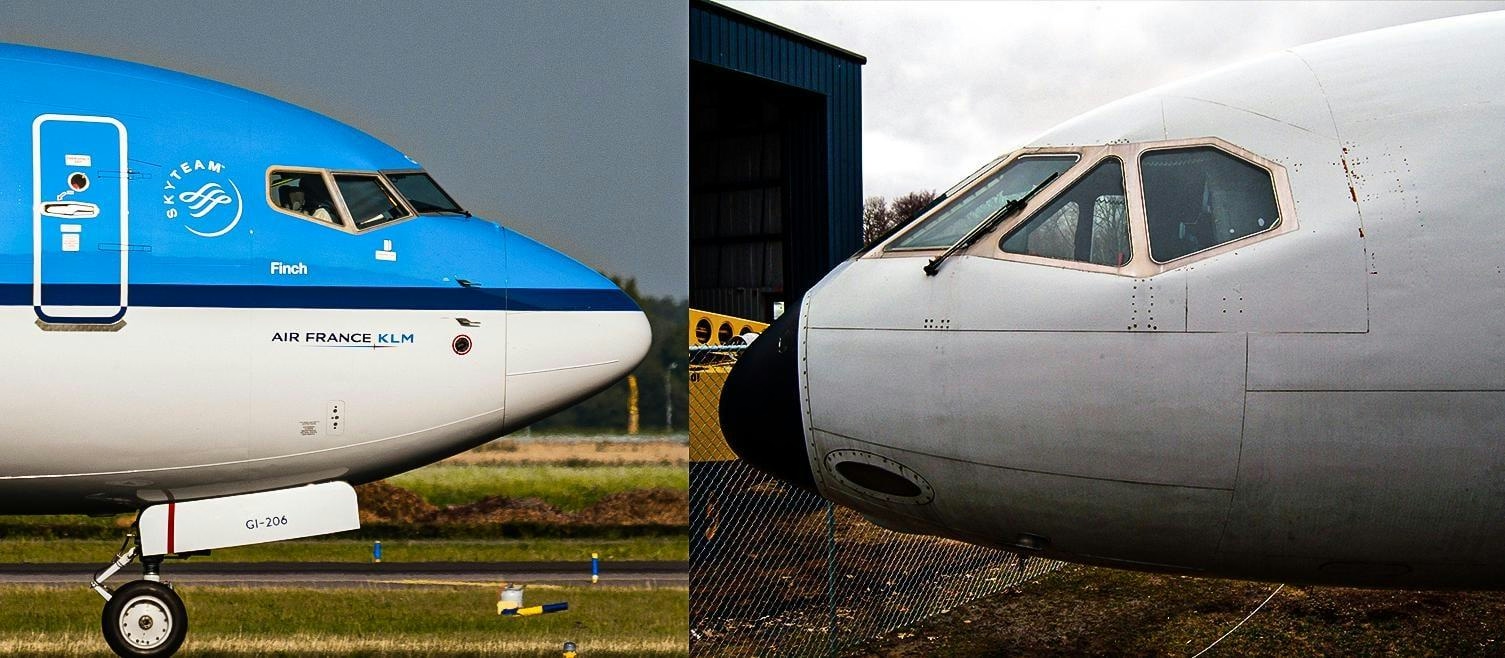
Supersonic aircraft are often distinguished by their long, pointed noses, designed to minimize drag at extremely high speeds. In contrast, modern commercial jets, which operate primarily at transonic speeds, typically feature more rounded nose designs to optimize aerodynamic efficiency. Despite this general trend, a subtle yet consistent difference exists between the two leading aircraft manufacturers: Boeing’s aircraft noses tend to be more pointed, while Airbus models usually exhibit rounder, more bulbous noses.
This variation is not merely aesthetic. Although the shape of an aircraft’s nose does influence aerodynamic performance, it is less critical than other design elements such as the wings. Consequently, major aircraft upgrades—like those seen in the Airbus A330neo or Boeing 777X—focus predominantly on wing redesigns rather than altering the nose. Both manufacturers generally maintain consistent nose designs across their narrowbody and widebody fleets, with notable exceptions including the double-decker Airbus A380, Boeing 747, and the Boeing 787 Dreamliner.
Distinguishing Features
Identifying whether an aircraft is a Boeing or an Airbus can be challenging for many observers. One of the most reliable visual cues lies in the shape of the nose. Boeing jets, with the partial exception of the 787, feature sharper, more pointed noses that evoke the image of a bird’s beak. In contrast, Airbus aircraft display smoother, rounder noses often likened to the profile of a dolphin. These design differences serve not only aerodynamic purposes but also function as subtle branding elements, enabling airlines and passengers to quickly recognize the manufacturer.
Historical and Technical Origins
Boeing’s preference for a pointed nose design is deeply rooted in its extensive history in commercial aviation. As a pioneer in the industry, Boeing established this nose shape with early models such as the 707, 727, and 737. These designs were developed through rigorous wind tunnel testing conducted before the advent of advanced computer simulations. Over the decades, Boeing engineers have refined and standardized this shape, balancing practical considerations for cockpit construction and aerodynamic performance.
Airbus, which entered the commercial aviation market later, adopted a different design philosophy. Its rounder noses reflect more contemporary approaches, leveraging computational modeling to optimize aerodynamic efficiency at typical cruising speeds. Both manufacturers must carefully balance aerodynamic advantages with factors such as manufacturing complexity and maintenance requirements, which influence the final nose design.
Market Dynamics and Competitive Pressures
The ongoing competition between Boeing and Airbus was prominently displayed at the 2025 Dubai Airshow, where both companies unveiled their latest aircraft models. While nose design is a visible aspect of their rivalry, it represents only a fraction of the broader competition encompassing fuel efficiency, passenger comfort, and operational costs.
This competitive landscape is further complicated by global trade tensions. For instance, disputes between the United States and China have delayed deliveries of China’s C919 jet, a direct competitor to Boeing’s 737 and Airbus’s A320. Meanwhile, Airbus has recently overtaken Boeing in single-aisle aircraft deliveries, highlighting a shifting balance in the global aviation market.
Conclusion
The contrasting nose shapes of Boeing and Airbus aircraft embody a combination of historical legacy, engineering philosophy, and branding strategy. Although the nose constitutes a relatively small component of an aircraft’s overall design, it remains a distinctive feature that continues to evolve as manufacturers adapt to technological advancements, market demands, and international competition.

Etihad Airways Suspends Airbus A380 Flights on Key Route

Aditya Birla Group Seeks Approval for Aircraft Leasing in GIFT City

Qatar Airways Highlights Innovation and Connectivity at Arabian Travel Market 2026

Hong Kong's Five-Year Plan Includes Andrew Fan's Aircraft Parts Processing Hub Proposal

ACIA Aero Leasing Delivers ATR72-600 to Air Nostrum

RTX Appoints Jill Albertelli as Head of Pratt & Whitney

TAT Technologies Joins Beyond Aero Hydrogen Aircraft Program

AURAK Study Highlights Barriers to Air Taxi Adoption in Emerging Economies

Xiamen Air Selects Altitude for 787 Maintenance at Heathrow

Etihad and Swissport Extend Global Partnership
