
将人工智能洞察转化为可执行行动

热门趋势
Categories
Airservices and Airways NZ Strengthen Aviation Safety Partnership
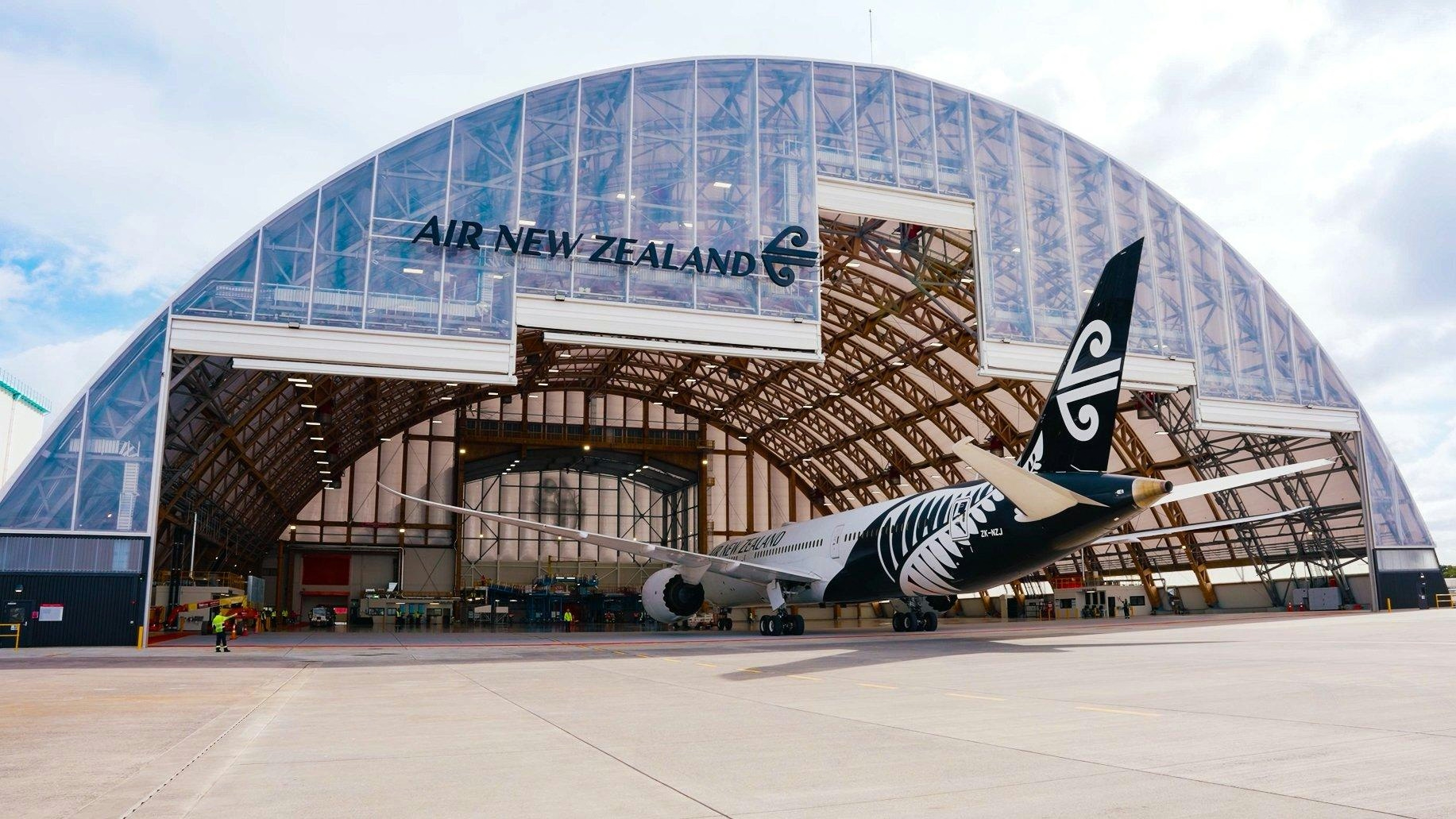
Airservices Australia and Airways New Zealand Strengthen Aviation Safety Partnership
Airservices Australia and Airways New Zealand have formalised a Memorandum of Understanding (MOU) to enhance collaboration in air traffic management, operational resilience, and regional coordination. Signed during the Civil Air Navigation Services Organisation (CANSO) Airspace Asia Pacific conference, the agreement establishes a framework for joint efforts in contingency planning, innovation, workforce development, and advanced safety analytics.
A Strategic Alliance for Regional Aviation
Rob Sharp, Chief Executive Officer of Airservices Australia, described the MOU as a significant advancement for the region’s two largest Air Navigation Service Providers (ANSPs). He emphasised that the agreement formalises an already strong working relationship, which will accelerate innovation in air traffic management, improve operational resilience, and ultimately provide more efficient services for passengers and airlines throughout the region.
James Young, Chief Executive of Airways New Zealand, underscored the shared dedication to aviation safety. He noted that the partnership allows both organisations to pool expertise and resources to tackle common challenges and develop innovative solutions for the aviation sector. Young highlighted that this collaboration will reinforce operational resilience and support the future growth of the region’s airspace.
Framework for Cooperation and Workforce Development
The MOU outlines a commitment to sharing knowledge and best practices, pursuing joint initiatives, and coordinating regional activities aimed at enhancing safety, resilience, and air traffic service performance. It also creates opportunities for staff secondments, joint training programs, and collaborative workforce development initiatives designed to strengthen capability across both organisations.
The partnership will concentrate on four primary areas: operations and innovation; workforce planning and training; safety intelligence, risk modelling, and performance monitoring; and international coordination alongside regional capacity building.
Challenges and Industry Implications
While the agreement builds on a history of cooperation in training and technology, both Airservices Australia and Airways New Zealand face challenges in deepening their partnership. Key issues include navigating regulatory compliance, ensuring seamless integration of safety protocols, and managing potential resistance from industry stakeholders. The aviation sector is closely monitoring the partnership, with safety regulators and airlines assessing its impact on operational efficiency and safety standards. Responses from competitors may vary, ranging from collaborative support to heightened rivalry, particularly if the alliance establishes new industry benchmarks.
The three-year MOU reflects a broader trend toward regional collaboration as the aviation industry seeks to enhance safety and operational performance amid evolving challenges.

Etihad Airways Suspends Airbus A380 Flights on Key Route

Aditya Birla Group Seeks Approval for Aircraft Leasing in GIFT City

Qatar Airways Highlights Innovation and Connectivity at Arabian Travel Market 2026

Hong Kong's Five-Year Plan Includes Andrew Fan's Aircraft Parts Processing Hub Proposal

ACIA Aero Leasing Delivers ATR72-600 to Air Nostrum

RTX Appoints Jill Albertelli as Head of Pratt & Whitney

TAT Technologies Joins Beyond Aero Hydrogen Aircraft Program

AURAK Study Highlights Barriers to Air Taxi Adoption in Emerging Economies

Xiamen Air Selects Altitude for 787 Maintenance at Heathrow

Etihad and Swissport Extend Global Partnership
