
图像

将人工智能洞察转化为可执行行动

立即加入 AeroGenie 候补名单!

热门趋势

Categories

Emirates Maintains Lead in Premium Aviation with A380 Strategy as Rivals Struggle to Compete
June 26, 2026By ePlane AI
Emirates Maintains Lead in Premium Aviation with A380 Strategy as Rivals Struggle to Compete
0
0
Emirates
Airbus A380
Premium Long-Haul

Emirates Maintains Lead in Premium Aviation with A380 Strategy as Rivals Struggle to Compete

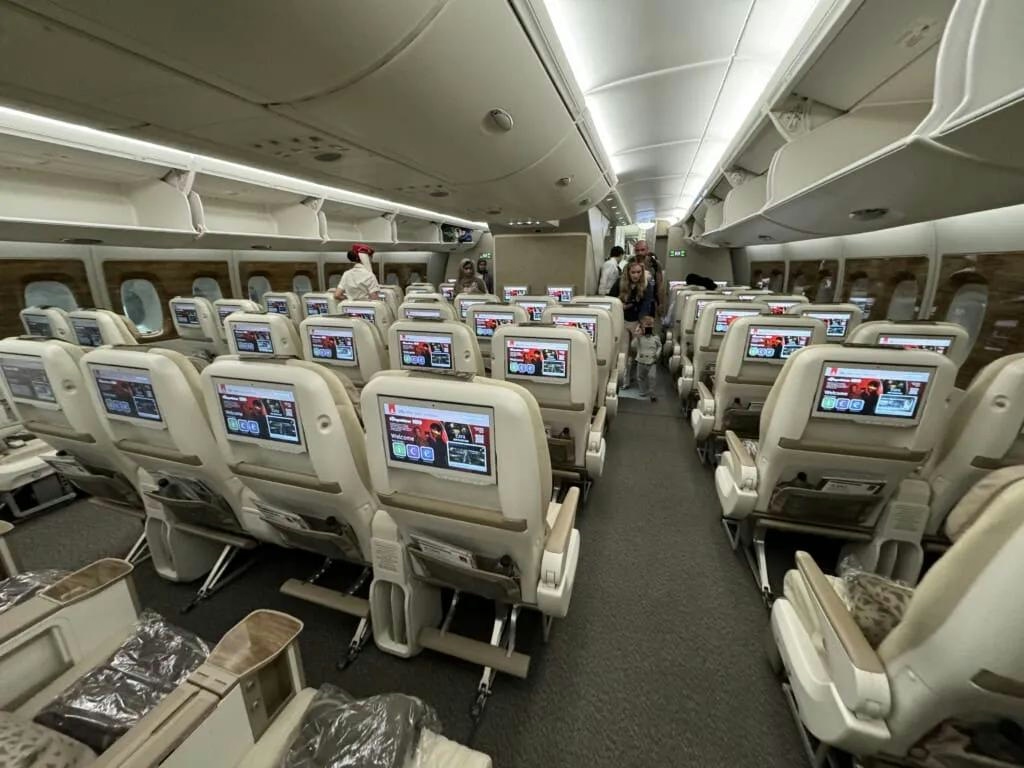
Emirates continues to set the standard in premium long-haul aviation by leveraging its distinctive Airbus A380 strategy to maintain a commanding lead amid growing challenges faced by competitors. As the global aviation industry contends with rising operating costs, sustainability demands, and geopolitical uncertainties, Emirates’ unwavering commitment to scale, comfort, and luxury remains unparalleled.

The A380: Cornerstone of Emirates’ Dominance

Central to Emirates’ success is its early and decisive investment in the Airbus A380. While many airlines hesitated, Emirates built the world’s largest A380 fleet, transforming Dubai into a pivotal global hub that efficiently connects East and West. The airline’s network is strategically designed around high-density, long-haul traffic, with the A380 enabling optimized connections and premium offerings such as private suites and onboard lounges. This approach has not only redefined passenger expectations but also established a premium ecosystem that competitors have found difficult to replicate.

Challenges Facing Competitors

Rivals including Lufthansa, Air France-KLM, and Etihad Airways are confronting significant obstacles in today’s aviation market. Lufthansa is pursuing consolidation through acquisitions, while Etihad aims to expand its widebody fleet to stimulate growth. However, these strategies are constrained by industry-wide challenges such as the need for costly airport infrastructure upgrades, high maintenance expenses, and the absence of a direct successor to the A380. In contrast, Emirates continues to modernize its A380 interiors and extend the aircraft’s lifecycle, underscoring its long-term commitment to the superjumbo.

The cessation of A380 production by Airbus has further solidified Emirates’ advantage. As the largest operator of a now-scarce aircraft type, Emirates occupies a unique market position that is both operationally and strategically defensive. No manufacturer is currently developing a comparable high-capacity aircraft, and existing alternatives like the Boeing 777X and Airbus A350 prioritize fuel efficiency over capacity. Emirates itself is awaiting delayed deliveries of the Boeing 777X and faces ongoing issues with the Rolls-Royce engine for the Airbus A350-1000, which has postponed its orders. Despite these setbacks, the airline remains optimistic about future fleet expansion.

Structural Barriers to Replicating Emirates’ Model

Several factors prevent competitors from emulating Emirates’ A380-based strategy. The permanent closure of the A380 production line and the absence of a direct replacement in development create a significant barrier. Additionally, the substantial airport infrastructure requirements for superjumbo operations, coupled with high maintenance and retrofitting costs for premium cabin layouts, pose formidable challenges. These structural limitations mean that replicating Emirates’ model would require decades of coordinated investment—an undertaking few airlines are positioned to pursue.

Industry forecasts suggest that Emirates will continue operating its A380 fleet well into the 2040s, further cementing its leadership in premium aviation. As competitors adapt to a landscape increasingly defined by efficiency and consolidation, Emirates’ unique approach ensures its dominance remains unchallenged for the foreseeable future.

More news
Saudia Cargo Deploys AI Workers to Enhance Cargo Sales

Saudia Cargo Deploys AI Workers to Enhance Cargo Sales

Saudia Cargo Deploys AI Workers to Enhance Cargo Sales Saudia Cargo has become the first cargo airline to integrate artificial intelligence (AI) workers into its commercial operations, following a strategic partnership with the digital air freight platform cargo.one. This pioneering initiative aims to automate and expedite the processing of inbound requests for quotations (RFQs), a traditionally labor-intensive and time-consuming component of airline cargo sales. AI-Driven Automation in Cargo Sales The AI system, developed on cargo.one’s AI-native operating platform, evaluates customer RFQs by considering factors such as flight schedules, alternative airports, and service levels. It then produces customized quotations within seconds, operating continuously and supporting multiple languages. This automation enables Saudia Cargo’s sales teams to concentrate on more complex and strategic customer engagements, including specialist shipments and high-value accounts. Cargo.one reports that its AI workers can reduce quotation turnaround times by 68% while achieving an 89% accuracy rate on first-time generated quotes. The platform also classifies sales opportunities and prepares customer-specific proposals in near real time, enhancing both operational efficiency and the overall customer experience. Industry Perspectives and Challenges Turhan Özen, Chief Commercial Officer of Saudia Cargo, emphasized the significance of this advancement within the company’s broader digital transformation and sales strategy. He highlighted that the AI workers are tailored to Saudia Cargo’s specific standards and processes, combining industry expertise, robust data foundations, and cutting-edge technology to improve efficiency and customer service, thereby strengthening the airline’s competitive position. Moritz Claussen, founder and co-CEO of cargo.one, expressed pride in supporting Saudia Cargo’s deployment of AI workers, noting that the investment in a logistics-specific, AI-native operating system has delivered substantial efficiency gains and operational improvements. He described this collaboration as a milestone in the evolution of logistics technology. Nevertheless, the introduction of AI workers in air cargo sales presents challenges. Industry analysts caution that issues such as data reliability and the complexity of supply chain information could complicate Saudia Cargo’s AI integration. Furthermore, skepticism from competitors and customers may arise, particularly concerning the transparency and control of AI-generated data. In response, rival airlines are expected to accelerate their own AI investments while emphasizing data governance and transparency to address these concerns. Despite these challenges, Saudia Cargo’s adoption of AI workers marks a significant milestone in the digital transformation of air cargo sales, establishing a new standard for efficiency and customer responsiveness within the sector.
Air Tanzania Expands Hangar Capacity at Kilimanjaro Airport

Air Tanzania Expands Hangar Capacity at Kilimanjaro Airport

Air Tanzania Expands Hangar Capacity at Kilimanjaro International Airport Air Tanzania has successfully completed a major expansion of its maintenance hangar at Kilimanjaro International Airport, significantly enhancing its operational infrastructure. The upgraded facility now has the capacity to accommodate up to five aircraft simultaneously, marking a substantial increase from its previous capabilities. This development involved extensive renovations and new construction, alongside the installation of advanced lighting systems, improved workspaces tailored for engineering staff, and the integration of modern Maintenance, Repair, and Overhaul (MRO) training equipment. Strategic Investment in Tanzania’s Aviation Sector The expansion forms part of a wider government-led initiative aimed at strengthening Tanzania’s aviation industry, with an investment totaling TZS 283.05 billion (approximately USD 109 million). This funding is intended to enable Air Tanzania to reduce maintenance costs and enhance operational efficiency, thereby supporting the airline’s long-term growth objectives. By upgrading its maintenance infrastructure, the national carrier is better positioned to manage its fleet and improve service delivery. Challenges Amidst Regional Competition Despite the benefits, the project faces several challenges. Securing adequate funding for such large-scale infrastructure developments remains a significant obstacle. Additionally, the airline must manage the increased operational costs associated with maintaining a larger facility. Compliance with stringent regulatory standards is another critical concern that Air Tanzania must address to ensure the new hangar meets all safety and operational requirements. This expansion occurs within a highly competitive regional aviation market, where multiple airlines and Fixed Base Operators (FBOs) are also investing in hangar capacity enhancements. Industry data reveals a growing trend of aviation businesses upgrading their facilities, intensifying competition across the sector. This dynamic may prompt rival carriers and service providers to pursue similar expansion projects or improve their service offerings to maintain market share. Nonetheless, Air Tanzania’s expanded hangar capacity at Kilimanjaro International Airport positions the airline to better support its fleet maintenance needs and potentially attract third-party maintenance contracts. This development not only advances the airline’s operational capabilities but also contributes to the broader growth and modernization of Tanzania’s aviation industry.
Toyota-Backed Air Taxi Reaches 100 km/h Ahead of Commercial Launch

Toyota-Backed Air Taxi Reaches 100 km/h Ahead of Commercial Launch

Toyota-Backed Air Taxi Reaches 100 km/h Ahead of Commercial Launch Milestone Flight Validates Innovative Design SkyDrive, a Toyota-backed urban air mobility (UAM) company, has successfully demonstrated stable flight at 100 km/h (62 mph) with its SD-05 multicopter. This achievement marks a critical advancement toward the vehicle’s commercial launch and regulatory certification. The SD-05’s wingless design, featuring 12 rotors, has proven capable of withstanding real-world aerodynamic forces, vibrations, and structural loads as anticipated by engineers. This validation is essential for progressing through Japan’s Civil Aviation Bureau (JCAB) certification process. Unlike American competitors such as Joby Aviation and Archer, which employ tilting rotors and fixed wings to accommodate more passengers over longer distances, the SD-05 embraces a minimalist approach. It is designed to carry a pilot and two passengers on short urban trips, with a current range of approximately 15 km (9.3 miles) per battery charge. SkyDrive aims to extend this range to between 30 and 40 km (18.6–24.9 miles) as battery technology advances. This streamlined architecture offers distinct advantages in dense urban environments, including flexible takeoff and landing capabilities and reduced maintenance costs compared to more mechanically complex alternatives. However, the absence of prior flight data for such a design means each test flight ventures into largely uncharted territory. SkyDrive reports that the recent high-speed test confirmed the flight characteristics and behavior aligned closely with predictions from the design and analysis phase, a crucial factor for regulatory approval. Development Progress and Industry Context The SD-05’s development has involved hundreds of test flights following the earlier SD-03 prototype. Independent evaluations of batteries, motors, and rotors have been conducted alongside aerodynamic testing in wind tunnels operated by Japan’s space agency, JAXA. This extensive data collection will underpin SkyDrive’s certification efforts in Japan and, eventually, with the U.S. Federal Aviation Administration (FAA). The UAM sector is becoming increasingly competitive. SkyDrive’s closest philosophical counterpart is China’s EHang EH216-S, a two-seat autonomous multicopter already certified by Chinese authorities but currently limited to low-altitude sightseeing operations. Germany’s Volocopter is also targeting short urban routes, though its commercial rollout has been slower than anticipated. Meanwhile, U.S.-based Joby Aviation, which is also backed by Toyota, recently reached the 100 km/h milestone with its own air taxi but continues to face regulatory challenges, internal disputes, and legal conflicts with competitors such as Archer Aviation and Beta Technologies. Archer, which aims to begin commercial service this year, has experienced a significant decline in its share price over the past year, reflecting broader investor uncertainty in the sector. Government initiatives, including the Trump administration’s eVTOL Integration Pilot Program, have played a pivotal role in supporting the development and integration of electric air taxis into national airspace. For SkyDrive, the recent high-speed flight represents more than a technical milestone; it is a vital step toward regulatory approval and a potential competitive advantage in the race to launch commercial urban air taxi services by 2028.
BETA and Surf Air Mobility Launch Electric Aircraft Trials in Hawaiʻi

BETA and Surf Air Mobility Launch Electric Aircraft Trials in Hawaiʻi

BETA and Surf Air Mobility Launch Electric Aircraft Trials in Hawaiʻi BETA Technologies and Surf Air Mobility have initiated a six to eight-week demonstration program in Hawaiʻi to evaluate the viability of electric aircraft for regional passenger and cargo services. Supported by Hawaiian Airlines, the initiative features BETA’s ALIA CTOL (conventional take-off and landing) electric aircraft conducting demonstration flights across the islands. The program aims to assess the operational, economic, and infrastructure requirements necessary for future commercial deployment. Collaborative Efforts and Operational Focus The trial leverages BETA’s advanced aircraft technology in conjunction with Surf Air Mobility’s expertise in regional airline operations. Utilizing Mokulele Airlines’ existing airport infrastructure and the SurfOS software platform, the program benefits from an integrated approach to electric aviation. Hawaiian Airlines contributes operational insights on inter-island passenger and cargo routes, participates in feasibility studies, and engages with local stakeholders and communities to ensure comprehensive evaluation. Throughout the campaign, the partners will gather extensive data on aircraft performance amid Hawaiʻi’s diverse weather conditions and route network. Key metrics under review include direct operating costs, battery efficiency, energy consumption, maintenance demands, and servicing requirements. The trials will also examine critical factors such as crew training, ground handling procedures, safety protocols, and the development of charging infrastructure—elements essential for scaling electric aircraft operations on a commercial level. Strategic Importance and Industry Context Hawaiʻi’s short inter-island routes and robust demand for regional air travel present an ideal environment for testing electric aviation technologies. BETA aims to demonstrate the economic and operational potential of the ALIA aircraft while generating valuable insights to support future high-frequency, low-emission passenger and cargo services. Despite the promising outlook, the trials face challenges including regulatory approval, market acceptance, and competition from other electric aviation companies. Industry observers anticipate increased interest from sectors such as cargo and medical transport, which stand to benefit from the operational efficiencies and reduced emissions offered by electric aircraft. In contrast to companies like Eve Air Mobility, which focus on urban air mobility solutions, BETA emphasizes CTOL variants tailored for cargo and medical transport applications. Following expected FAA certification, Surf Air Mobility plans to integrate BETA aircraft into its Hawaiʻi operations. The company is also preparing to establish a factory-authorized maintenance, repair, and overhaul (MRO) facility within the state. This facility will support long-term electric aircraft operations and contribute to building the technical infrastructure necessary for commercial-scale electric aviation. As the demonstration program progresses, its findings are poised to influence the future of regional air travel in Hawaiʻi and inform broader adoption of electric aviation technologies worldwide.
Airlines Confront Engine Maintenance Delays Amid Global MRO Shortages

Airlines Confront Engine Maintenance Delays Amid Global MRO Shortages

Airlines Confront Engine Maintenance Delays Amid Global MRO Shortages Air travelers worldwide are poised to experience ongoing flight disruptions and tighter airline schedules as global shortages in maintenance, repair, and overhaul (MRO) capacity place mounting pressure on carriers. A recent industry study reveals that shortages of spare parts, limited repair facilities, and surging demand for engine maintenance are creating significant operational challenges. These issues threaten to affect flight availability and complicate travel planning for years ahead. The severity of the problem was underscored by United Airlines CEO Scott Kirby, who recently cautioned that a shortage of available engines will remain a major constraint for at least the next five years. Similarly, the International Air Transport Association (IATA) highlighted persistent engine-related difficulties as a critical bottleneck during its annual meeting. Modern Engines and Emerging Maintenance Challenges The latest generation of single-aisle aircraft, which now form the backbone of domestic and short-haul international travel, operate thousands of flights daily, connecting cities and regions across the globe. However, the advanced engines powering these aircraft present maintenance challenges that extend beyond routine servicing. Airlines are contending with limited availability of spare parts, shortages of replacement engines, and constrained repair capacity. These factors collectively reduce the operational time engines can remain in service before requiring maintenance. This situation has resulted in a growing backlog of aircraft awaiting repairs. At the peak of the crisis in 2025, hundreds of planes equipped with Pratt & Whitney GTF engines were grounded, awaiting shop visits, replacement parts, or spare engines, highlighting the scale of the maintenance bottleneck. Operational Impact and Industry Response In response to these challenges, airlines have adapted their fleet strategies to minimize disruption. Many carriers have extended leases on older aircraft, postponed retirement plans, leased additional planes from other operators, or reduced capacity on certain routes. While these measures help sustain service levels, they also increase operating costs and complicate long-term fleet planning. Passengers may experience schedule changes, reduced flight frequencies, or limited seat availability on busy routes as airlines navigate these operational constraints. The aviation maintenance sector is expanding rapidly to address these issues, yet labor shortages, material constraints, and rising costs continue to hamper progress. In an effort to meet growing demand, companies such as SIA Engineering and Safran have established joint ventures to provide MRO services for CFM International Leap engines. Concurrently, airlines like Eurowings are joining collaborative networks such as the International Airline Technical Pool to enhance outstation recovery capabilities and better manage supply chain disruptions. Rising Demand and Mounting Pressure on MRO Infrastructure Robust passenger demand continues to drive airline fleet expansion, with deliveries of new single-aisle aircraft engines reaching approximately 2,000 units in 2024 and expected to increase sharply over the coming decade. As more aircraft enter service, maintenance requirements are projected to rise rapidly. Industry forecasts anticipate that annual engine shop visits will multiply several times by 2040, placing even greater strain on existing MRO infrastructure. Without substantial investment in repair facilities and supply chains, airlines may face prolonged maintenance turnaround times, complicating efficient fleet management. For travelers, these challenges highlight the critical importance of a resilient aviation supply chain to maintain aircraft availability and support the sustained growth of global tourism.
GTA Holdings Receives Approval for ACE Market Listing

GTA Holdings Receives Approval for ACE Market Listing

GTA Holdings Berhad Secures Approval for ACE Market Listing GTA Holdings Berhad, a specialist provider of aviation maintenance, repair, and overhaul (MRO) services, has obtained approval from Bursa Malaysia Securities for its proposed listing on the ACE Market. Operating through its wholly-owned subsidiary, Global Turbine Asia Sdn. Bhd., established in 2010, the company serves a diverse clientele that includes aviation operators, MRO-related customers, and defence-linked markets. GTA benefits from strategic partnerships with original equipment manufacturers (OEMs) within the Safran group and the EPI consortium. Its operations are based at the Helicopter Centre located at Sultan Abdul Aziz Shah Airport in Subang, a prominent aviation maintenance hub in Malaysia. Business Model and Financial Performance GTA’s business model is anchored in delivering proactive maintenance service packages, corrective maintenance works, and the sale of aviation equipment. For the financial year ending 31 December 2024, the group reported revenue of RM236.65 million alongside a profit after tax of RM36.61 million. Revenue streams were diversified, with RM91.79 million generated from proactive maintenance, RM50.19 million from corrective maintenance, and RM94.67 million from equipment sales. The company has cultivated enduring relationships with both aviation and defence-linked clients, underpinning its market position. Dato’ Nonee Ashirin binti Dato’ Mohd Radzi, Managing Director and CEO, remarked on the milestone, stating, “We are honoured to have received Bursa Malaysia Securities Berhad’s approval for GTA’s proposed listing on the ACE Market. This marks an important milestone in our corporate journey and reflects the progress we have made in building a specialised aviation support business with strong technical capabilities, trusted customer relationships, and a clear growth strategy.” Initial Public Offering and Strategic Plans According to GTA’s exposure prospectus, the initial public offering (IPO) will consist of 329.0 million shares, comprising 205.0 million new shares and 124.0 million existing shares. This represents approximately 25.48% of the enlarged share capital totaling 1,291,347,300 shares. The public issue allocates 64.57 million shares to the Malaysian public, 12.91 million shares to eligible directors and employees, and 127.52 million shares through private placement to institutional and selected investors. Proceeds from the IPO are designated to support several strategic initiatives, including the establishment of a new operating facility, expansion of helicopter MRO activities in the Middle East, entry into MRO services for landing gear, wheels, and brakes, as well as working capital requirements and listing-related expenses. The new facility is anticipated to enhance GTA’s technical capabilities, facilitate additional certifications, increase headcount, and enable new training programmes. Hong Leong Investment Bank Berhad has been appointed as Principal Adviser, Sponsor, Sole Underwriter, and Sole Placement Agent for the IPO. Regulatory Environment and Industry Outlook Looking ahead, GTA Holdings will need to navigate the challenges posed by stricter delisting regulations on the ACE Market, which now place greater emphasis on long-term corporate value and compliance rather than short-term share price performance. This regulatory shift is expected to increase market scrutiny and heighten the demand for robust corporate governance standards. As competitors also adapt to these changes, the aviation MRO industry may witness a broader transition towards sustainable growth strategies, with companies prioritising long-term value creation over immediate financial returns.
Microsoft and Alaska Airlines Collaborate to Advance E-Fuel Supply

Microsoft and Alaska Airlines Collaborate to Advance E-Fuel Supply

Microsoft and Alaska Airlines Collaborate to Advance E-Fuel Supply Launch of Commercial-Scale Synthetic Fuel Plant Microsoft, Alaska Airlines, and industrial technology company Twelve have joined forces to inaugurate a commercial-scale synthetic e-fuel facility in Moses Lake, Washington. The plant, known as AirPlant One, produces low-carbon jet fuel by synthesizing captured carbon dioxide, water, and renewable electricity. According to Twelve, this innovative process can reduce lifecycle carbon dioxide emissions by up to 90 percent compared to traditional jet fuel, representing a significant advancement in efforts to decarbonize the aviation sector. The synthetic fuel generated at AirPlant One is designed as a drop-in replacement, fully compatible with existing aircraft and airport infrastructure. It meets all current technical standards, enabling airlines to integrate the fuel without requiring modifications to their fleets or fueling systems. This compatibility is crucial for facilitating the adoption of sustainable aviation fuels (SAF) on a broader scale. Industry Challenges and Market Dynamics Despite this technological progress, the partnership underscores the persistent challenges confronting the aviation industry’s transition to sustainable fuels. Production costs for SAF remain prohibitively high, limiting its share to just 0.6 percent of total aviation fuel consumption in the previous year. Airlines striving to reduce their carbon footprints must also contend with rising operational expenses and geopolitical uncertainties that continue to affect fuel supply and pricing. The push toward greener fuels has intensified competition within the industry. Leading carriers such as Lufthansa and Air France-KLM are strengthening their positions by investing heavily in SAF and exploring alternative sustainable solutions. This wave of market consolidation is likely to influence the future structure of aviation fuel supply, as airlines and technology providers compete to scale production and secure dependable sources of low-carbon fuel. Strategic Collaborations and Future Prospects The collaboration between Microsoft and Alaska Airlines exemplifies how corporate procurement strategies can support emerging clean technology companies like Twelve in obtaining the necessary financing to bring innovative projects to fruition. As the aviation sector faces increasing pressure to reduce emissions, such partnerships may prove vital in overcoming both economic and technical obstacles, thereby facilitating wider adoption of sustainable fuels across the industry.
Airbound and Andhra Pradesh Sign Agreement on Drone Delivery

Airbound and Andhra Pradesh Sign Agreement on Drone Delivery

Airbound and Andhra Pradesh Sign Agreement to Launch Drone Delivery Network Partnership to Establish Scalable Aerial Logistics Bengaluru-based aerospace company Airbound has entered into a Memorandum of Understanding (MoU) with the Andhra Pradesh Drone Corporation (APDC) to develop a scalable drone delivery network across the Amaravati Capital Region. The agreement, formalized in New Delhi, was signed by APDC Chairperson and Managing Director Geetanjali Sharma and Airbound Founder and CEO Naman Pushp, in the presence of Union Minister for Civil Aviation Kinjarapu Ram Mohan Naidu. This collaboration marks a significant advancement in India’s aerial logistics sector, aiming to integrate drone technology into regional supply chains. The initiative, known as the Amaravati Capital Region Drone Delivery Network (ACR DDN), seeks to connect the cities of Amaravati, Vijayawada, and Guntur. It is designed to support logistics for healthcare, e-commerce, and commercial sectors. Pilot operations are set to begin in Guntur, with an ambitious target of achieving 10,000 daily drone flights across Andhra Pradesh within the next year. If successful, this scale of operation could position Andhra Pradesh among the world’s largest commercial drone networks. Technological Innovation and Economic Implications At the core of the project is Airbound’s proprietary blended-wing-body tailsitter aircraft. Constructed from lightweight carbon fibre and weighing only 1.5 kilograms, the unmanned aerial vehicle (UAV) features a payload-to-weight ratio of 1.5:1, significantly surpassing the conventional industry standard of 4:1. This innovative design enables delivery costs to be reduced by up to twenty times compared to traditional methods, with transit expenses potentially as low as 10 paise per kilometre. Union Civil Aviation Minister Kinjarapu Ram Mohan Naidu praised Airbound’s technological progress as a reflection of India’s growing capabilities in next-generation aviation. He underscored the potential for domestic development and scaling of such advanced technologies to enhance connectivity, create high-skilled employment opportunities, and stimulate economic growth. Challenges and Competitive Landscape Despite the promising outlook, the project faces several challenges. Regulatory uncertainties persist as India’s drone policies continue to evolve, potentially affecting the deployment timeline and operational scope. The integration of drone technology in densely populated urban environments presents logistical complexities that must be addressed. Furthermore, competition from established global players is intensifying. For example, Walmart has announced plans to expand its drone delivery network to 270 locations, aiming to serve 40 million U.S. residents by 2027. Such developments may prompt accelerated efforts by competitors to establish drone logistics capabilities in India. Market analysts have expressed reservations regarding the feasibility and profitability of large-scale drone delivery in regions characterized by high population density and complex airspace management. Additionally, India’s advancements in drone warfare technology, including the development of compact missile systems deployable from drones, could influence the regulatory and strategic framework governing commercial drone operations. Nonetheless, the partnership between Airbound and APDC represents a bold initiative to transform logistics in Andhra Pradesh. It may also serve as a pioneering model for the deployment of drone-enabled delivery networks across India.
Hyundai’s Supernal and Microsoft to Collaborate on Urban Air Mobility Projects

Hyundai’s Supernal and Microsoft to Collaborate on Urban Air Mobility Projects

Hyundai’s Supernal and Microsoft Join Forces to Advance Urban Air Mobility Hyundai Motor Company is intensifying its efforts to revolutionize next-generation transportation through a strategic collaboration between its advanced air mobility subsidiary, Supernal, and technology giant Microsoft. This partnership is designed to harness Microsoft’s cloud computing and artificial intelligence capabilities to accelerate the development of software-defined vehicles (SDVs) and urban air mobility (UAM) platforms. By integrating cutting-edge digital infrastructure with its automotive expertise, Hyundai aims to position itself as a leading contender in the nascent UAM industry. Pioneering Software-Defined Vehicles and Air Mobility Platforms Software-defined vehicles, often characterized as “computers on wheels,” depend on proprietary operating systems and sophisticated software to manage vehicle functions and enable over-the-air updates. Hyundai plans to introduce its first SDV by late 2027, directly challenging established players such as Tesla. The company views the integration of advanced software as essential not only for ground transportation but also for the emerging air mobility sector, where seamless connectivity and real-time data processing are critical. Despite the technological promise, Hyundai’s air mobility ambitions face significant financial challenges. Over the past five years, Supernal has reported cumulative losses amounting to $1.5 billion, prompting investor concerns about the sustainability of Hyundai’s UAM strategy. Market analysts remain cautious, questioning whether the collaboration with Microsoft will be sufficient to mitigate these financial pressures and yield concrete advancements in a market that is still largely unproven. Navigating Market Challenges and Competitive Pressures The urban air mobility market remains in its early stages, grappling with a complex array of technological, regulatory, and societal obstacles. Regulatory frameworks governing UAM are still under development in many jurisdictions, with safety, noise pollution, and infrastructure requirements posing significant hurdles. Public acceptance is equally critical, as communities weigh the potential benefits of reduced urban congestion against concerns over noise and disruption. Hyundai’s partnership with Microsoft is also expected to intensify competition within the sector. Established autonomous mobility companies such as Waymo may accelerate their own UAM initiatives in response, seeking to maintain or expand their market positions. The race to commercialize urban air mobility is thus poised to become increasingly competitive, with major players pursuing strategic alliances and technological innovation. Despite these challenges, Hyundai remains steadfast in its commitment to transforming urban transportation. By combining Supernal’s aviation expertise with Microsoft’s digital prowess, the company aims to overcome current obstacles and secure a foothold in the future of urban mobility. The ultimate success of this collaboration will hinge on Hyundai’s ability to innovate technologically while effectively managing financial constraints and navigating evolving regulatory landscapes.
Airbus Expands Its Supplier Network in China

Airbus Expands Its Supplier Network in China

Airbus Expands Its Supplier Network in China European aerospace giant Airbus is intensifying its collaboration with Chinese suppliers, highlighting China’s growing strategic significance as the company scales up its global aircraft production. At the recent fourth China International Supply Chain Expo in Beijing, Airbus took a leading role as a “chain leader,” showcasing a collaborative network that includes 11 key Chinese and international suppliers specializing in materials, aerostructures, manufacturing, and logistics. Strengthening Supply Chain Resilience Amid Global Challenges This expansion occurs against a backdrop of persistent supply chain challenges faced by global aircraft manufacturers, who are striving to meet rising airline demand. Airbus’s strategy to diversify its supplier base within China and neighboring regions aims to foster a more competitive and resilient industrial ecosystem. John Harrison, Airbus’s general counsel and head of public affairs, emphasized China’s dual importance as both a critical market and a production hub during an aerospace supply-chain forum at the expo. China represents Airbus’s largest single-country market for commercial aircraft, accounting for approximately 20 percent of the company’s annual deliveries. Airbus jets constitute about 55 percent of China’s in-service civil aviation fleet. Over the past four decades, Airbus’s relationship with China has evolved from straightforward aircraft sales to a comprehensive industrial partnership encompassing engineering, manufacturing, final assembly, maintenance, and aircraft recycling. Currently, Airbus collaborates with around 200 Chinese suppliers, integrating locally produced components across its commercial aircraft programs. Industrial Growth and Strategic Partnerships in China George Xu, CEO of Airbus China, reported that the company’s industrial cooperation value in China surpassed $1.4 billion in 2025, with expectations for continued growth as production rates increase. More than half of Airbus’s direct procurement spending in China is sourced from the Aviation Industry Corp of China (AVIC), which stands as Airbus’s largest global aerostructures supplier outside of engine manufacturers. The two A320-family final assembly lines in Tianjin are pivotal to Airbus’s global production strategy, supporting the ambitious target of manufacturing 75 single-aisle aircraft per month by 2027. Among the suppliers featured alongside Airbus at the expo was Zhejiang Xizi Aviation Manufacture Co., a key provider of components for the A220, A320, and A350 aircraft. General Manager Mo Chi noted that Airbus-related business accounts for roughly 80 percent of the company’s operations, driving significant advancements in manufacturing standards and management systems. Zhejiang Xizi also supplies parts to Boeing and China’s domestically developed passenger jets, underscoring its broad industry reach. Challenges and Competitive Pressures Despite these advancements, Airbus’s expansion in China faces notable challenges. Recent supply chain disruptions have caused delivery delays, such as those experienced by Qantas, leading to increased scrutiny of Airbus’s production schedules. These setbacks have impacted Airbus’s competitive position, particularly as rival Boeing reported higher delivery rates in May 2026. Additionally, competitors like Brazil’s Embraer are seeking to exploit Airbus’s difficulties with its A220 program. In response to these pressures, Airbus is also adjusting its supplier relationships. The company, together with Safran, recently acquired Tikehau Capital’s stake in metal supplier Aubert & Duval, reflecting broader efforts to secure critical materials and reinforce supply chain stability. Despite these headwinds, Airbus remains steadfast in its commitment to expanding its industrial footprint in China, viewing the country as a comprehensive strategic partner across manufacturing, research, and aircraft lifecycle services.
line









