
将人工智能洞察转化为可执行行动

热门趋势
Categories
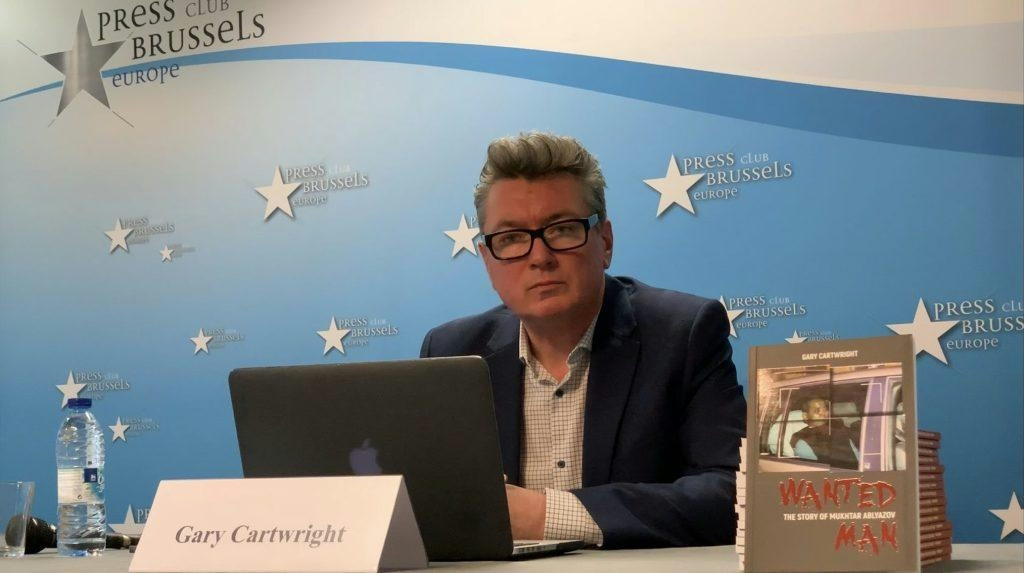
EU Today Editor Discusses Sanctions and Russia’s Shadow Aviation Supply Chains
EU Today Editor Discusses Sanctions and Russia’s Shadow Aviation Supply Chains
Following an extensive investigation by EU Today into Russia-linked aviation supply chains and potential sanctions circumvention, Editor Gary Cartwright spoke with the Ukrainian news outlet Podrobnosti about the findings, the pressures encountered after publication, and the broader challenges faced by journalists covering sanctions-sensitive issues. Originally published in Ukrainian, the interview is presented here in English.
Investigating Sanctions Evasion in Russia’s Aviation Sector
Cartwright outlined EU Today’s sustained focus on sanctions enforcement, particularly in relation to Russia’s aviation industry. He emphasized that uncovering evidence of sanctions evasion is a complex and often hazardous endeavor. Journalists, researchers, and civil society organizations meticulously analyze contracts, invoices, customs records, and procurement trails to expose hidden networks before governmental authorities intervene.
Since Russia’s annexation of Crimea in 2014, the European Union has relied heavily on sanctions as a key instrument in responding to Moscow’s aggression against Ukraine. These measures expanded significantly following the full-scale invasion in 2022, targeting sectors including finance, energy, transport, dual-use goods, aviation, shipping, technology, and military-industrial supply chains. However, as Cartwright noted, the effectiveness of sanctions depends largely on rigorous enforcement. Russia has repeatedly adapted by rerouting supplies through third countries, brokers, logistics firms, and intermediaries, complicating efforts to stem the flow of restricted goods.
EU Today has maintained dedicated coverage of sanctions since 2014, including a specialized Sanctions section and extensive reporting on Russia’s shadow fleet, Western components embedded in Russian weaponry, and the networks facilitating the continued movement of prohibited items. Its White Paper on Russia’s shadow fleet has attracted over 32,000 views. Cartwright himself has actively participated in demonstrations in Brussels advocating for the renewal of sanctions—a process that was not always politically assured prior to 2022.
For Cartwright, EU Today functions as more than a news outlet; it serves as a public-interest platform designed to highlight issues that might otherwise remain obscured within technical documentation. This mission has also informed the outlet’s earlier advocacy efforts, such as its Holodomor petition submitted to the British Parliament.
Unveiling the Opaque Russian Aviation Supply Chains
In May 2026, EU Today published an article delving into the opaque world of Russian aviation supply chains. Despite sanctions restricting spare parts, maintenance, insurance, and certification, many Western-owned aircraft leased to Russia—primarily Boeing and Airbus models—continue to operate both within and beyond Russian borders. This situation raises a critical question: how are parts, repairs, and services still reaching Russian aviation entities under such restrictions?
The investigation was grounded in a comprehensive review of documents including contracts, invoices, purchase orders, licensing materials, and freight records. While the article named several companies involved, Cartwright clarified that the documents alone did not constitute proof of unlawful conduct or sanctions violations by every party mentioned. The publication prompted swift responses, including legal demands and private communications directed at EU Today.
The report also underscored broader market implications. Sanctions targeting Russia’s shadow aviation supply chains have contributed to increased costs and delays for European airlines, as access to aircraft and parts becomes more constrained. This dynamic risks placing EU carriers at a competitive disadvantage, potentially allowing non-EU airlines to capture greater market share. In response, European airlines are lobbying for regulatory reforms aimed at mitigating disruptions and bolstering their global competitiveness.
Cartwright concluded by stressing the need for stronger protections for journalists, researchers, and civil society actors investigating sanctions evasion. As enforcement challenges persist and market pressures intensify, transparent reporting remains vital to understanding both the risks involved and the wider economic consequences of sanctions policy.

Etihad Airways Suspends Airbus A380 Flights on Key Route

Aditya Birla Group Seeks Approval for Aircraft Leasing in GIFT City

Qatar Airways Highlights Innovation and Connectivity at Arabian Travel Market 2026

Hong Kong's Five-Year Plan Includes Andrew Fan's Aircraft Parts Processing Hub Proposal

ACIA Aero Leasing Delivers ATR72-600 to Air Nostrum

RTX Appoints Jill Albertelli as Head of Pratt & Whitney

TAT Technologies Joins Beyond Aero Hydrogen Aircraft Program

AURAK Study Highlights Barriers to Air Taxi Adoption in Emerging Economies

Xiamen Air Selects Altitude for 787 Maintenance at Heathrow

Etihad and Swissport Extend Global Partnership
