
将人工智能洞察转化为可执行行动

热门趋势
Categories
Japan Delays JSM Deployment Due to F-35A Software Issues
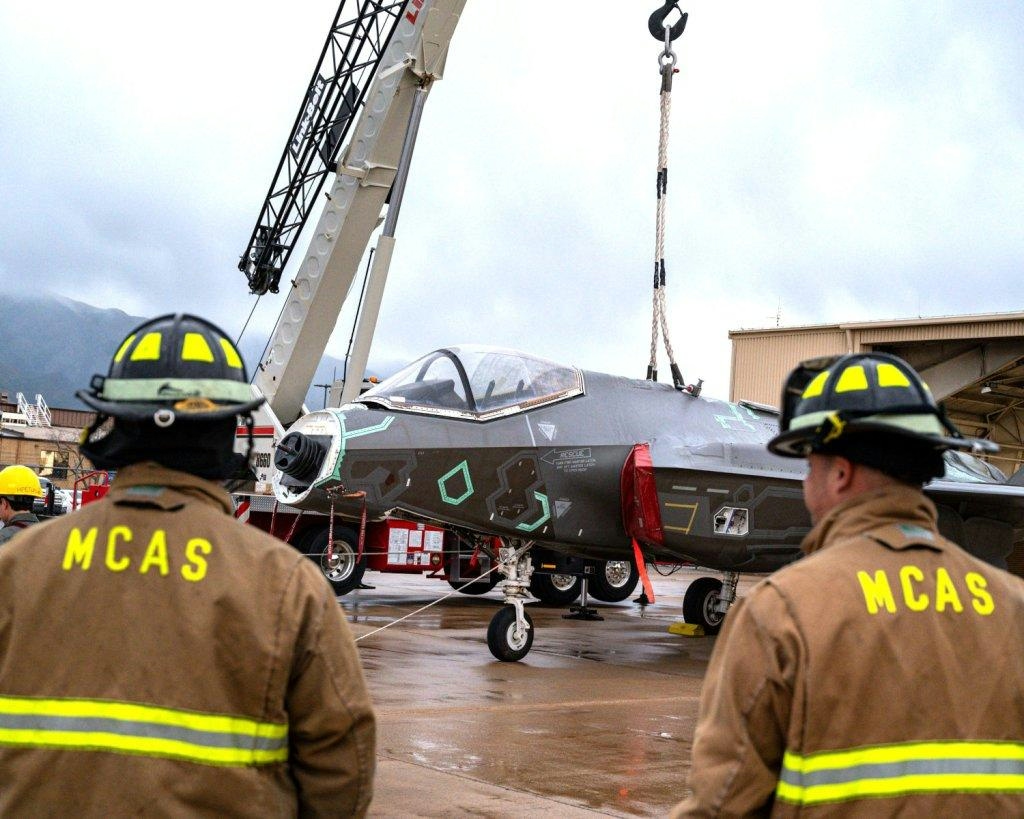
Japan Postpones Deployment of Joint Strike Missile for F-35A Fleet Amid Software Integration Challenges
Japan has delayed the operational deployment of the Kongsberg Joint Strike Missile (JSM) for its F-35A fighter jets due to unresolved software integration issues. This setback underscores ongoing difficulties within the broader F-35 program, which have affected multiple international operators.
Software Development Delays Hamper Operational Readiness
The Japan Air Self-Defense Force (JASDF) recently received its initial shipment of JSMs, transported from Norway aboard a Boeing KC-767 tanker. Despite this delivery, JASDF Chief of Staff Hiroaki Uchikura confirmed that the missiles are not yet ready for operational use. The F-35A aircraft require further software development to fully integrate and employ the new weapon system.
“The launch platform for the JSM is the F-35A,” Uchikura stated in Tokyo. “Currently, software development on the aircraft side necessary to operate the JSM is underway. We will continue coordinating with the U.S. government so that Japan can begin operating the JSM as soon as possible.” When asked about a timeline for deployment, Uchikura refrained from providing specifics, citing sensitivities related to “relations with other countries,” and acknowledged that Japan has “not yet acquired the capability to fully utilize the JSM.”
The delay in integrating the JSM may affect Japan’s overall operational readiness and diminish the strike capabilities of its F-35A fleet. The JSM is unique as the only internally carried missile on the F-35A that combines anti-ship and land-attack functions. It boasts a range exceeding 150 nautical miles (277 kilometers) and is equipped with an infrared seeker. Weighing 416 kilograms (917 pounds), the high-subsonic missile represents a significant enhancement to the aircraft’s offensive potential.
Broader Implications Within the F-35 Program
Japan’s software challenges reflect wider issues confronting the international F-35 program. The Pentagon has reported that software upgrades for the F-35 have stalled, resulting in a lack of new combat capabilities and persistent stability and functionality problems. The integration of the JSM is specifically linked to the long-delayed Block 4 upgrade, which builds upon the Technical Refresh 3 (TR-3) hardware and software baseline. These delays have impacted not only Japan but also other F-35 operators awaiting enhanced capabilities.
Norway was the first country to deploy the JSM with its F-35A fleet, and other nations including Australia, Germany, and the United States have placed orders for the missile. Japan continues to collaborate closely with the U.S. government and industry partners to resolve the software issues, with the goal of bringing the JSM into operational service at the earliest opportunity.

Etihad Airways Suspends Airbus A380 Flights on Key Route

Aditya Birla Group Seeks Approval for Aircraft Leasing in GIFT City

Qatar Airways Highlights Innovation and Connectivity at Arabian Travel Market 2026

Hong Kong's Five-Year Plan Includes Andrew Fan's Aircraft Parts Processing Hub Proposal

ACIA Aero Leasing Delivers ATR72-600 to Air Nostrum

RTX Appoints Jill Albertelli as Head of Pratt & Whitney

TAT Technologies Joins Beyond Aero Hydrogen Aircraft Program

AURAK Study Highlights Barriers to Air Taxi Adoption in Emerging Economies

Xiamen Air Selects Altitude for 787 Maintenance at Heathrow

Etihad and Swissport Extend Global Partnership
