
将人工智能洞察转化为可执行行动

热门趋势
Categories
JetCat Defense Introduces New Turbine Engines for Military Use
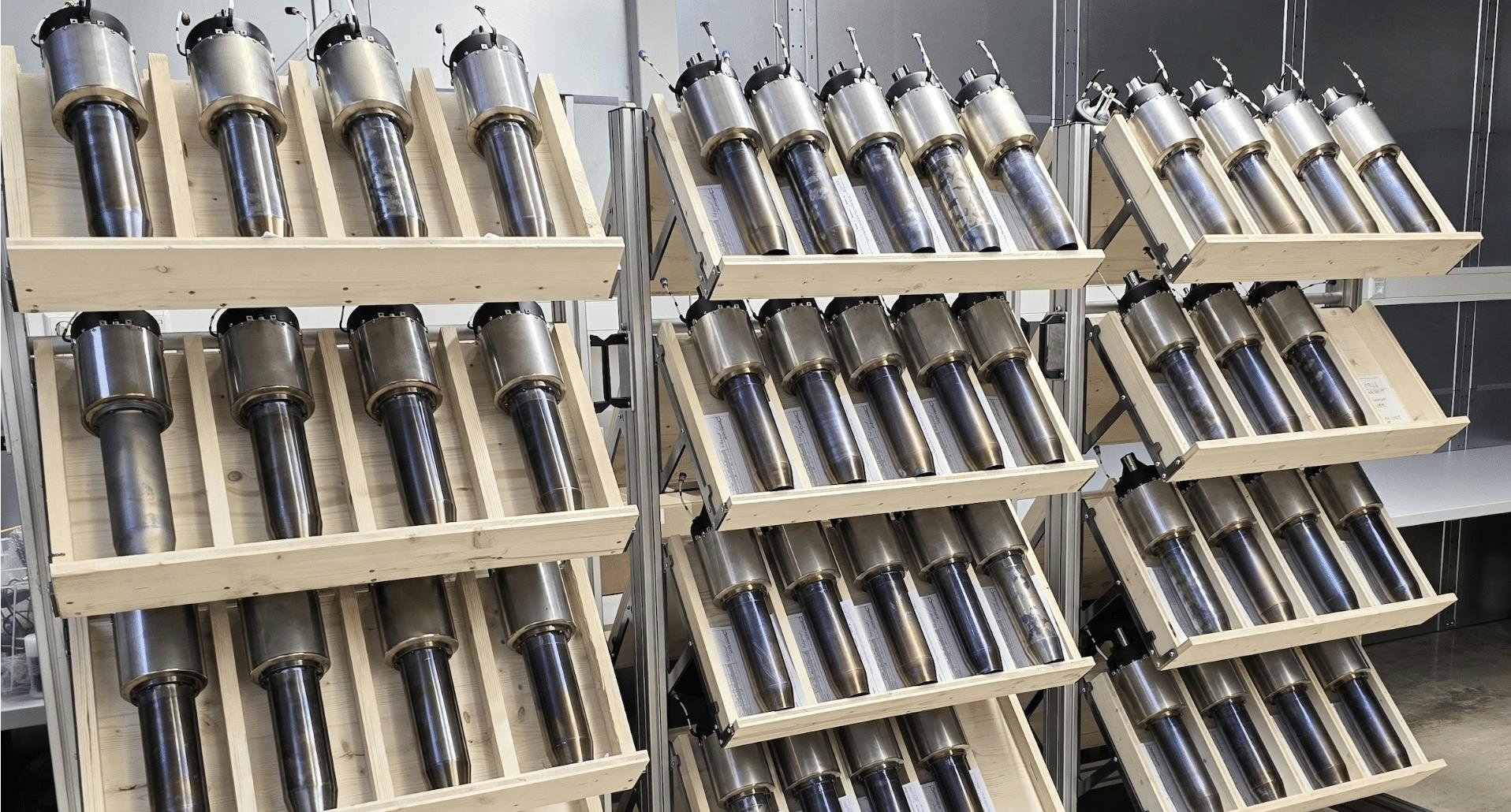
JetCat Defense Unveils Advanced Turbine Engines for Military Applications
JetCat Defense has announced the upcoming launch of its latest turbine engines, the P850 and P420, set to be showcased at the Air & Space Forces Association’s Air, Space & Cyber Conference from September 22 to 24 in National Harbor, Maryland. The U.S.-based company, a joint venture between BSEL USA and JetCat, seeks to merge military propulsion expertise with commercial innovation. Their new propulsion systems are designed to comply with Broad Agency Announcement (BAA) requirements, addressing the evolving needs of modern defense operations.
Engine Specifications and Capabilities
The P850 engine, positioned within the 200-pound-thrust class, is derived from JetCat’s established P1000 platform. It is engineered for applications where constraints on weight, space, and onboard electrical power are paramount. Notably, the P850 offers a compact design that facilitates streamlined installation, alongside a 2kW onboard electrical output to support mission-critical systems. Its high thrust-to-weight ratio enhances overall performance, making it suitable for a range of demanding military platforms.
In contrast, the P420 engine belongs to the 100-pound-thrust class and builds upon the P400 series. This model is optimized for mass deployment scenarios, with a focus on improved responsiveness and operational reliability. Key improvements include faster startup times, dual-redundant ignition systems, and expanded utility in challenging operational environments. Both engines incorporate all necessary subsystems and accessories within the engine volume and utilize electrical start mechanisms, eliminating the need for pyrotechnic devices. This design choice simplifies logistics and enhances safety.
JetCat Defense emphasizes cost efficiency by integrating commercial off-the-shelf (COTS) components, thereby reducing dependence on exotic materials and mitigating supply chain risks. The engines are intended for versatile deployment across ground, sea, and air-launch platforms, reflecting a broad operational scope.
Production Plans and Market Challenges
Adam Cherrill, Vice President of Business Development at JetCat Defense, highlighted the strategic advantage of combining JetCat’s commercial innovation and high-rate production capabilities with BSEL’s military engine expertise. He noted that this collaboration enables rapid response to U.S. defense demand with scalable manufacturing capacity.
The company is currently accepting orders for both the P850 and P420 engines. JetCat Defense plans to establish a pilot production line by the end of the year, with a phased increase to low-rate production in 2026 and full-rate production targeted for 2027. This production timeline aligns with U.S. defense initiatives emphasizing mass deployment and rapid fielding, offering an affordable and expendable propulsion solution.
Despite these promising developments, JetCat Defense faces significant challenges in a competitive market dominated by established industry leaders such as GE Aerospace, which recently announced new Turbine-Based Combined Cycle (TBCC) propulsion system designations. Industry analysts are closely monitoring how JetCat’s engines will perform in terms of cost-effectiveness and operational capability relative to existing technologies. Competitors may accelerate their own propulsion system enhancements to maintain market dominance. Additionally, JetCat must navigate complex regulatory and logistical hurdles, including compliance with stringent military standards and integration into existing defense platforms.
As JetCat Defense prepares to present its new engines at the upcoming conference, the success of the P850 and P420 will depend on their ability to meet evolving military requirements while overcoming both market competition and operational challenges.

Etihad Airways Suspends Airbus A380 Flights on Key Route

Aditya Birla Group Seeks Approval for Aircraft Leasing in GIFT City

Qatar Airways Highlights Innovation and Connectivity at Arabian Travel Market 2026

Hong Kong's Five-Year Plan Includes Andrew Fan's Aircraft Parts Processing Hub Proposal

ACIA Aero Leasing Delivers ATR72-600 to Air Nostrum

RTX Appoints Jill Albertelli as Head of Pratt & Whitney

TAT Technologies Joins Beyond Aero Hydrogen Aircraft Program

AURAK Study Highlights Barriers to Air Taxi Adoption in Emerging Economies

Xiamen Air Selects Altitude for 787 Maintenance at Heathrow

Etihad and Swissport Extend Global Partnership
