
将人工智能洞察转化为可执行行动

热门趋势
Categories
Path from Regional First Officer to United Airlines Boeing 787 Captain
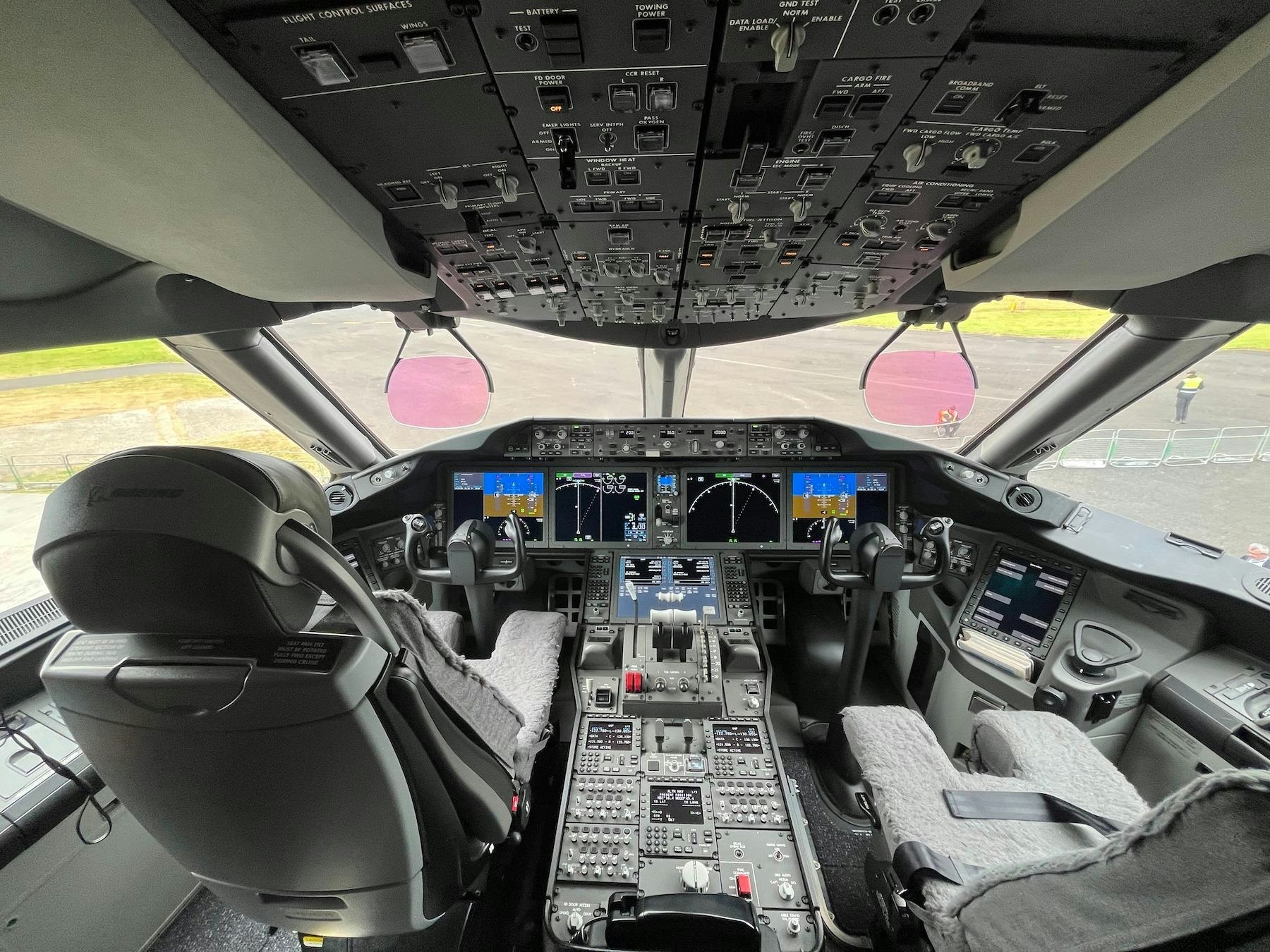
Path from Regional First Officer to United Airlines Boeing 787 Captain
The progression to becoming a captain at a major airline such as United Airlines is a highly structured and competitive process. For many pilots, the pinnacle of their career is commanding a widebody aircraft like the Boeing 787—a role that carries significant prestige and financial reward, with top captains earning upwards of half a million dollars annually. Achieving this status demands years of dedication, rigorous training, and navigating a complex seniority system that often takes decades to ascend.
The Early Stages of a Pilot’s Career
The journey begins with obtaining a Private Pilot’s License (PPL), which authorizes pilots to operate single-engine aircraft for recreational purposes. This is followed by acquiring an Instrument Rating (IR) to enable flying in adverse weather conditions, and subsequently a Commercial Pilot’s License (CPL), which permits pilots to be compensated for their flying services. Most aspiring airline pilots also secure a Multi-Engine Rating (MER). However, to qualify for the Airline Transport Pilot License (ATPL)—the mandatory credential for airline pilots in the United States—candidates must accumulate at least 1,500 flight hours, a substantial increase from the 250 hours required for a CPL.
To build these hours, many pilots work as Certified Flight Instructors (CFIs), often adding instrument (CFII) and multi-engine (MEI) instructor qualifications. The financial investment to progress from zero experience to a CPL typically exceeds $100,000. The licensing process itself can take one to two years, with an additional two to three years required to reach the necessary flight hours for an ATPL.
United Aviate: A Structured but Competitive Pathway
United Airlines has developed the Aviate program to address pilot shortages and facilitate career advancement. Aviate targets pilots who already hold a CFI and IR and are employed at partner flight schools. While the program offers a conditional job offer (CJO) upon a successful interview, it does not guarantee a position within United’s mainline operations. Distinctively, United operates the Aviate Academy in Phoenix, which provides comprehensive training from zero flight hours; however, students bear the full cost of this education.
After meeting the required flight hours, pilots typically transition to regional airlines as first officers, where they continue to accumulate experience and seniority. Advancement to United’s mainline fleet and ultimately to a widebody captaincy depends on a combination of performance, seniority, and the availability of positions.
Challenges on the Road to the 787 Captaincy
The path to commanding a Boeing 787 is not without its challenges. The 787 Dreamliner has faced technical issues, including recent groundings related to problems with the Traffic Alert and Collision Avoidance System (TCAS). These incidents have raised concerns about the aircraft’s reliability, eliciting negative market reactions and heightened scrutiny of United’s fleet management strategies. Concurrently, competitors such as American Airlines are expanding their international route networks—introducing new flights to destinations like Tokyo from Chicago O’Hare—to capture market share and exploit any perceived vulnerabilities.
Beyond United, other airlines operating the 787, such as Air New Zealand, have encountered operational and financial difficulties with their Dreamliner fleets. These broader industry challenges underscore ongoing concerns about the aircraft’s reliability and its impact on airline operations. For United pilots, such factors can influence career progression, operational efficiency, and the overall experience of advancing to a widebody captaincy.
Conclusion
The route from regional first officer to United Airlines Boeing 787 captain is clearly defined but demanding, shaped by technical challenges, market competition, and the realities of airline seniority systems. For those who persevere, the professional and financial rewards remain among the most significant in commercial aviation.

Hong Kong's Five-Year Plan Includes Andrew Fan's Aircraft Parts Processing Hub Proposal

ACIA Aero Leasing Delivers ATR72-600 to Air Nostrum

RTX Appoints Jill Albertelli as Head of Pratt & Whitney

TAT Technologies Joins Beyond Aero Hydrogen Aircraft Program

AURAK Study Highlights Barriers to Air Taxi Adoption in Emerging Economies

Xiamen Air Selects Altitude for 787 Maintenance at Heathrow

Etihad and Swissport Extend Global Partnership

Sepehran Airlines B737 Returns to Mashhad After Tyre and Engine Issues

Etihad Deploys Widebody Fleet to Meet Strong Demand

Korean Air Finalizes $36.2 Billion Deal with Boeing
