
将人工智能洞察转化为可执行行动

热门趋势
Categories
PySAF Converts Bio-Crude into Jet Fuel
PySAF Converts Bio-Crude into Jet Fuel
The Urgency of Sustainable Aviation Fuel
Aviation contributes approximately one billion tonnes of CO₂ emissions annually, representing about 2.5% of global carbon dioxide output. However, the sector’s overall climate impact is significantly greater when accounting for non-CO₂ effects at cruising altitudes, such as contrails and nitrogen oxides, which amplify its warming effect by two to three times compared to direct emissions alone. Unlike road transport, aviation cannot transition to battery power in the near term due to the insufficient energy density of current electrochemical storage technologies for commercial flights. Consequently, sustainable aviation fuel (SAF) remains the only viable immediate solution to reduce the industry’s carbon footprint.
The SAF market is experiencing rapid growth, with global production expected to reach around one million tonnes in 2024—double the output of the previous year. This expansion is largely driven by regulatory mandates. The United Kingdom, for instance, requires a 10% SAF blend by 2030, increasing to 22% by 2040, which will demand over one billion litres of SAF annually for UK airlines alone. Similarly, the European Union’s ReFuelEU Aviation regulation imposes comparable and progressively stringent blending targets across its 27 Member States. Market analysts project that the global SAF industry could be worth between $15 billion and $20 billion annually by 2030. Despite this growth, current production satisfies less than 0.5% of total jet fuel demand. The predominant feedstock—hydroprocessed used cooking oil—is approaching its supply limits, creating a structural supply gap rather than a temporary shortfall.
Unlocking the Potential of Biomass and Bio-Crude
The United Kingdom holds substantial untapped biomass resources, including agricultural and forestry residues, energy crops, and organic waste, amounting to tens of millions of tonnes of dry biomass annually, as detailed in the UK’s 2023 Biomass Strategy. Much of this biomass remains underutilized or is employed for low-value heat generation. Fast pyrolysis, a well-established thermochemical process, can rapidly convert this biomass into fast pyrolysis bio-crude, a liquid intermediate. Despite its promise, global production of bio-crude remains limited to a few hundred thousand tonnes per year, primarily used for industrial heat or as feedstock for niche products. Its application as a precursor for SAF has been constrained not by energy content but by the absence of a clean, scalable upgrading process.
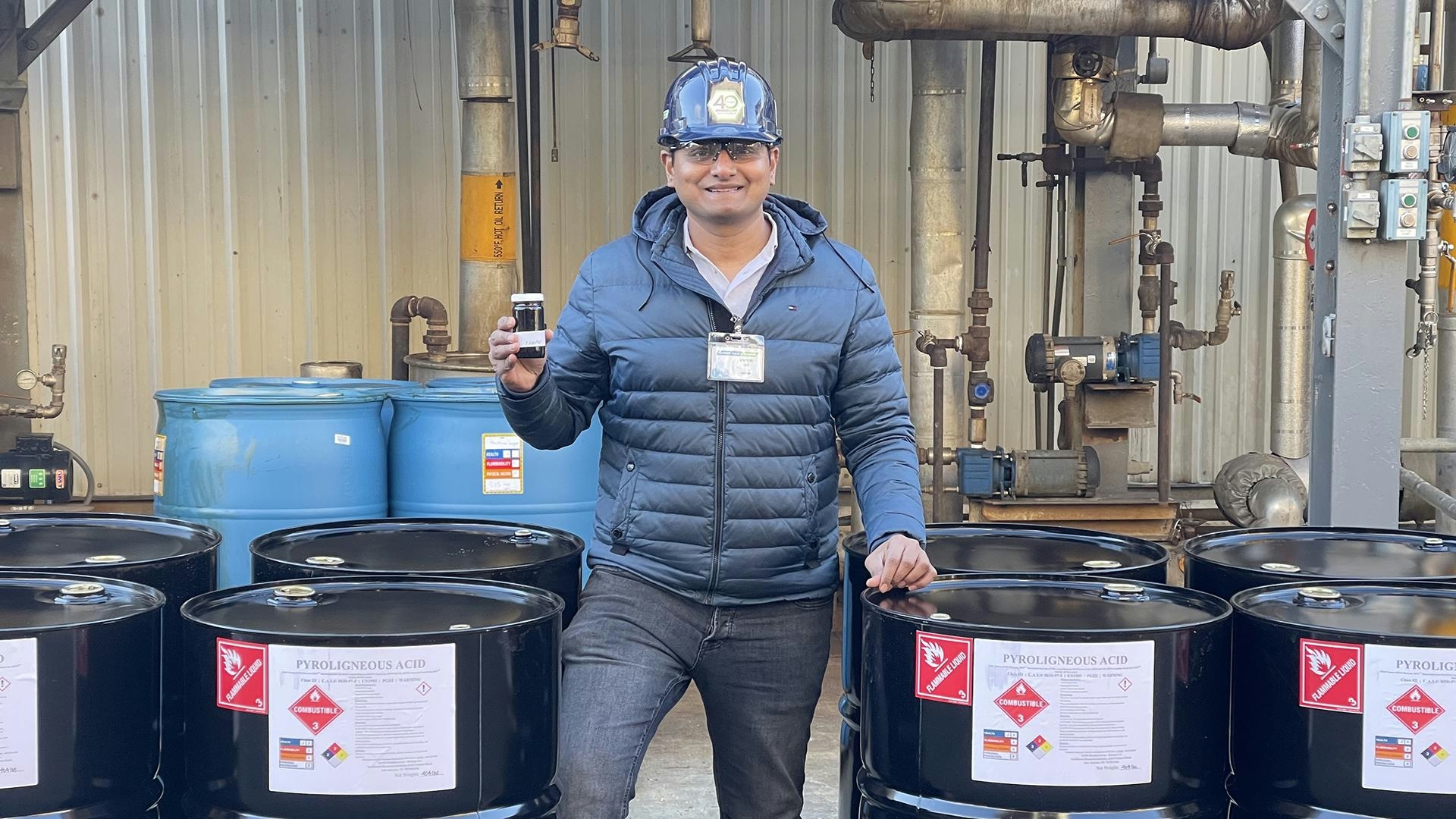
Dr. Sanjeev Gajjela, who began his work with fast pyrolysis bio-crude during his doctoral studies at Mississippi State University, has dedicated two decades to developing bio-crude upgrading technologies across both industry and academia, securing approximately 40 patents. His research, including work at a commercial tolling facility in South Carolina, forms the foundation of PySAF’s innovative fractionation platform. This technology aims to unlock the potential of bio-crude as a viable feedstock for jet fuel production.
Challenges and Market Dynamics
Despite the promise of PySAF’s technology, significant challenges persist. The conversion of bio-crude into jet fuel is an energy-intensive and costly process, concerns that are exacerbated by stringent European Union regulations which risk rendering SAF production prohibitively expensive. Nevertheless, market momentum remains robust. Demand for alternative fuels has surged amid ongoing geopolitical instability and a global fuel crisis. Competitors are advancing as well; for example, UK airline Loganair is currently trialing ClimaHtech Green Flight’s advanced SAF pathways, while Germany has committed €350 million to a major eSAF project.
As the aviation industry intensifies efforts to decarbonize, PySAF’s technology represents a promising advancement toward addressing the SAF supply gap—provided it can surmount the economic and technical barriers that have historically limited the use of bio-crude in sustainable aviation fuel production.

Etihad Airways Suspends Airbus A380 Flights on Key Route

Aditya Birla Group Seeks Approval for Aircraft Leasing in GIFT City

Qatar Airways Highlights Innovation and Connectivity at Arabian Travel Market 2026

Hong Kong's Five-Year Plan Includes Andrew Fan's Aircraft Parts Processing Hub Proposal

ACIA Aero Leasing Delivers ATR72-600 to Air Nostrum

RTX Appoints Jill Albertelli as Head of Pratt & Whitney

TAT Technologies Joins Beyond Aero Hydrogen Aircraft Program

AURAK Study Highlights Barriers to Air Taxi Adoption in Emerging Economies

Xiamen Air Selects Altitude for 787 Maintenance at Heathrow

Etihad and Swissport Extend Global Partnership
