
将人工智能洞察转化为可执行行动

热门趋势
Categories
Rolls-Royce Developed a Jet Engine That Prompted Airbus to Redesign Its Aircraft
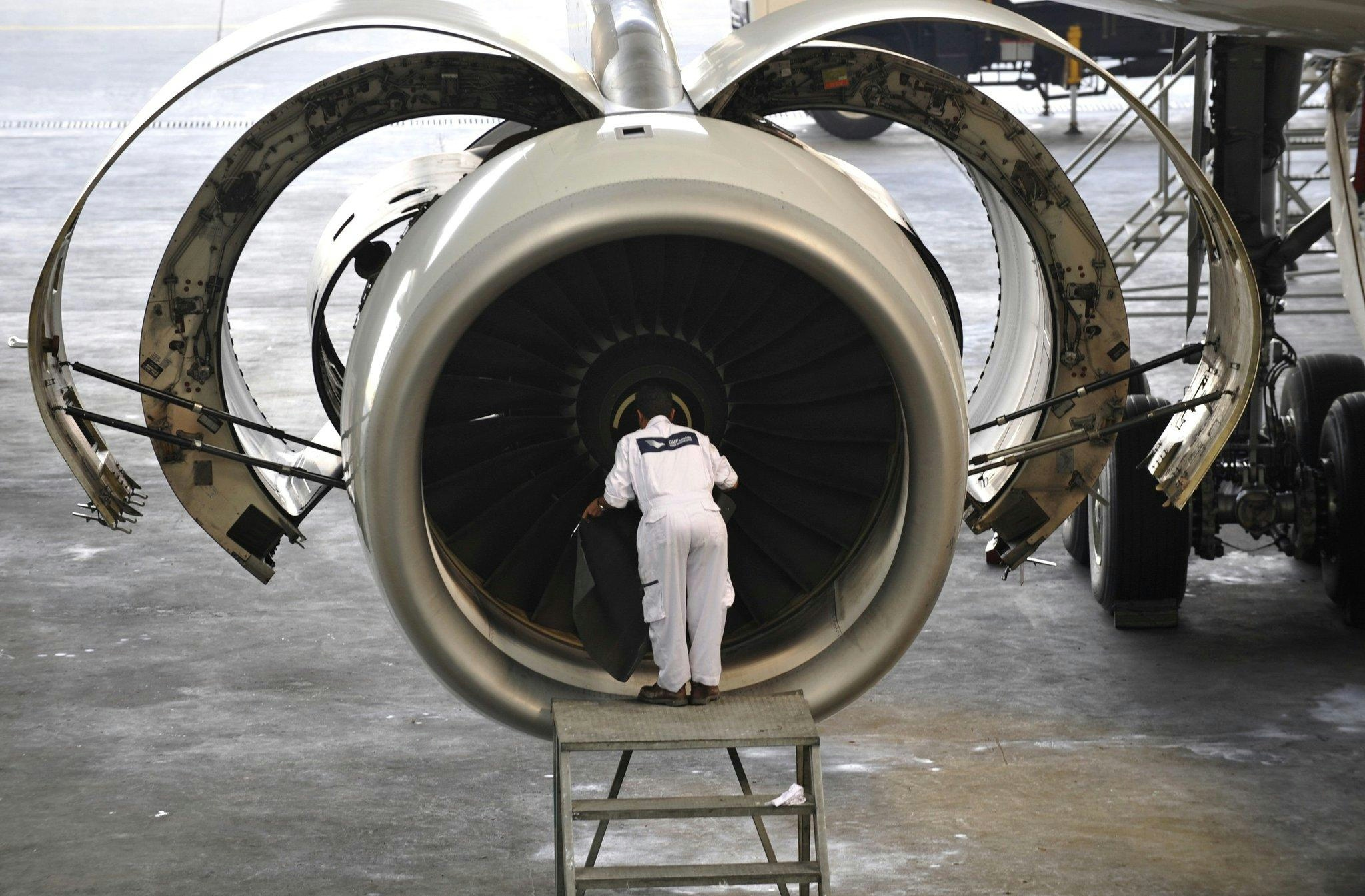
Rolls-Royce Engine Innovations Prompt Airbus Aircraft Redesigns Amid Industry Challenges
Rolls-Royce’s role in modern aviation extends well beyond the provision of engines, significantly influencing aircraft design and performance. When Airbus embarked on the development of the A380, the world’s largest passenger aircraft, the British manufacturer’s Trent 900 engine was a fundamental component from the very beginning. The engine’s considerable power output shaped critical design decisions, affecting the wing structure, braking systems, noise reduction measures, and fuel efficiency. This close integration effectively embedded the Trent 900 into the superjumbo’s core engineering framework.
As the aviation sector confronts increasing pressure to reduce carbon emissions, Rolls-Royce is applying insights gained from the Trent engine family to develop the UltraFan, a next-generation engine designed to deliver lower fuel consumption, quieter operation, and compatibility with sustainable aviation fuels. This innovation is particularly significant given that aviation accounted for 2.5% of global energy-related carbon dioxide emissions in 2023, according to the International Energy Agency (IEA).
Engineering That Shapes Aircraft
The Airbus A380 stands as a remarkable engineering achievement, measuring 239 feet in length with a wingspan approaching 262 feet, and capable of accommodating over 850 passengers in an all-economy layout. Meeting the thrust requirements for such a massive aircraft necessitated powerful engines. The A380 can be equipped with either four Rolls-Royce Trent 900 engines or four Engine Alliance GP7000s. Rolls-Royce asserts that the Trent 900 offers the lowest lifetime fuel burn for the A380, with incremental efficiency improvements of up to 1.6% since its launch. While these gains may appear modest, they translate into substantial fuel savings and emissions reductions over the course of long-haul operations.
The development of the A380 and Trent 900 was a highly coordinated effort. Rather than adapting the aircraft to accommodate an unexpectedly powerful engine, Airbus and Rolls-Royce collaborated closely, developing the airframe and engine in parallel with the anticipation of a very large thrust class. The engine’s size and the aircraft’s weight influenced every aspect of the design, including the wing and pylon structures, as well as cooling and hydraulic systems. Notably, Airbus chose to install thrust reversers only on the two inboard engines, relying instead on advanced carbon brakes and wing spoilers to provide stopping power, particularly on wet or contaminated runways.
New Engines, New Challenges
Rolls-Royce’s influence on aircraft design continues with the Airbus A350-1000, where the introduction of a new Rolls-Royce engine has necessitated a redesign of the long-haul jet to meet airlines’ demands for enhanced efficiency and durability. Emirates, for instance, has expressed concerns regarding the Trent XWB-97 engine’s performance under the hot and sandy conditions prevalent in the Gulf region, underscoring the operational challenges associated with new engine technologies.
At the same time, United Airlines CEO Scott Kirby has criticized the industry’s dependence on single engine suppliers, highlighting issues such as engine shortages and a contract dispute with Rolls-Royce that resulted in the cancellation of a significant A350 order. Despite these challenges, Rolls-Royce reports notable fuel-burn savings from its Trent XWB-84 EP engine, which is now offered as an option for the Airbus A350-900.
Supply-chain disruptions have further complicated matters, delaying high-profile projects such as Qantas’s ambitious plans for nonstop flights from Australia to London and New York. Airbus has struggled to deliver A350-1000 aircraft on schedule, impacting the airline’s expansion strategy.
The Path Forward
With aviation emissions surpassing one billion tons of CO₂ in 2023—reaching over 90% of pre-pandemic levels—the IEA emphasizes the urgent need for low-carbon fuels, improved engine and airframe designs, and enhanced operational efficiencies. Given the extended lifespans of commercial aircraft, incremental technological advances like those pioneered by Rolls-Royce remain vital to the industry’s transition toward a more sustainable future.
Embraer Delivers 2,000th E-Jet as Airbus A220 Seeks Market Share
iniBuilds Releases Second In-Depth A380 Video
Ryanair and Alaska Airlines Apply AI to Operational Decision-Making

Digital Payments, AI, and Aviation Strengthen Philippines-India Relations
PlaneSense Suspends PC-12 Jet Card Sales
How AI Could Transform Bird-Strike Prevention for Business Aviation
American Airlines and Boeing Complete First 737 MAX Landing Gear Swap

Vietjet and Thales sign major MRO and AI deals in Paris
Etihad CEO Cites Aircraft Capacity as Limiting Factor Amid Growth in China and Africa

Artificial Intelligence Enters the Cockpit
