
将人工智能洞察转化为可执行行动

热门趋势
Categories
The Quietest Widebody Cabin and What It Means for Boeing
The Quietest Widebody Cabin and What It Means for Boeing
Boeing has traditionally dominated the widebody aircraft market, consistently outselling its European competitor Airbus. However, the competitive landscape is evolving. In 2024, Airbus surpassed Boeing by delivering 89 widebody jets, edging ahead by a single aircraft. While Boeing’s 787 Dreamliner continues to secure orders and the highly anticipated 777X is expected to enter service within the next 18 months, Airbus’s sustained success with the A350 program presents a formidable challenge to the American manufacturer.
The A350’s Quiet Cabin and Operational Advantages
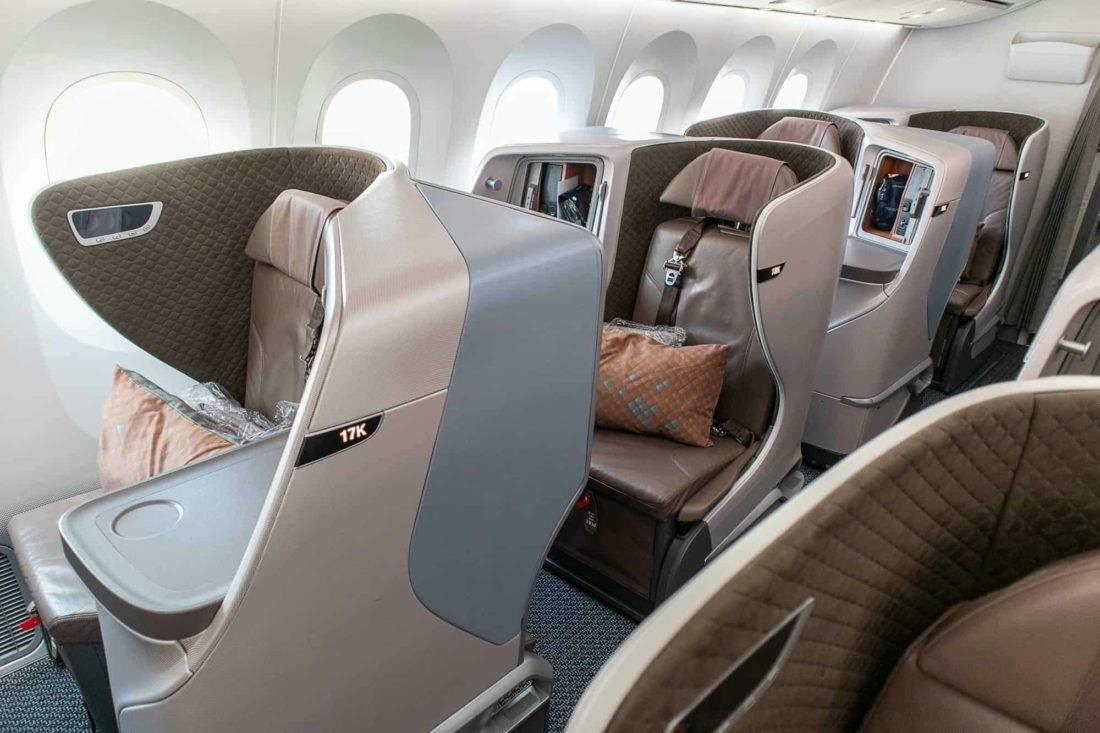
A defining feature of the Airbus A350 is its exceptionally quiet cabin, which Airbus markets as the quietest among widebody aircraft. In-flight noise levels typically remain below 60 decibels, a significant improvement over earlier jet travel when cabin noise often exceeded 80 decibels. This reduction is achieved through a combination of advanced noise-reduction technologies, including high-bypass Rolls-Royce XWB engines equipped with acoustic linings, aerodynamic enhancements, and superior insulation. The result is a notably tranquil environment for both passengers and crew, enhancing the overall flying experience.
Beyond its quietness, the A350’s range and fuel efficiency have made it a preferred choice for airlines operating ultra-long-haul routes. The A350-900 and A350-1000 variants offer ranges of 8,100 and 9,000 nautical miles respectively, surpassing Boeing’s 787-9 and even the widely used 777-300ER. Although the 777-300ER accommodates more passengers, the A350-1000 delivers greater range and up to 20% lower fuel consumption, according to Airbus. Boeing’s forthcoming 777X aims to narrow this efficiency gap, but delays in its introduction have led some airlines to favor Airbus’s offerings.
| Specification | A350-900 | A350-1000 | 787-9 | 777-300ER |
|---|---|---|---|---|
| Seat Capacity | 332–352 | 350–410 | 296 | 386 |
| Range (Nautical Miles) | 8,100 | 9,000 | 7,565 | 7,370 |
Boeing’s Strategic Challenges and Market Outlook
As Boeing advances its own initiatives to develop quieter cabins, it confronts the dual imperative of sustaining operational discipline and a robust safety culture while expanding its market presence. The company’s recent 37% surge in share price, partly driven by a potential 500-aircraft deal with China, signals renewed investor optimism. Nevertheless, market conditions remain uncertain, particularly in the Asia-Pacific region where recovery from the pandemic has been uneven.
Airbus is well-positioned to leverage Boeing’s recent difficulties, especially in markets where airlines prioritize quieter, more efficient aircraft. The A350’s growing dominance reflects a broader industry shift: as airlines and passengers increasingly value comfort, efficiency, and environmental performance, the quietest cabin has emerged as a critical competitive factor in the widebody segment.
For Boeing, reclaiming its leadership in the widebody market will demand not only technological innovation but also an unwavering commitment to safety and reliability amid intensifying competition.

Etihad Airways Suspends Airbus A380 Flights on Key Route

Aditya Birla Group Seeks Approval for Aircraft Leasing in GIFT City

Qatar Airways Highlights Innovation and Connectivity at Arabian Travel Market 2026

Hong Kong's Five-Year Plan Includes Andrew Fan's Aircraft Parts Processing Hub Proposal

ACIA Aero Leasing Delivers ATR72-600 to Air Nostrum

RTX Appoints Jill Albertelli as Head of Pratt & Whitney

TAT Technologies Joins Beyond Aero Hydrogen Aircraft Program

AURAK Study Highlights Barriers to Air Taxi Adoption in Emerging Economies

Xiamen Air Selects Altitude for 787 Maintenance at Heathrow

Etihad and Swissport Extend Global Partnership
