
حوّل رؤى الذكاء الاصطناعي إلى أفعال منسّقة

الرائج الآن
Categories
Advanced combat aircraft project faces hurdle over costly GE engines
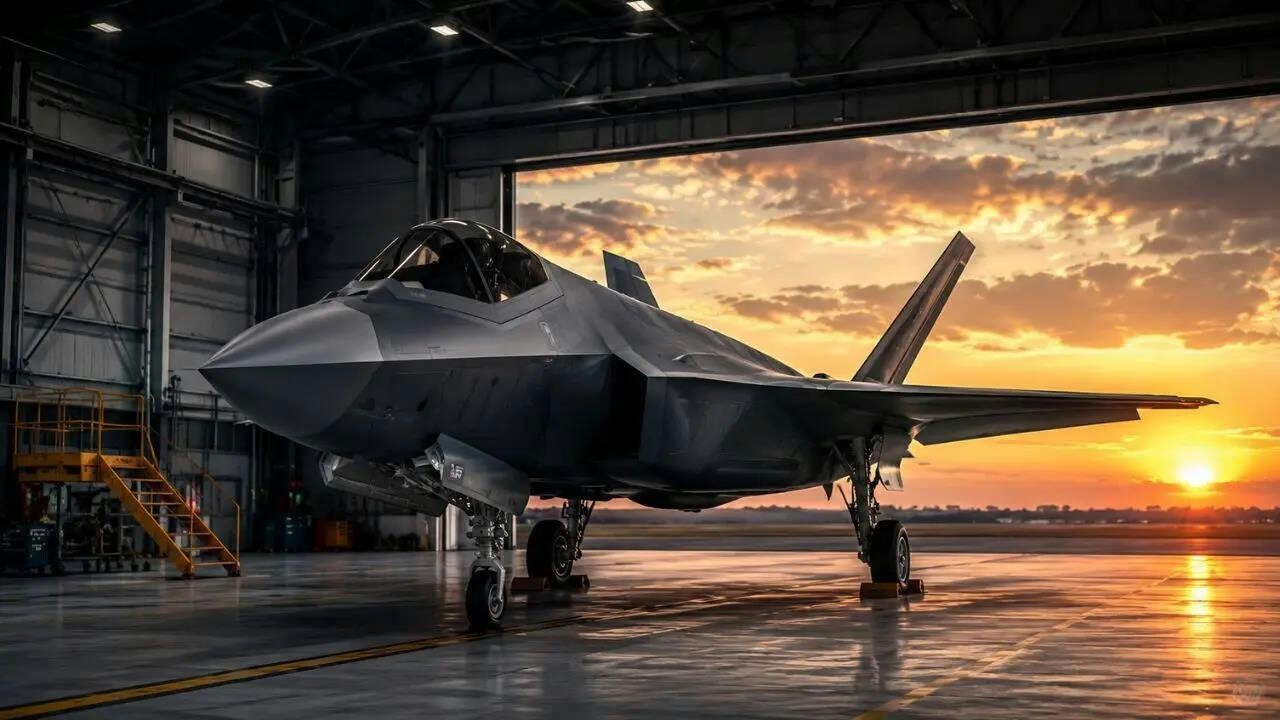
Advanced Combat Aircraft Project Faces Hurdle Over Costly GE Engines
Rising Engine Costs Challenge AMCA Development
The Defence Research and Development Organisation (DRDO) is encountering a significant obstacle in its Advanced Medium Combat Aircraft (AMCA) project due to the escalating costs of General Electric (GE) engines. As the agency progresses with the design and development of this next-generation fighter, the unexpectedly high price quoted by GE for the F414 engines has compelled DRDO to explore more affordable and adaptable alternatives.
While the technical discussions between GE and Hindustan Aeronautics Limited (HAL) regarding a joint venture to manufacture the F414 engine in India have concluded, commercial negotiations remain ongoing and are expected to extend over several months. This partnership aims to cover a comprehensive range of activities including procurement, technology transfer, licensed manufacturing, maintenance, repair and overhaul (MRO), spares, warranties, and delivery schedules. The F414 engines produced under this collaboration are intended to power both the Tejas Mark 2 and the initial variant of the AMCA. A more advanced AMCA variant is planned to utilize a higher-thrust engine currently being co-developed by Safran and HAL.
However, the immediate challenge lies in the cost of the F414 engines for the AMCA’s prototype phase. Initial estimates placed the price at approximately Rs 70–80 crore per engine, but the revised figure is reportedly nearly three times higher. Given the AMCA’s twin-engine configuration, the engine cost alone could escalate to $380–400 million (Rs 3,500–3,800 crore) per aircraft. This substantial increase raises serious concerns about the programme’s overall affordability and its impact on development timelines.
Exploring Alternative Engine Options Amid Global Trends
In response to these cost pressures, DRDO is actively seeking alternative engine suppliers. Globally, engine manufacturers are adapting to the evolving demands of next-generation combat aircraft by pursuing innovative partnerships and technologies. MTU Aero Engines, for instance, is advocating for collaborative ventures tailored to the emerging collaborative combat aircraft (CCA) market, emphasizing rapid and cost-effective market entry with scalable solutions. Rolls-Royce has secured funding from the US Air Force for its Orpheus autonomous fighter engine project, signaling a strategic shift toward alternative propulsion technologies.
Meanwhile, GE Aerospace continues to advance its engine technology, having completed initial ground tests of a hybrid CT7 demonstrator aimed at improving efficiency in future engines. However, these developments do not alleviate the immediate financial challenges posed by the current F414 engine pricing.
Progress and Partnerships in AMCA Prototype Development
The AMCA project remains a cornerstone of India’s future air combat capabilities. Recently, the Ministry of Defence invited three shortlisted consortiums to submit formal commercial and technical bids for manufacturing five prototypes of the aircraft. The contenders include Tata Advanced Systems Ltd (TASL); a consortium led by Larsen & Toubro (L&T) alongside Bharat Electronics Ltd (BEL) and Dynamatic Technologies Ltd; and another consortium comprising Bharat Forge, the public sector undertaking BEML, and Data Patterns.
The selected partner will collaborate closely with the Aeronautical Development Agency (ADA) under DRDO to build five flying prototypes and one structural test aircraft. Although a limited number of F414 engines from GE were initially sought for the design and development phase, the steep cost escalation has intensified efforts to identify viable alternatives. This search underscores the challenges India faces as it advances its flagship fighter programme amid evolving technological and economic constraints.

Etihad and Swissport Extend Global Partnership

Sepehran Airlines B737 Returns to Mashhad After Tyre and Engine Issues

Etihad Deploys Widebody Fleet to Meet Strong Demand

Korean Air Finalizes $36.2 Billion Deal with Boeing

Australia’s RFDS Queensland Section Orders Six King Air 260Cs

Korean Air Finalizes Order for 103 Boeing Jets and Engines

Embraer E195-E2 Features Distinctive Engine Placement Among Regional Jets

What Passengers Can Expect on Boeing’s New 777X Jet

How Ethiopian Airlines Became Africa’s Leading Carrier Amid Gulf Competition

Joby Aviation Extends Autonomous Flight Capabilities with Cross-Country Tour
