
حوّل رؤى الذكاء الاصطناعي إلى أفعال منسّقة

الرائج الآن
Categories
Advancing Innovation in Canadian Aerospace
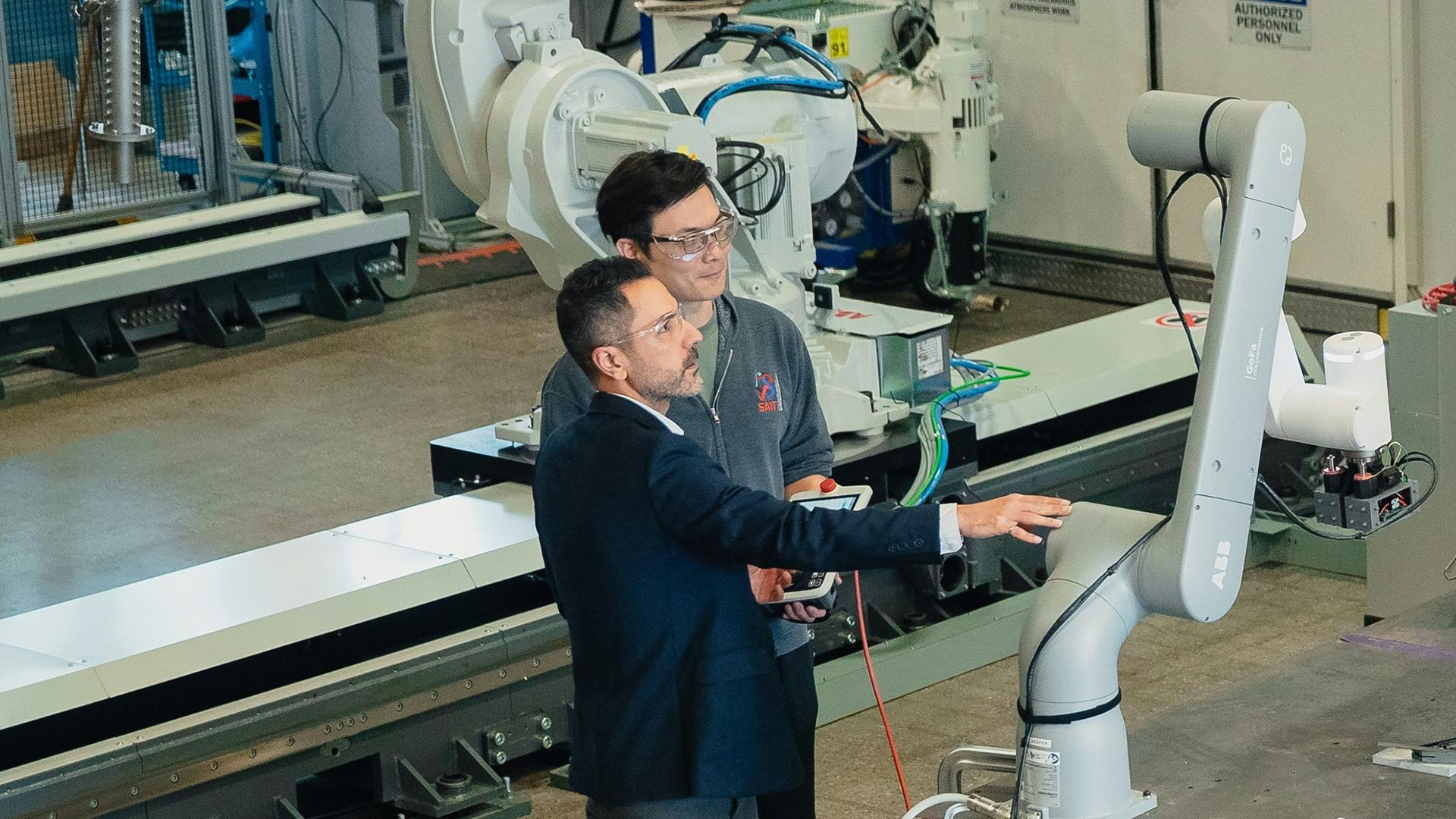
Advancing Innovation in Canadian Aerospace
A Hub for Cutting-Edge Aerospace Research
The Centre for Aerospace Research (CfAR) at the University of Victoria stands at the forefront of Canada’s aerospace innovation, pioneering advancements in uncrewed aircraft, hybrid-electric aviation, and small satellite missions. As the institution hosting Western Canada’s first aerospace engineering graduate program, CfAR plays a dual role in both developing state-of-the-art technologies and cultivating the next generation of aerospace engineers.
The aerospace industry is experiencing a profound transformation driven by electrification, autonomy, artificial intelligence, and the expanding space economy. These dynamic forces are fundamentally altering the design, construction, and operation of aircraft and spacecraft. Meeting these evolving challenges requires more than isolated research; it demands integrated organizations that bring together multidisciplinary expertise, advanced infrastructure, and robust partnerships with industry and government stakeholders.
Integrated Approach to Aerospace Innovation
Located in Victoria, British Columbia, CfAR exemplifies this comprehensive approach. The Centre has emerged as one of Canada’s premier aerospace research hubs by combining expertise in both aeronautics and astronautics. Its philosophy centers on a practical “design-build-fly” model that vertically integrates the entire research and development cycle. Rather than limiting itself to fundamental research, CfAR supports the full innovation continuum, collaborating with partners from initial concept and simulation through design, manufacturing, environmental and flight testing, and operational deployment. This holistic methodology enables government agencies, industry players, and research organizations to mitigate risks associated with emerging technologies and accelerate their commercialization.
CfAR’s broad technical capabilities distinguish it within the sector. By bridging traditionally siloed disciplines, the Centre fosters innovation transfer between aviation and space applications, creating synergistic research programs. Since launching British Columbia’s first CubeSat in 2022, space systems engineering has become a cornerstone of CfAR’s activities. In collaboration with the Canadian Space Agency (CSA) and Defence Research Development Canada (DRDC), CfAR has established a space engineering program with proven orbital heritage, supporting both scientific research and technology demonstration.
Notable Missions and Future Endeavors
Among CfAR’s significant missions are ORCASat (2022) and the forthcoming MARMOTSat (2026), which have showcased the Centre’s expertise in spacecraft avionics and ground station operations. Its most ambitious project to date, PolarLink, is an 8U CubeSat equipped with an optical communication payload scheduled for launch in 2027. Conducted under the Space Low Earth Orbit program with DRDC, PolarLink aims to evaluate low-Earth-orbit satellite constellations as communication relays, with a particular focus on enhancing connectivity in Canada’s Arctic regions.
Challenges and Industry Collaborations
Despite these technological advances, the aerospace sector continues to face significant challenges, particularly in securing sustained funding for research and development. Business expenditures in aerospace R&D reached a record $962 million in 2025, highlighting both the scale of investment and the ongoing need for financial support. Market responses remain optimistic, with companies such as Air Canada and Airbus launching joint initiatives to scale domestic sustainable aviation fuel (SAF) production, underscoring a strong commitment to reducing the environmental impact of corporate travel. Additionally, competitor collaborations and the development of a national defence ecosystem—emphasized by KF Aerospace CEO Tracy Medve at ADSE 2026—reflect the sector’s dedication to innovation and sustainability.
As aviation and space systems become increasingly interconnected, the University of Victoria’s CfAR occupies a unique and vital position within Canada’s innovation landscape, offering comprehensive expertise across the full spectrum of aerospace research and development.

Etihad Airways Suspends Airbus A380 Flights on Key Route

Aditya Birla Group Seeks Approval for Aircraft Leasing in GIFT City

Qatar Airways Highlights Innovation and Connectivity at Arabian Travel Market 2026

Hong Kong's Five-Year Plan Includes Andrew Fan's Aircraft Parts Processing Hub Proposal

ACIA Aero Leasing Delivers ATR72-600 to Air Nostrum

RTX Appoints Jill Albertelli as Head of Pratt & Whitney

TAT Technologies Joins Beyond Aero Hydrogen Aircraft Program

AURAK Study Highlights Barriers to Air Taxi Adoption in Emerging Economies

Xiamen Air Selects Altitude for 787 Maintenance at Heathrow

Etihad and Swissport Extend Global Partnership
