صورة

أيروجيني — مساعدك الذكي للطيران.

اسأل عن أي شيء. قم بتحليل كل شيء. تصرّف فورًا.

الرائج الآن

Categories

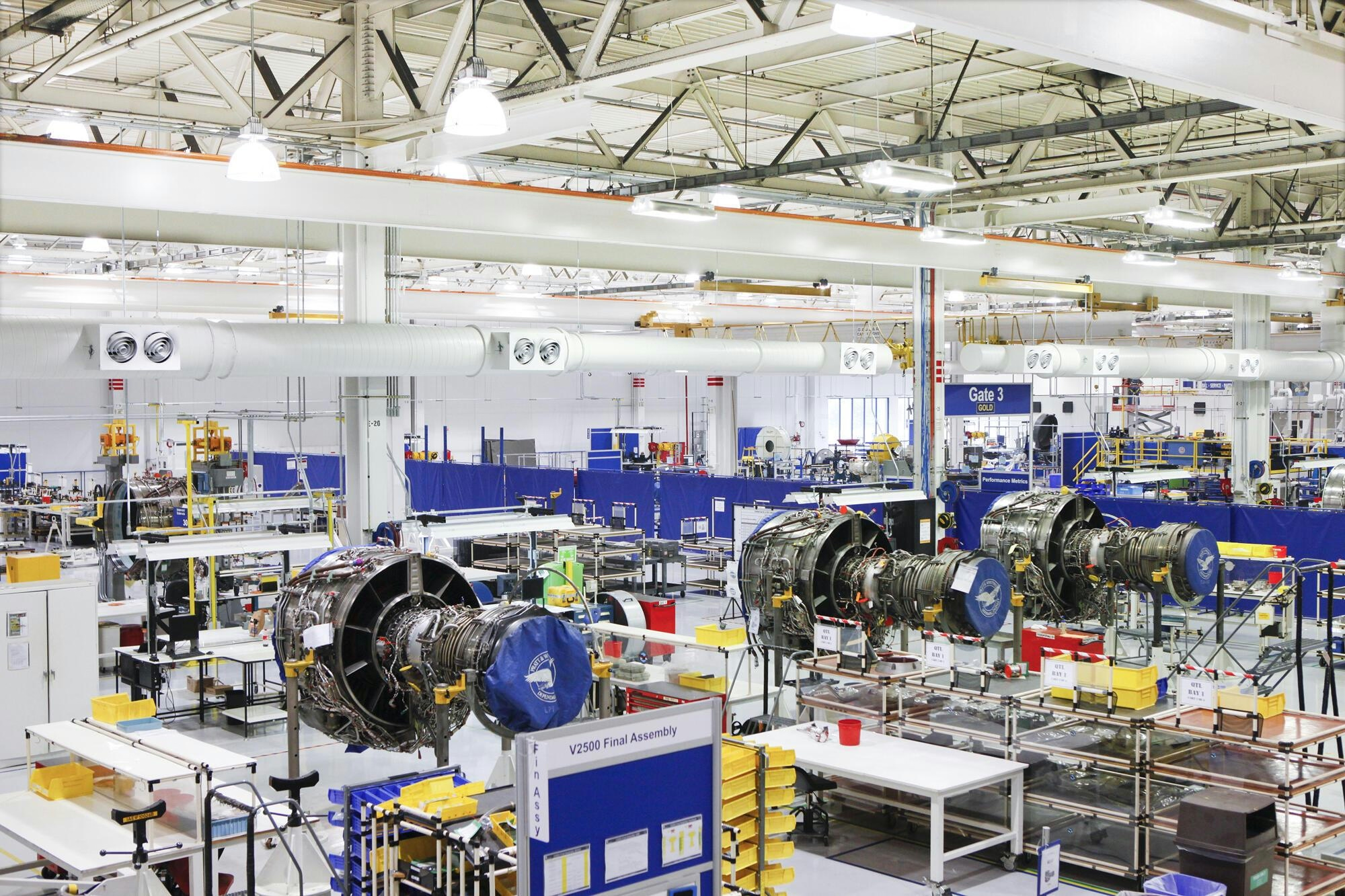
AerFin Introduces V2500 Engine Support at MRO Americas
April 21, 2026By ePlane AI
AerFin Introduces V2500 Engine Support at MRO Americas
0
0
AerFin
V2500 Engine
MRO Americas

AerFin Expands Engine Maintenance Services with V2500 Support at MRO Americas

AerFin, a prominent aviation asset specialist, has announced the launch of V2500 engine support at MRO Americas, marking a significant enhancement of its maintenance, repair, and overhaul (MRO) capabilities. This strategic expansion positions the company to better meet the increasing demands of the global aviation aftermarket, where engine maintenance is expected to represent approximately 20% of the market between 2026 and 2035.

Enhanced Capabilities and Facility Expansion

With new certifications from the European Union Aviation Safety Agency (EASA), the Federal Aviation Administration (FAA), and the UK Civil Aviation Authority (CAA), AerFin is now authorized to conduct light maintenance activities on the V2500 engine platform. These services are delivered from the company’s expanded Indurent Park facility, which opened in January 2025. The 116,000-square-foot headquarters includes 26 engine bays and supports up to 200 quick-turn engine shop visits annually, effectively doubling AerFin’s previous capacity.

The V2500 engine remains a vital component of the Airbus A320 family, underpinning narrowbody operations worldwide. As these engines enter more intensive maintenance cycles, airlines and lessors face increasing pressure to maintain fleet availability while controlling costs and operational complexity. AerFin’s new V2500 support services, which include borescope inspections, C checks, line replaceable unit (LRU) replacements, and comprehensive visual inspections, are designed to provide customers with enhanced visibility into asset condition and greater control over maintenance planning.

Simon Bayliss, Chief Operating Officer at AerFin, emphasized the importance of this development, stating, “Securing V2500 accreditation is an important step for AerFin and for our customers. This is a platform that continues to underpin global narrowbody operations, and the need for reliable, timely support has never been greater. We’re focused on delivering practical capability that helps operators make informed decisions, maintain availability, and protect asset value.”

Strategic Positioning Amid Market Challenges

The introduction of V2500 engine support complements AerFin’s broader integrated approach, which encompasses engines, material supply, teardown, and asset optimization. Building on its established Engine MRO Lite capabilities that already support multiple narrowbody platforms, AerFin aims to provide a cohesive service offering that enables customers to respond more effectively to evolving maintenance demands and operational pressures.

Despite these advancements, AerFin faces considerable challenges as it enters the competitive V2500 support market. Established engine maintenance providers are expected to intensify competition, requiring AerFin to ensure seamless integration of its new services while maintaining rigorous regulatory compliance. The company’s move is likely to attract heightened scrutiny from both airlines and regulatory authorities, with competitors potentially enhancing their own offerings or forming strategic alliances to protect market share.

Asim Chalise, Vice President of MRO Sales at AerFin, highlighted the operational benefits of the new capability: “With V2500 engines moving into heavier checks, understanding condition early and acting quickly can make a real difference. Our capability allows us to assess, advise, and intervene where needed—whether through inspection, targeted replacements, or ongoing maintenance support. It’s about helping customers stay ahead in a demanding environment.”

AerFin’s expansion into V2500 engine support underscores its commitment to delivering practical, compliant solutions tailored to the evolving needs of the aviation industry, particularly as the North American MRO sector continues its growth trajectory.

More news
AAR links airlines to 5,000 suppliers with new AI parts-buying tool

AAR links airlines to 5,000 suppliers with new AI parts-buying tool

AAR Introduces Airvoyant: An AI-Powered Platform Connecting Airlines to Over 5,000 Suppliers WOOD DALE, Ill., April 21, 2026 — AAR CORP. (NYSE: AIR), a prominent provider of aviation services, has launched Airvoyant, an innovative AI-driven procurement platform designed to revolutionize the sourcing of aircraft parts for airlines and maintenance, repair, and overhaul (MRO) operators. Developed on Amazon Web Services (AWS) and integrated with Aeroxchange’s extensive network of more than 5,000 suppliers, Airvoyant seeks to automate and streamline the traditionally manual and fragmented process of parts procurement. Transforming Procurement with Artificial Intelligence Airvoyant’s intelligent system directly connects buyers to suppliers, enabling real-time inventory searches, consolidated quote comparisons, and simplified one-click purchasing decisions. The platform employs AI agents that analyze supplier quotes and generate purchase recommendations by leveraging historical procurement data, including past transactions, pricing trends, and supplier performance metrics. This data-centric approach is intended to pave the way for autonomous ordering and more informed sourcing decisions. The platform is designed to integrate seamlessly with major enterprise resource planning (ERP) systems such as Trax, embedding intelligent procurement capabilities within existing operational workflows. Additional AI functionalities focusing on demand consolidation, vendor optimization, and automated negotiation are slated for release later this year, promising to further enhance Airvoyant’s utility. Industry Collaboration and Market Challenges Several leading airlines, including Delta Air Lines and Air Canada, are actively collaborating as subject matter experts, providing critical feedback to refine the platform. Launch partners and advisors such as Air Europa, Allegiant, Atlas Air, JetBlue, Thai Airways, and Virgin Atlantic have already begun to experience the benefits of Airvoyant in their MRO parts procurement processes. Despite its potential, Airvoyant faces challenges in a market where manual procurement practices and long-standing supplier relationships remain deeply rooted. Industry analysts note that adoption may be gradual, as many airlines and procurement professionals continue to rely on traditional, email-based requests for quotations (RFQs) and manual quote evaluations. Skepticism from stakeholders hesitant to transition to AI-driven systems is anticipated, while competitors may respond by enhancing their own procurement technologies or forming partnerships with AI providers to maintain competitive advantage. The broader implications of AI adoption on the aviation workforce also warrant consideration. Some industry participants have expressed concerns regarding the potential displacement of traditional procurement roles as automation becomes more widespread. AAR’s Commitment to Advanced Aviation Solutions AAR underscores that Airvoyant’s cloud-native architecture ensures real-time processing, seamless integration, and robust security, enabling customers to embrace advanced automation with confidence. By unifying procurement workflows and providing direct access to a broad network of trusted suppliers, Airvoyant aims to accelerate sourcing, expand supplier reach, and deliver measurable cost savings on parts expenditure. “Airvoyant represents the first scalable solution to deliver agentic AI to airlines and MROs,” stated John M. Holmes, AAR’s Chairman, President, and CEO. “These AI tools will reshape how customers source and procure parts, plan maintenance, and optimize operations.” Airvoyant complements AAR’s growing aviation software portfolio, which includes Trax and Aerostrat, reinforcing the company’s dedication to next-generation solutions for airline and MRO operations. For further details, visit AAR’s software portfolio or Airvoyant.
Ethiopian Airlines Expands 787 Fleet to 46 with New Order

Ethiopian Airlines Expands 787 Fleet to 46 with New Order

Ethiopian Airlines Expands 787 Fleet to 46 with New Order Ethiopian Airlines has significantly increased its Boeing 787 fleet to a total of 46 aircraft by exercising options on six additional Boeing 787-9s, thereby completing all 15 options from a 2023 order. This development was announced during a signing ceremony held in Washington on Monday, marking a notable milestone for Africa’s largest carrier. Since 2005, Ethiopian Airlines has placed a cumulative total of 134 orders with Boeing, while it continues to hold 17 outstanding orders with Airbus. Fleet Expansion Amid Industry Challenges The recent order follows an agreement for 11 Boeing 787-9s announced at the Dubai Airshow in November 2023, which included 15 options. Of these, nine options were exercised in December 2023, with the remaining six confirmed this week. This expansion comes at a time when the global aviation industry is grappling with significant supply chain disruptions that have impacted new aircraft deliveries worldwide. Between 2021 and 2025, these disruptions are estimated to have cost airlines approximately $30 billion, raising concerns about potential delays in fleet modernization and expansion. Despite these challenges, Ethiopian Airlines remains committed to its ambitious growth strategy. The airline is concurrently investing $12.5 billion in the construction of Africa’s largest airport in Bishoftu, a project designed to enhance its status as a premier hub for long-haul travel on the continent. This infrastructure development is expected to intensify competition for long-haul routes, particularly within Africa, as the carrier seeks to consolidate its market position. Implications for the Aviation Market Market responses to Ethiopian Airlines’ fleet expansion have already begun to emerge. Competitors such as Austrian Airlines are reportedly contemplating an increase in their own Boeing 787 long-haul fleets, indicating a potential shift in the competitive dynamics of intercontinental air services. As Ethiopian Airlines continues to grow both its fleet and infrastructure, it is strategically positioning itself to meet the rising demand for long-haul travel in Africa, while managing the operational risks associated with ongoing global supply chain constraints.
Can SAF Technology Reduce Aviation Emissions?

Can SAF Technology Reduce Aviation Emissions?

Can SAF Technology Reduce Aviation Emissions? Sustainable Aviation Fuel (SAF) is increasingly recognized as one of the most promising solutions for reducing carbon emissions within the aviation industry. Its key advantage lies in its compatibility with existing fuel infrastructure, enabling airlines to integrate SAF without requiring significant operational adjustments. As the sector progresses, momentum is building across the entire value chain. Governments are establishing regulatory frameworks to support SAF adoption, while private sector entities are driving demand through strategic procurement and investment initiatives. Growing Corporate Demand and Market Dynamics The recently published Amex GBT Sustainable Aviation Fuel (SAF) Index 2026 highlights the critical role corporate travel programs are expected to play in the expansion of SAF usage. Projections suggest that by 2030, corporate travel could account for up to half of the global demand for SAF. This anticipated increase is viewed as a vital catalyst for bolstering market confidence, encouraging further production, and fostering innovation within the sector. Elizabeth Rolfes, Sustainability Analyst at AMEX GBT, emphasized the significance of this development, describing the index as a comprehensive guide to the evolving SAF landscape and its implications for corporate travel programs. Despite this optimism, the widespread adoption of SAF faces considerable challenges. High production costs, constrained supply chains, and complex regulatory environments continue to impede rapid scaling. The industry’s response has been varied: while some airlines are actively embracing SAF and investing heavily in its development, others remain cautious due to economic uncertainties. Concurrently, competitors are exploring alternative or complementary technologies such as electric propulsion and carbon capture, reflecting a broader search for effective decarbonization strategies. Policy Challenges and Future Prospects Policy decisions add further complexity to the SAF landscape. For instance, Singapore recently delayed the implementation of its SAF levy, citing geopolitical tensions and the necessity to balance environmental objectives with economic and market considerations. This decision highlights the intricate relationship between policy frameworks, market forces, and global events in shaping the trajectory of sustainable aviation. As SAF technology continues to advance and collaboration among industry stakeholders intensifies, its potential to substantially reduce aviation emissions remains significant. However, addressing the economic, logistical, and regulatory hurdles will be essential for SAF to realize its full potential in the sector’s broader decarbonization efforts.
Divya Manchanda Discusses ePlane’s Vision for Air Taxis and Drones

Divya Manchanda Discusses ePlane’s Vision for Air Taxis and Drones

ePlane’s Vision for Air Taxis and Drones in India’s Advanced Air Mobility Sector At the Transport Logistic & Air Cargo India 2026 event in Mumbai, Divya Manchanda, Executive Vice President of Business Partnerships and Advanced Air Mobility (AAM) Strategy at The ePlane Company, shared insights into the company’s strategic ambitions within India’s rapidly evolving AAM landscape. Manchanda detailed how ePlane is positioning itself at the forefront of this transformation through its flagship electric air taxi, the e200X. Central to this effort is the use of advanced NVIDIA-powered digital twins, which enable real-time simulations of various operational scenarios, including extreme weather conditions and system failures. These simulations are instrumental in accelerating safety validation and certification processes, critical milestones as the industry moves closer to commercial deployment. Progress and Challenges in Drone and Air Taxi Development Manchanda also highlighted significant advancements in cargo drone technology, citing Amber Wings’ DGCA-certified ATVA-1 hybrid drone and the development of subsequent platforms such as the ATVA-2 and heavy-lift variants. These innovations are designed to address diverse applications ranging from defense to logistics, reflecting the maturation of India’s drone ecosystem. Despite these promising developments, Manchanda acknowledged the considerable challenges facing the sector. Globally, the AAM industry has been marked by legal disputes among key players, including Joby Aviation and Archer Aviation, over trade secrets and business relationships, illustrating the competitive and sometimes contentious nature of the market. Within India, integrating new air mobility solutions into existing airspace infrastructure remains a complex issue, necessitating close collaboration with regulatory authorities to ensure both safety and operational efficiency. Consistency in drone logistics systems presents another significant hurdle, as the industry strives to establish standards that will facilitate seamless and secure operations. Market observers are closely monitoring how companies manage international partnerships and maintain operational transparency, with expectations of increased scrutiny as the sector expands. Concurrently, competitors are intensifying efforts through aggressive marketing of personal air taxis and lobbying for regulatory frameworks that favor their respective technologies. Government Support and Future Outlook Despite these obstacles, Manchanda emphasized the robust support from the Indian government for AAM initiatives. She pointed to ongoing efforts to expand airspace access, develop pilot training programs, and construct vertiport infrastructure as clear indicators of a collaborative approach aimed at fostering innovation. “The regulatory environment is evolving rapidly, and we’re seeing a willingness to engage with industry to address challenges head-on,” she remarked. As ePlane advances its vision for electric air taxis and next-generation drones, the company remains committed to prioritizing safety, technological leadership, and ecosystem partnerships. With strong government backing and a focus on rigorous validation, Manchanda expressed confidence that India is well-positioned to emerge as a leader in advanced air mobility, even as the industry navigates complex competitive and regulatory dynamics.
Pem-Air Expands V2500 Maintenance Capabilities

Pem-Air Expands V2500 Maintenance Capabilities

Pem-Air Expands V2500 Maintenance Capabilities Amid Industry Shifts Pem-Air Turbine Engine Services (Pem-Air) has announced a significant expansion of its maintenance, repair, and overhaul (MRO) portfolio to include comprehensive services for the IAE V2500 engine family. This strategic development enables Pem-Air to provide end-to-end support across all V2500 variants, which power widely used aircraft such as the Airbus A320ceo, MD-90, and Embraer C-390. Meeting Growing Demand for V2500 Support The V2500 engine remains one of the most prevalent powerplants in commercial aviation, with thousands of units actively operating worldwide. The sustained demand for these engines has intensified the need for reliable and cost-effective aftermarket support. Pem-Air’s expanded capabilities are designed to assist operators, lessors, and other aviation stakeholders in managing engine lifecycles more efficiently, reducing downtime, and preserving long-term asset value. The enhanced service offering encompasses full performance restoration and overhaul, module-level repair and refurbishment, advanced inspection and diagnostic services, and lifecycle-focused maintenance planning aimed at optimizing cost and reliability. Additionally, Pem-Air provides on-wing and field service support to ensure rapid response during aircraft-on-ground (AOG) events. Strategic Positioning and Industry Challenges This expansion aligns with Pem-Air’s broader strategy to scale its capacity across high-demand engine platforms and reflects a wider industry trend toward regional growth and diversification in aviation maintenance services. However, the company faces several challenges as it broadens its V2500 maintenance capabilities. Regulatory compliance remains a critical hurdle, requiring strict adherence to aviation standards. Furthermore, Pem-Air must navigate competition from established MRO providers such as Piedmont Propulsion and Duncan Aviation, who may respond by enhancing their own service offerings or expanding their geographic reach. The industry-wide shortage of skilled technicians also presents a significant challenge, as advanced engine technologies demand specialized expertise. Despite these obstacles, market reactions to Pem-Air’s expansion are expected to be positive, with increased demand anticipated from airlines and lessors seeking dependable and economically viable maintenance solutions amid ageing fleets and evolving operational pressures. By investing in full-scope V2500 support, Pem-Air strengthens its position as a trusted maintenance partner in a competitive and rapidly evolving sector. The company aims to deliver comprehensive, lifecycle-focused solutions that address the evolving needs of its global customer base.
FedEx Conducts First Intra-City Drone Delivery Trials in Bengaluru

FedEx Conducts First Intra-City Drone Delivery Trials in Bengaluru

FedEx Completes Pioneering Intra-City Drone Delivery Trials in Bengaluru FedEx has successfully concluded India’s first intra-city drone delivery flight trials in Bengaluru, marking a notable advancement in the country’s urban logistics landscape. Conducted in partnership with the Indian Institute of Technology Madras under the FedEx SMART Centre research framework, the trials aimed to assess the operational efficiency of drone deliveries within metropolitan boundaries. Efficiency Gains and Operational Insights The FedEx SMART Centre’s analysis demonstrated that a typical 53-kilometer road journey in Bengaluru, which generally exceeds one hour, could be reduced to an aerial route of approximately 39 to 42 kilometers. During the trials, this translated into a one-way transit time of around 21 minutes, underscoring the potential for significant time savings in time-sensitive logistics operations. The drone flights successfully navigated complex airspace, including Airport Yellow and Red Zones, with all requisite approvals obtained from the Directorate General of Civil Aviation. Nitin Navneet Tatiwala, vice president of marketing, customer experience, and air network for the Middle East, Indian Subcontinent, and Africa (MEISA) at FedEx, emphasized that these trials align with the broader objectives of the FedEx SMART Centre. Beyond drone delivery, the centre’s research agenda encompasses air cargo optimization, electric vehicle integration, and advanced demand forecasting. These initiatives collectively aim to develop resilient, sustainable, and future-ready supply chain ecosystems through collaboration with academia, industry stakeholders, and policymakers. Challenges and Industry Implications Despite the promising results, the widespread adoption of drone deliveries in India faces considerable challenges. Regulatory complexities, safety concerns, and the integration of emerging technologies into existing logistics frameworks remain significant barriers. Industry analysts caution that while drone deliveries have the potential to alleviate urban congestion and expedite delivery times, questions about scalability and cost-effectiveness persist. FedEx’s progress is being closely monitored by competitors within the logistics sector, some of whom may accelerate their own drone initiatives or engage in regulatory lobbying to influence the competitive landscape. Concurrently, advancements in universal robotic systems and artificial intelligence-driven logistics solutions could provide FedEx with a strategic advantage. However, the ultimate success of these drone delivery trials will depend on the company’s ability to navigate immediate operational and regulatory challenges. As FedEx and its partners continue to explore drone technology, the outcomes of the Bengaluru trials may play a pivotal role in shaping the future of urban logistics in India and potentially on a global scale.
BeauTech Expands GTF Presence with PW1500G Contract

BeauTech Expands GTF Presence with PW1500G Contract

BeauTech Expands GTF Presence with PW1500G Contract BeauTech Power Systems has announced the acquisition of five Pratt & Whitney PW1500G geared turbofan (GTF) engines, purchased directly from Pratt & Whitney, a subsidiary of RTX. These engines will be leased to a major customer to support the expansion of an Airbus A220 fleet. This acquisition follows BeauTech’s initial foray into the GTF market in late 2025, when it invested in PW1900G engines, marking a significant step in broadening its portfolio of next-generation engine assets. Strategic Expansion in Engine Leasing The addition of the PW1500G engines, specifically designed for the Airbus A220, reinforces BeauTech’s position as a flexible leasing partner for both regional and narrowbody aircraft operators. This move diversifies the company’s coverage across a range of legacy and current-generation engine types, enhancing its capacity to meet evolving customer demands. BeauTech’s strategic focus on modern, fuel-efficient platforms aligns with industry trends favoring advanced engine technologies that improve operational efficiency and reduce environmental impact. Navigating Industry Challenges BeauTech’s expansion occurs amid ongoing challenges within the aviation sector related to Pratt & Whitney’s manufacturing difficulties, which have resulted in the grounding of over a thousand aircraft worldwide. These issues have attracted increased scrutiny from aviation regulators and may cause delays in engine deliveries. Consequently, BeauTech faces operational risks and uncertainties concerning engine availability and regulatory compliance. The competitive landscape may also intensify as rivals seek alternative engine options or attempt to leverage any disruptions affecting BeauTech’s operations. Tobias Konrad, Chief Operating Officer of BeauTech, described the acquisition as a natural progression in the company’s GTF strategy, building on its initial entry into the segment last year. He reaffirmed BeauTech’s commitment to providing customers with advanced engine solutions despite current market headwinds. The investment underscores the company’s ambition to scale its presence in the competitive GTF market, where demand for efficient, next-generation engines remains robust. By aligning its portfolio with high-demand assets, BeauTech aims to offer operators reliable leasing options that facilitate fleet growth and enhance operational efficiency. This transaction exemplifies BeauTech’s ongoing strategy to expand its asset base, strengthen customer partnerships, and establish itself as a key player in the evolving aircraft engine leasing sector, even as it contends with the complexities of today’s market environment.
CTS Engines Secures Long-Term CF6 Overhaul Contract with San Francisco Airlines

CTS Engines Secures Long-Term CF6 Overhaul Contract with San Francisco Airlines

CTS Engines Secures Long-Term CF6 Overhaul Contract with San Francisco Airlines Strategic Partnership to Support CF6-80C2 Engine Maintenance CTS Engines (CTS), a specialist in jet engine maintenance, repair, and overhaul (MRO), has entered into a multi-year agreement with S.F. Airlines, one of China’s foremost cargo carriers, to provide comprehensive overhaul and repair services for its CF6-80C2 engines. These engines power S.F. Airlines’ Boeing 767 and 747 fleets, and the contract reinforces a strategic partnership centered on enhancing reliability, operational efficiency, and continuity. This collaboration reflects a mutual commitment to sustaining the performance and longevity of S.F. Airlines’ widebody aircraft. The agreement capitalizes on CTS’s recent certification from the Civil Aviation Administration of China (CAAC), authorizing the company to deliver approved maintenance services tailored to the airline’s specific operational requirements. All maintenance activities will be conducted at CTS’s newly established, purpose-built facility in Coral Springs, Florida. Designed specifically for mature engine platforms such as the CF6 series, this facility aims to ensure rapid turnaround times and minimize aircraft downtime, thereby supporting uninterrupted cargo operations. Expertise and Market Challenges CTS was selected for this contract due to its extensive technical expertise with the CF6-80C2 engine, operational flexibility, and demonstrated long-term commitment to customer support. The company’s specialization in legacy engines enables it to provide in-depth knowledge and consistent performance, a critical advantage for airlines operating established aircraft types. CTS leadership emphasized that the agreement not only strengthens an existing relationship with S.F. Airlines but also underscores a shared dedication to maintaining the long-term viability of the airline’s fleet. As S.F. Airlines continues to invest in its Boeing 767 operations, CTS is positioned as a key partner in ensuring engine reliability and extending asset life, thereby supporting efficient global cargo transport. Nonetheless, CTS faces potential challenges amid a broader trend of consolidation within the U.S. MRO sector, driven largely by private equity investment. This consolidation could alter competitive dynamics, potentially impacting CTS’s market position and operational flexibility. Furthermore, the sustained high demand for aerospace engine overhaul services is likely to provoke intensified competition, placing additional pressure on market participants. Compounding these challenges is the increasing power demand from AI data centers, which is exerting strain on aircraft engine manufacturers. This surge may affect the availability and pricing of CF6 engines, factors that could influence CTS’s capacity to meet its contractual obligations and maintain its competitive advantage in a rapidly evolving market. Despite these headwinds, CTS’s focused approach and regulatory compliance position the company to deliver significant value to S.F. Airlines. The new agreement highlights both organizations’ commitment to operational excellence and the long-term sustainability of the airline’s fleet, even as the aftermarket environment continues to transform.
Aviation Authority to Investigate Drone Noise Complaints in Cork

Aviation Authority to Investigate Drone Noise Complaints in Cork

Aviation Authority to Investigate Drone Noise Complaints in Cork The Irish Aviation Authority (IAA) has announced an investigation into rising concerns over noise generated by delivery drones operating in Cork city. This follows a series of complaints from residents living beneath frequent drone flight paths. While some locals appreciate the convenience offered by airborne delivery services, others—particularly those residing near the Marina base—have expressed frustration over the persistent drone noise disrupting their daily lives. Controversy Surrounding Drone Operations and Airspace Regulation The introduction of Manna’s delivery drones in Cork quickly sparked controversy, especially after the IAA designated the city’s airspace as a ‘no-fly zone’ for all but approved drone operators. This restriction requires any other drone operators to submit flight applications at least two days in advance. The decision, made by the Dublin-based authority, drew criticism from Cork residents and officials who lamented the absence of local consultation prior to the designation. At a recent meeting of Cork City Council’s Roads and Transportation Strategic Policy Committee, councillors engaged in a notably robust exchange with IAA representatives. Former Lord Mayor Kieran McCarthy reported that local officials conveyed firsthand accounts of the disruption and noise experienced by residents. In response, Manna emphasized that its drone operations adhere to strict guidelines intended to minimize disturbance to the community. Regulatory Challenges and Future Policy Developments The IAA clarified that its current mandate focuses primarily on the safety of drone operations. However, it is in the process of establishing a national working group to address broader concerns, including noise pollution and privacy issues related to commercial drone activity. This group is expected to inform forthcoming government policy, with new legislation anticipated later this year. Councillor McCarthy highlighted that while drone deliveries remain a relatively new phenomenon, they are poised to become a more significant issue as their use expands throughout Cork and across Ireland. The increase in drone activity presents complex challenges for both regulators and the community. Ensuring compliance with aviation regulations becomes more difficult as drone numbers grow, while safety risks and public complaints about noise pollution continue to mount. These developments have intensified calls for clearer regulatory frameworks and stronger oversight mechanisms. Market responses to the controversy include heightened scrutiny of drone operations and anticipation of regulatory changes that may affect the industry. Competitors in the drone delivery sector are likely to pursue innovations aimed at reducing noise and interference, as well as enhancing security measures to better protect controlled airspace. Despite ongoing concerns, drone deliveries in Cork will continue for the time being. Local councillors have committed to advocating for legislation that empowers local authorities to manage this evolving technology effectively, seeking to balance technological innovation with the well-being and interests of residents.
Coforge Launches AI Platforms to Enhance Airline Customer Experience and Disruption Management

Coforge Launches AI Platforms to Enhance Airline Customer Experience and Disruption Management

Coforge Launches AI Platforms to Enhance Airline Customer Experience and Disruption Management Coforge, a mid-tier IT services company, has introduced two AI-native platforms—Voyager.AI and FlightFlex.AI—designed to assist global airlines in navigating operational complexities and elevating customer engagement through real-time, data-driven insights. This development arrives as airlines confront increasing pressure to satisfy rising customer expectations while managing frequent operational disruptions, prompting the industry to adopt artificial intelligence as a strategic advantage. Personalization and Customer Engagement with Voyager.AI Voyager.AI functions as a sophisticated personalization engine, enabling airlines to deliver customized offers and experiences throughout the entire customer journey. By consolidating booking data, loyalty program information, and behavioral signals into unified, real-time traveler profiles, the platform moves beyond traditional static segmentation. Utilizing AI-driven identity stitching and predictive modeling, Voyager.AI identifies the most relevant offers or messages for each traveler, facilitating proactive engagement across digital channels. This capability is intended to boost ancillary revenue streams and reinforce customer loyalty by transforming every interaction into a targeted commercial opportunity. Enhancing Operational Resilience through FlightFlex.AI FlightFlex.AI addresses one of the aviation sector’s most persistent challenges: managing large-scale flight disruptions. Such disruptions—stemming from weather conditions, air traffic congestion, crew shortages, or technical faults—often cause cascading effects across airline networks, increasing operational costs and diminishing passenger satisfaction. FlightFlex.AI integrates real-time decision-making, automated recovery workflows, and proactive passenger communication to oversee the entire disruption lifecycle. The platform supports complex recovery operations including schedule adjustments, crew re-rostering, aircraft reassignment, and mass passenger rebooking, all while keeping passengers informed in real time to reduce dissatisfaction. Erika Moore, Chief Officer of Strategy & Growth for Travel, Transportation, and Hospitality at Coforge, highlighted the company’s deep sector expertise. She stated, “With Voyager.AI and FlightFlex.AI, we are enabling airlines to make decisions in real time. We understand the criticality of engaging at the right time and in the right way.” Moore further explained that these platforms are designed to help airlines transition toward a more retail-like traveler experience, integrating seamlessly with core operational systems and digital channels. Industry Context and Competitive Landscape The launch of these platforms occurs amid broader industry skepticism regarding the measurable return on investment from AI initiatives. Recent examples, such as Microsoft’s Copilot facing criticism over low ROI, underscore the challenges technology providers encounter in demonstrating clear business value. Competitors may respond by adopting more advanced AI models; for instance, Anthropic’s Claude is gaining recognition for handling high-end tasks, while market leaders like Meta are embedding AI tools directly into business platforms to encourage adoption among small enterprises. Coforge’s emphasis on disruption management reflects the increasing importance of operational visibility and rapid response within the travel sector. Both Voyager.AI and FlightFlex.AI are engineered to function across complex airline environments—including multi-hub, multi-fleet, and multi-regulatory frameworks—making them scalable solutions for global carriers. As domain-specific, AI-native platforms emerge as critical differentiators in aviation and IT services, Coforge positions itself as a trusted partner for airlines seeking to modernize and transform their operations.
line










