
حوّل رؤى الذكاء الاصطناعي إلى أفعال منسّقة

الرائج الآن
Categories
Australia Launches System to Convert CO₂ into Aviation Fuel
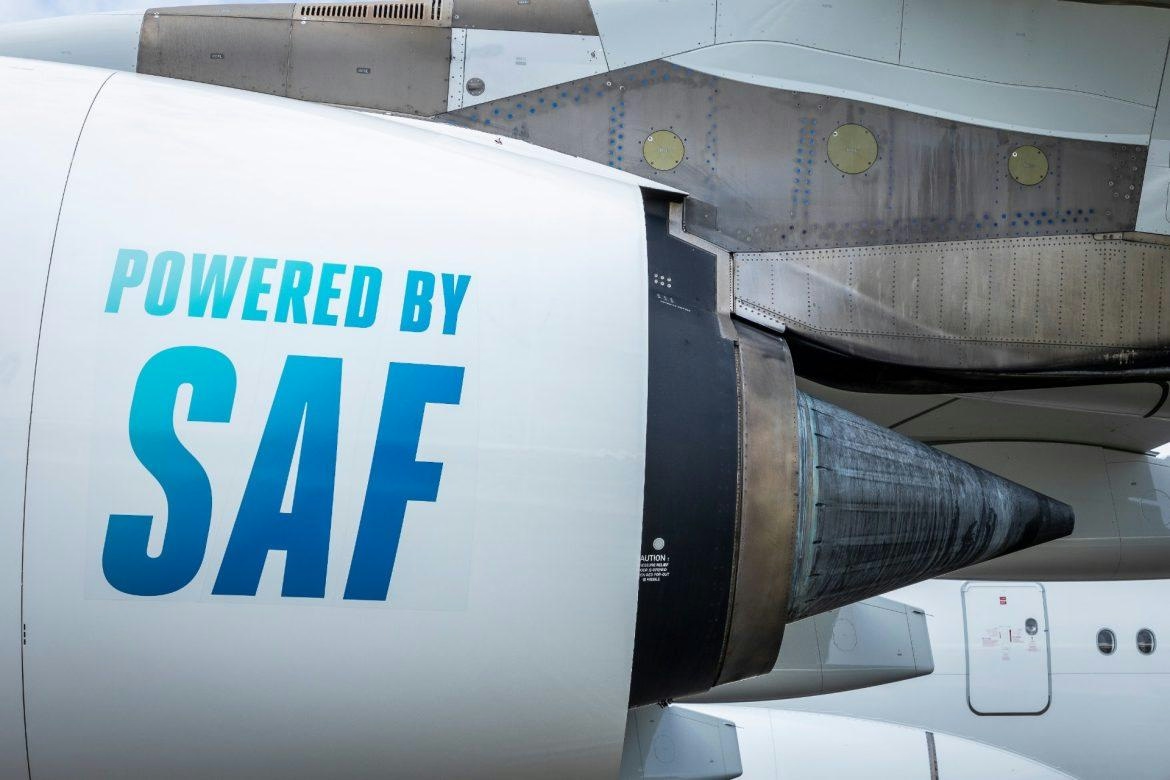
Australia Unveils Innovative System to Convert CO₂ into Aviation Fuel
Researchers at RMIT University in Australia have developed a groundbreaking technology that directly transforms industrial carbon dioxide emissions into components suitable for aviation fuel. Published in the journal Nature Energy, this advancement represents a significant stride toward decarbonizing the aviation industry, which remains one of the most challenging sectors to address in the global effort against climate change.
Tackling the Aviation Sector’s Energy Challenge
The aviation industry continues to rely predominantly on liquid fuels, as current battery technologies are insufficient to meet the energy demands of long-haul flights. Sustainable aviation fuel (SAF) derived from captured emissions is increasingly recognized as a strategic approach to reducing the sector’s carbon footprint while preserving operational feasibility. By converting CO₂ emissions into usable fuel, this technology offers a promising pathway to mitigate the environmental impact of air travel.
A Streamlined and Practical Conversion Process
The system developed by RMIT researchers introduces a novel, integrated method that captures and electrochemically converts CO₂ in a single step. This streamlined process reduces energy losses and technical complexity, resulting in lower overall energy consumption. Designed to operate near major emission sources, the technology can utilize exhaust gases directly, enhancing its suitability for industrial application.
Professor Tianyi Ma, who leads the project, highlighted the significance of this integration: “By merging the conversion stages, we have managed to simplify the process and reduce unnecessary energy losses.”
Industrial Viability and Development Roadmap
A notable advantage of the RMIT system is its ability to function without the need for highly purified CO₂, making it adaptable to real-world industrial environments. Peng Li, the study’s lead author, emphasized that this flexibility is essential for practical deployment.
The research team has constructed and tested a 3-kilowatt prototype under industrial conditions, evaluating its performance, stability, and energy efficiency. Their development plan includes scaling up to a 20-kilowatt pilot system, followed by a 100-kilowatt demonstrator, with the goal of achieving commercial maturity within six years.
Market Prospects and Challenges Ahead
The global market for sustainable aviation fuel is projected to reach $50 billion by 2036, reflecting both substantial growth potential and increasing competition. The introduction of this new fuel source could influence jet fuel pricing and provoke varied responses from industry players, including investments in similar technologies or strategic partnerships aimed at enhancing sustainable fuel portfolios.
Despite its promise, the technology faces significant hurdles. High initial capital investment is required to develop and scale CO₂ conversion systems, and ensuring the economic viability of the resulting aviation fuel remains a critical concern. Additionally, navigating complex regulatory frameworks will be pivotal in determining the speed and extent of commercial adoption.
Contribution to the Energy Transition
The RMIT team underscores that their system is not a standalone solution but rather a practical tool to aid emission reductions during the transition to cleaner energy sources. Its greatest potential lies in providing a sustainable alternative for sectors that are difficult to electrify, such as aviation, while making productive use of emissions that would otherwise exacerbate global warming.
If successfully scaled and commercialized, this Australian innovation could become an essential component in the broader portfolio of solutions required to combat climate change and transform the future of sustainable aviation.

Etihad Airways Suspends Airbus A380 Flights on Key Route

Aditya Birla Group Seeks Approval for Aircraft Leasing in GIFT City

Qatar Airways Highlights Innovation and Connectivity at Arabian Travel Market 2026

Hong Kong's Five-Year Plan Includes Andrew Fan's Aircraft Parts Processing Hub Proposal

ACIA Aero Leasing Delivers ATR72-600 to Air Nostrum

RTX Appoints Jill Albertelli as Head of Pratt & Whitney

TAT Technologies Joins Beyond Aero Hydrogen Aircraft Program

AURAK Study Highlights Barriers to Air Taxi Adoption in Emerging Economies

Xiamen Air Selects Altitude for 787 Maintenance at Heathrow

Etihad and Swissport Extend Global Partnership
