
حوّل رؤى الذكاء الاصطناعي إلى أفعال منسّقة

الرائج الآن
Categories
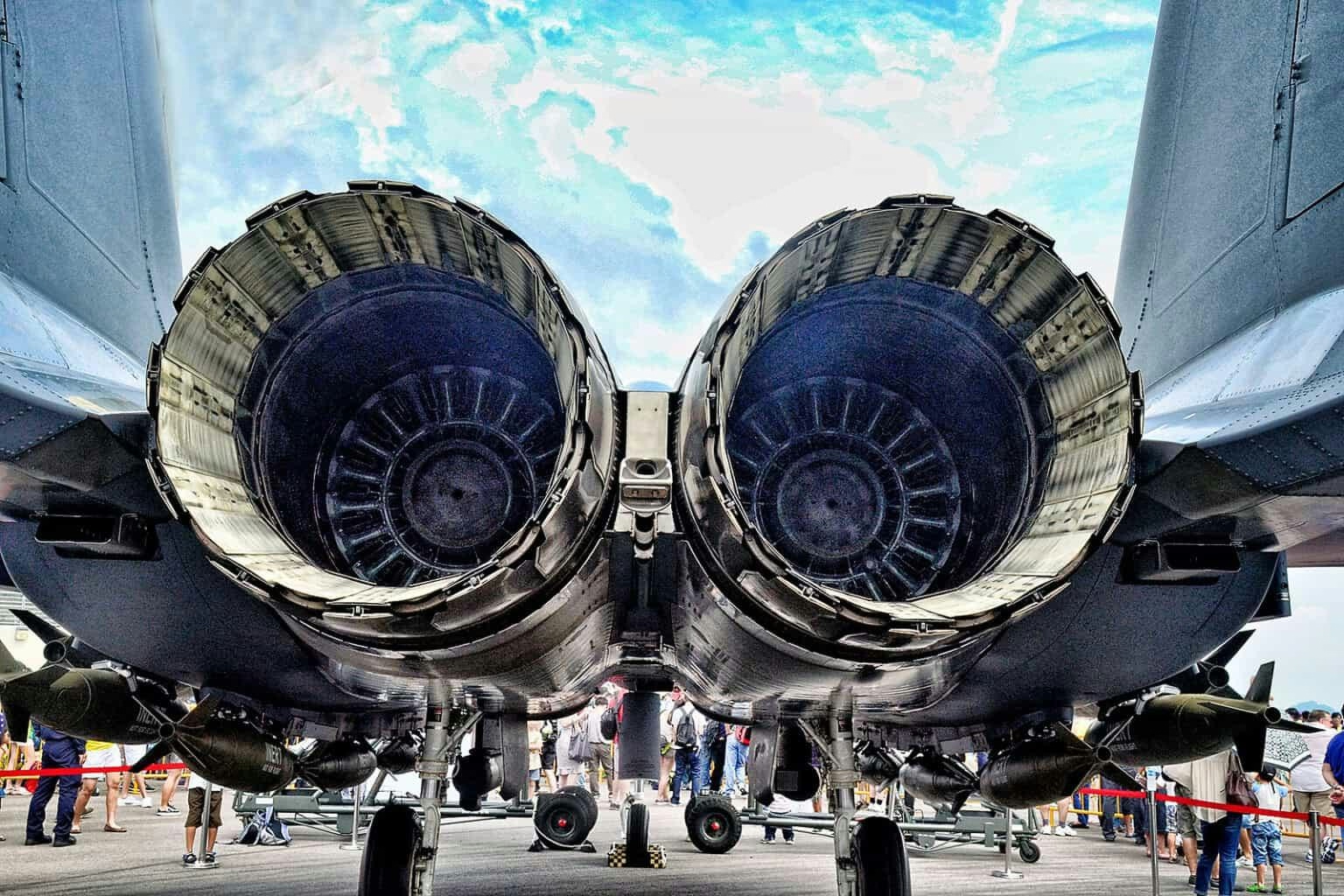
Engine Competition Intensifies for F-15EX and F-16 Fighters
Engine Competition Intensifies for F-15EX and F-16 Fighters
For nearly fifty years, the propulsion systems for American F-15 and F-16 fighter jets have been dominated by a duopoly of two manufacturers: Pratt & Whitney and GE Aerospace. This longstanding arrangement, however, is now facing potential disruption. On August 4, the U.S. Air Force issued a Request for Information (RFI) inviting industry participants to propose alternative engine options for the Boeing F-15EX Eagle II and Lockheed Martin F-16 Fighting Falcon. This initiative signals a possible transformation not only for U.S. military aviation but also for allied air forces that operate these aircraft through Foreign Military Sales.
Motivations Behind the Shift
The Air Force’s decision to open the engine competition is not driven by dissatisfaction with the current engine performance. Instead, it stems from growing frustration with the existing procurement and production processes. The industrial base supporting these engines has been beset by persistent challenges, including production delays, quality-control shortcomings, parts obsolescence, and material shortages. These issues have occasionally caused aircraft deliveries to stall, as engines fail to arrive on schedule. With demand for engines expected to reach as many as 180 units annually by fiscal year 2034, the Air Force is actively seeking to diversify its supplier base to mitigate risk and enhance supply chain resilience.
Historical Context and Current Challenges
Since their introduction in the 1970s, every F-15 and F-16 fighter has been powered exclusively by either Pratt & Whitney’s F100 or GE Aerospace’s F110 engines. These two companies have alternated in securing contracts over the decades, with GE’s F110-129 engine currently powering the latest F-15EX following a $1.6 billion contract awarded in 2021. However, reliance on just two suppliers has exposed vulnerabilities, particularly when both face simultaneous production constraints.
The timing of this competition coincides with a period of significant transition for the Air Force. The retirement of older F-15 models is introducing new complexities in training and logistics, as the service must carefully manage the balance between phasing out legacy aircraft and ramping up production of new engines. This dynamic places increased pressure on maintenance and supply chains, underscoring the critical need for dependable and timely engine deliveries.
Technological and Market Implications
The renewed competition is already influencing technological developments within the fighter engine market. The F-16’s integration of the AVEN thrust vectoring nozzle with GE’s F110 engine exemplifies the push toward advanced propulsion and avionics capabilities. Competitors are expected to respond with innovations to maintain or enhance their market positions. The F-15EX continues to offer exceptional speed and payload capacity, while the F-16 is being equipped with the X-BAT’s F110-GE-129 engine as part of the Air Force’s Collaborative Combat Aircraft (CCA) Increment 2 program.
Future Prospects
By issuing the RFI, the Air Force has demonstrated a willingness to consider new suppliers and emerging technologies to secure engine availability and performance for decades ahead. As industry players prepare their proposals ahead of the August 28, 2026 deadline, this competition has the potential to reshape the propulsion landscape for two of the world’s most iconic fighter jets and may ultimately bring an end to one of military aviation’s longest-standing duopolies.

Etihad Airways Suspends Airbus A380 Flights on Key Route

Aditya Birla Group Seeks Approval for Aircraft Leasing in GIFT City

Qatar Airways Highlights Innovation and Connectivity at Arabian Travel Market 2026

Hong Kong's Five-Year Plan Includes Andrew Fan's Aircraft Parts Processing Hub Proposal

ACIA Aero Leasing Delivers ATR72-600 to Air Nostrum

RTX Appoints Jill Albertelli as Head of Pratt & Whitney

TAT Technologies Joins Beyond Aero Hydrogen Aircraft Program

AURAK Study Highlights Barriers to Air Taxi Adoption in Emerging Economies

Xiamen Air Selects Altitude for 787 Maintenance at Heathrow

Etihad and Swissport Extend Global Partnership
